Best No-KYC Crypto Exchanges in 2026: 5 That Actually Work
Trading without identity verification is still possible in 2026, with real trade-offs attached. These are the 5 no-KYC exchanges that hold up in practice, what the limits look like, and what stacking fee cashback on top does to your costs.

- 5 established exchanges still offer futures trading without mandatory KYC in 2026: Bitunix, WEEX, BloFin, MEXC and LeveX.
- No-KYC does not mean no rules: expect 24-hour withdrawal caps, crypto-only funding and geo-restrictions, and expect the policy to change faster than on KYC venues.
- Privacy is the feature, not anonymity from the law: your on-chain history still exists, and taxes still apply wherever you live.
- Fee schedules on no-KYC venues now match the majors, and cashback of 30 to 50% of every fee applies on all 5 listed here.
- Verification is not the enemy: if you need fiat rails, large size or consumer protection, a regulated KYC venue is the better tool.
- If an exchange promises no-KYC forever with no limits, treat it like a bot promising guaranteed returns: as a warning sign.
The list of exchanges where you can deposit crypto and trade futures without uploading a passport gets shorter every year, and most articles about it are padded with venues that quietly added mandatory verification long ago. These 5 still work without KYC in 2026, with limits you should know before you fund an account. We support cashback on every one of them, which also means we track their policies for a living. Here is the honest state of no-KYC trading, including the part where we tell you it is not for everyone.
The short list
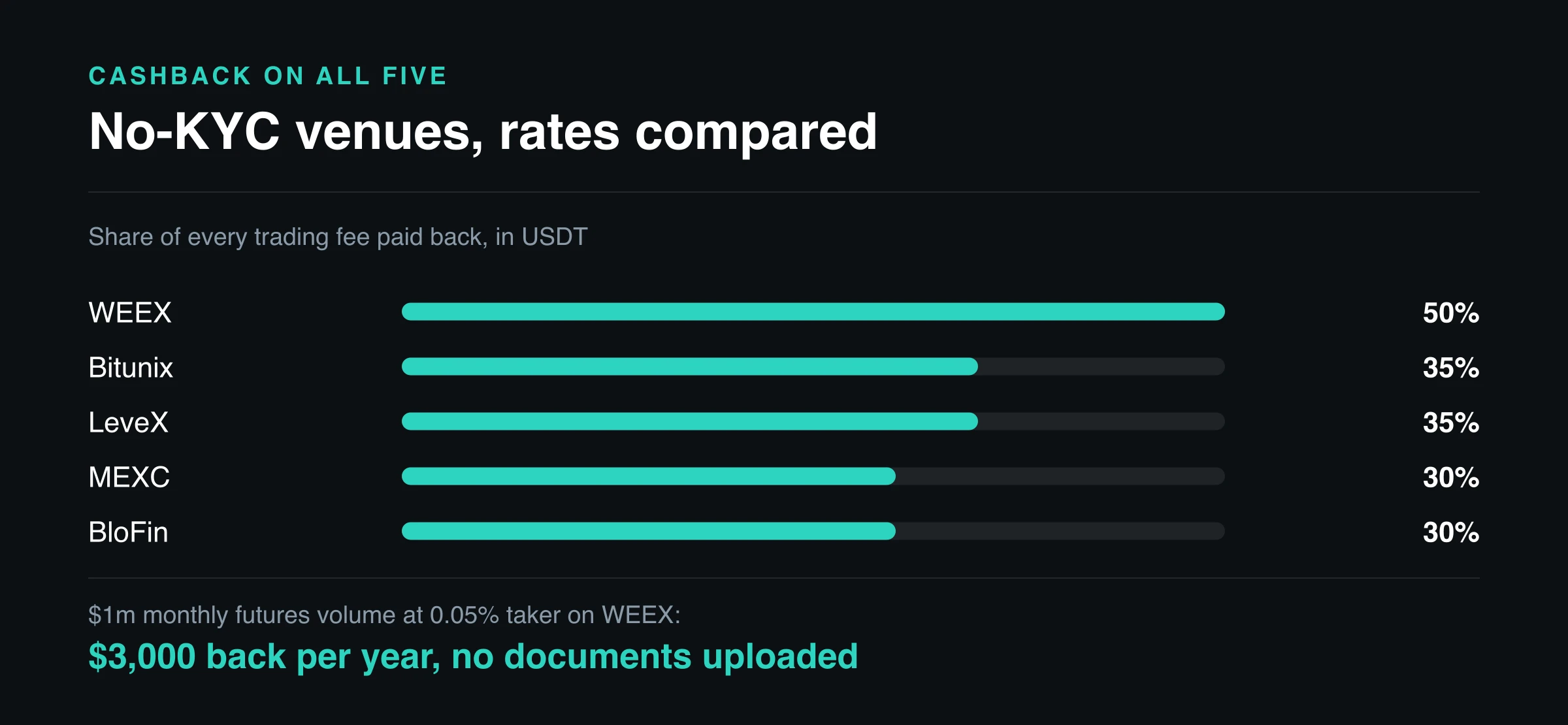
Best overall: Bitunix. No mandatory KYC for trading and standard withdrawals, a mature futures platform, and a 35% fee cashback rate through Trade Reclaim. Highest cashback: WEEX at 50%, the top rate across all 9 exchanges we support. Deepest altcoin range without KYC: MEXC. BloFin and LeveX round out the list for traders who want alternatives with the same posture.
All 5 share the same basic shape: crypto in, trade futures, crypto out, no identity documents for standard usage. The differences are in withdrawal caps, product depth and how aggressively each geo-blocks restricted countries. The sections below go venue by venue.
The 5 exchanges, ranked
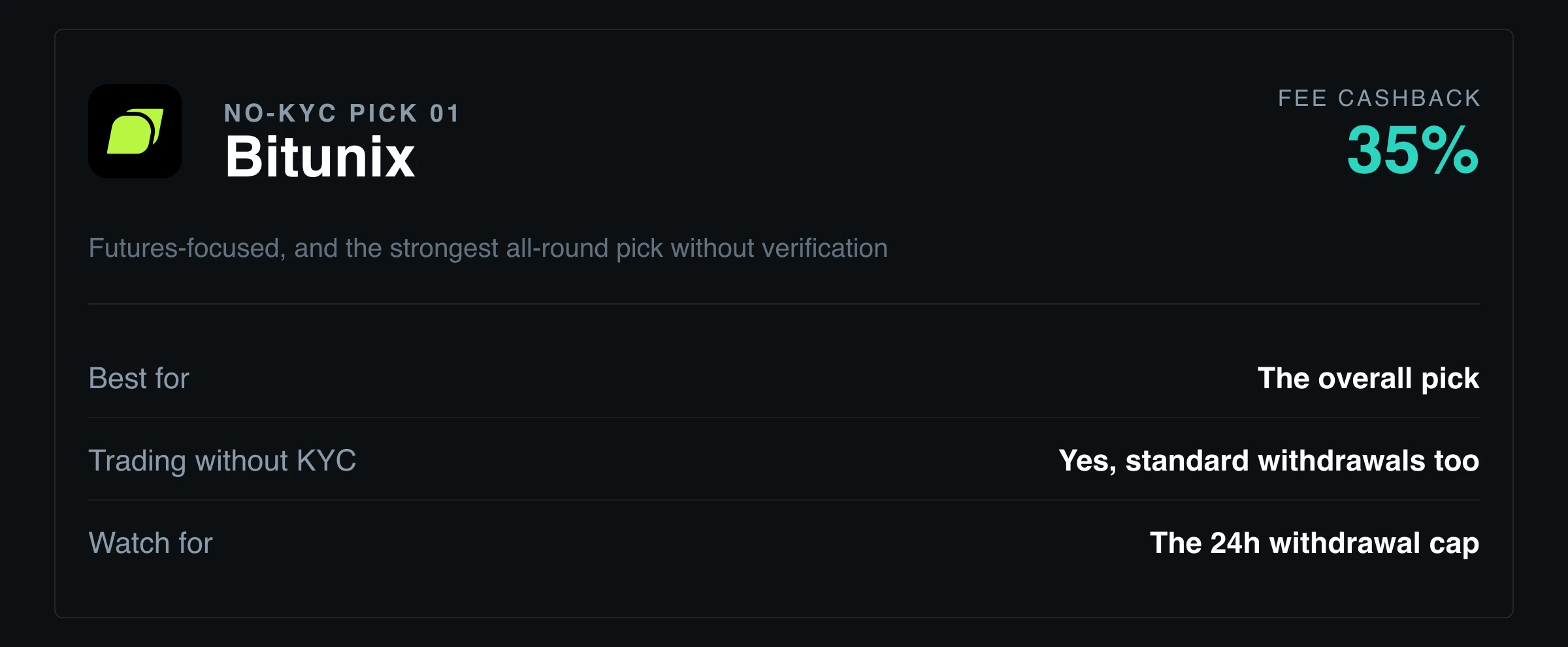
1. Bitunix, the best no-KYC exchange overall
Bitunix is futures-first and treats no-KYC as a product position rather than a loophole, which is the single most useful thing you can know about it. Trading and standard withdrawal volumes require no verification at all, the order book on majors is deep enough that slippage does not eat your entries, and the interface is closer to a professional terminal than to a beginner app. The platform has been operating long enough to have a track record, and it publishes a proof-of-reserves page, which is the minimum bar we apply before supporting any venue.
In daily use the important detail is the withdrawal cap. Below it you move crypto out without a single document; above it, verification is triggered like anywhere else. That cap is generous enough for most retail traders but it is not infinite, and it moves, so check the current limit table before you size a position you might need to exit quickly. Funding is crypto-only by definition: there is no bank transfer without identity, and any platform claiming otherwise is not doing what it says.
On cost, Bitunix lands where it matters. Taker fees sit in the same range as the KYC majors, and with the current cashback rate at 35% through Trade Reclaim, the effective taker fee drops below what most verified accounts on larger exchanges pay. That is the part traders underrate: choosing a no-KYC venue no longer means paying a privacy premium, and on Bitunix it means paying less than the mainstream alternative.
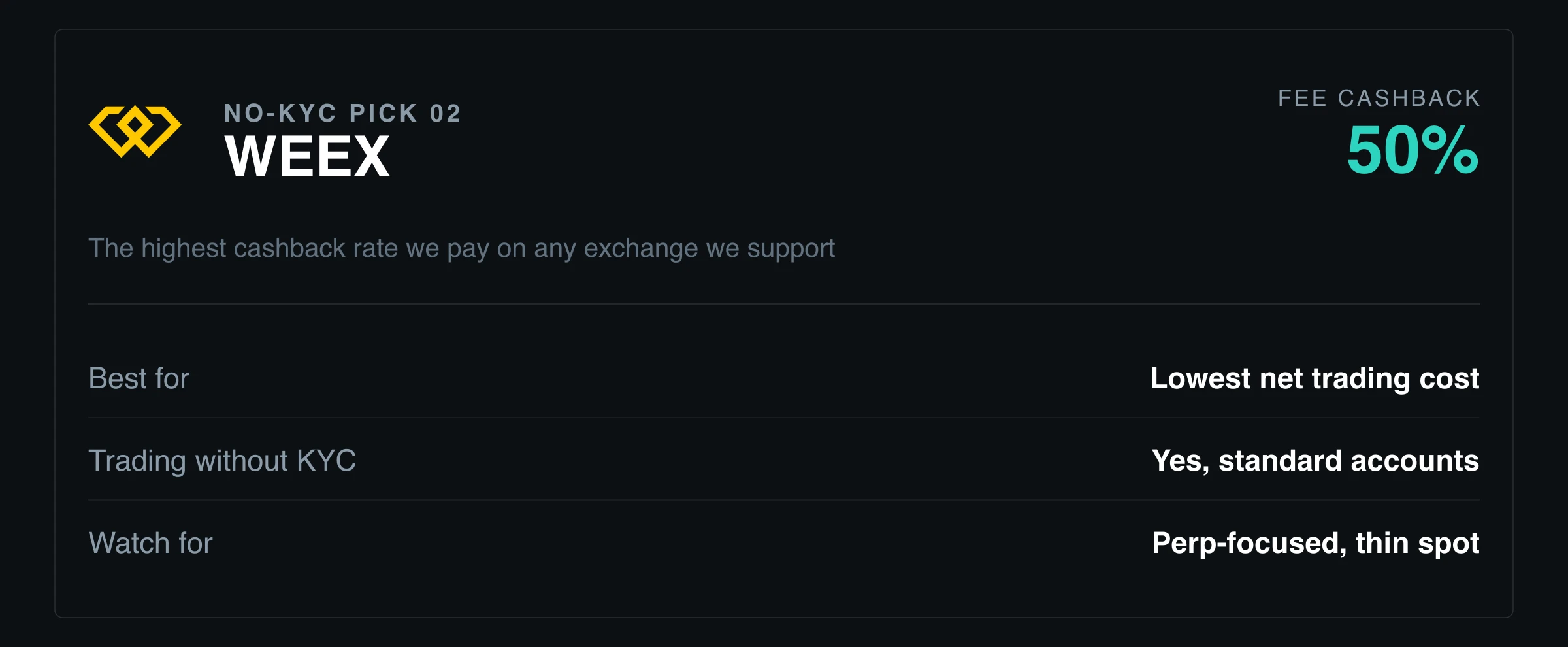
2. WEEX, the cashback leader
WEEX pays the highest cashback rate we pay anywhere: 50% of every trading fee. If your priority is the lowest net cost without verification, this is the mathematical answer and the rest of the list cannot catch it. The platform is a futures venue with copy trading and a steady rhythm of bonus campaigns, and standard accounts trade without mandatory KYC.
The trading experience is built around perpetuals rather than spot breadth, so treat it as an execution venue for majors and liquid alts rather than a place to hunt long-tail listings. Copy trading is prominent in the interface; it is a feature worth ignoring unless you have verified the trader you are copying, because a leaderboard position is a marketing surface, not a track record.
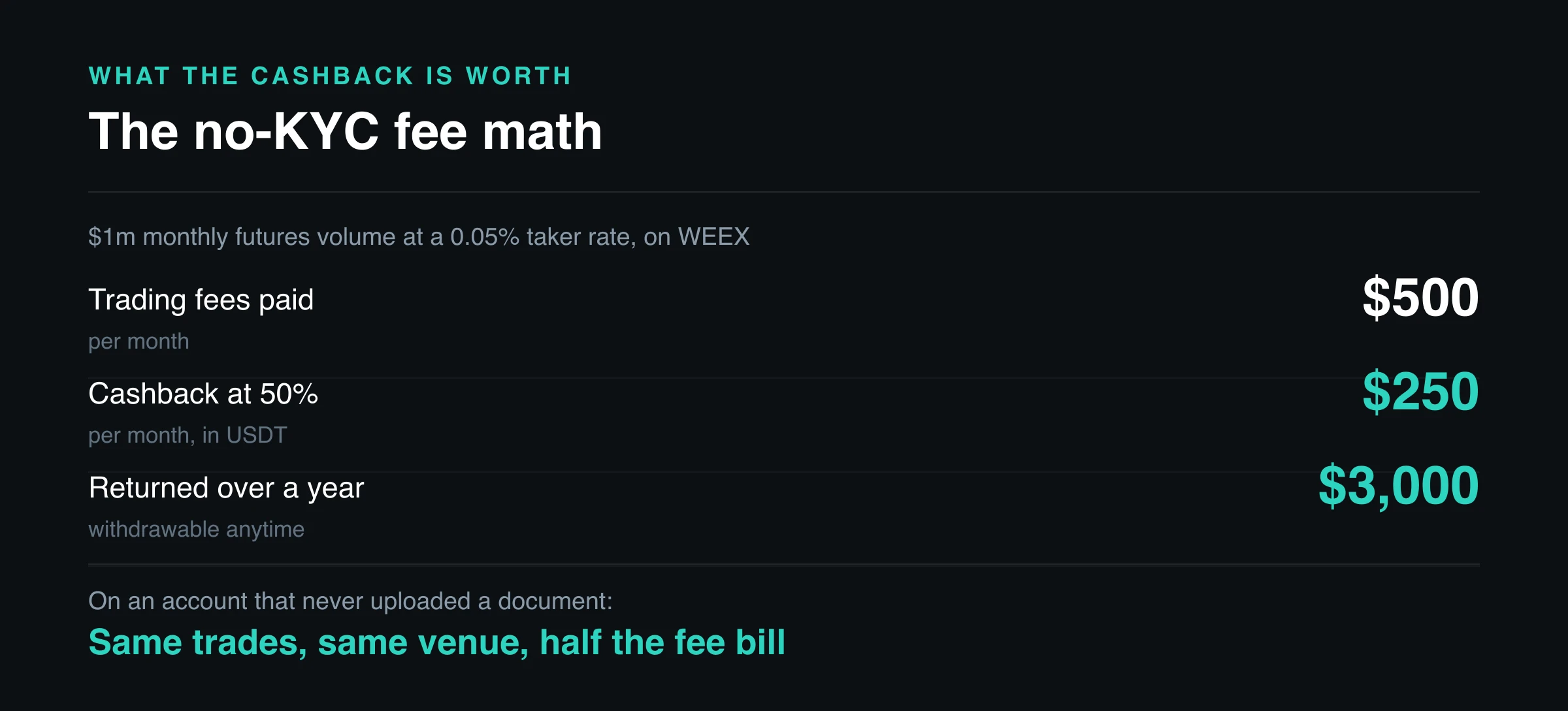
The cashback math is what makes WEEX interesting for an active account. At 50% of every trading fee, a trader doing $1m of monthly futures volume at a 0.05% taker rate pays about $500 a month in fees and gets $250 of it back, in USDT, withdrawable anytime. Over a year that is $3,000 returned on an account that never uploaded a document, which for most people is larger than any bonus campaign they will ever qualify for.
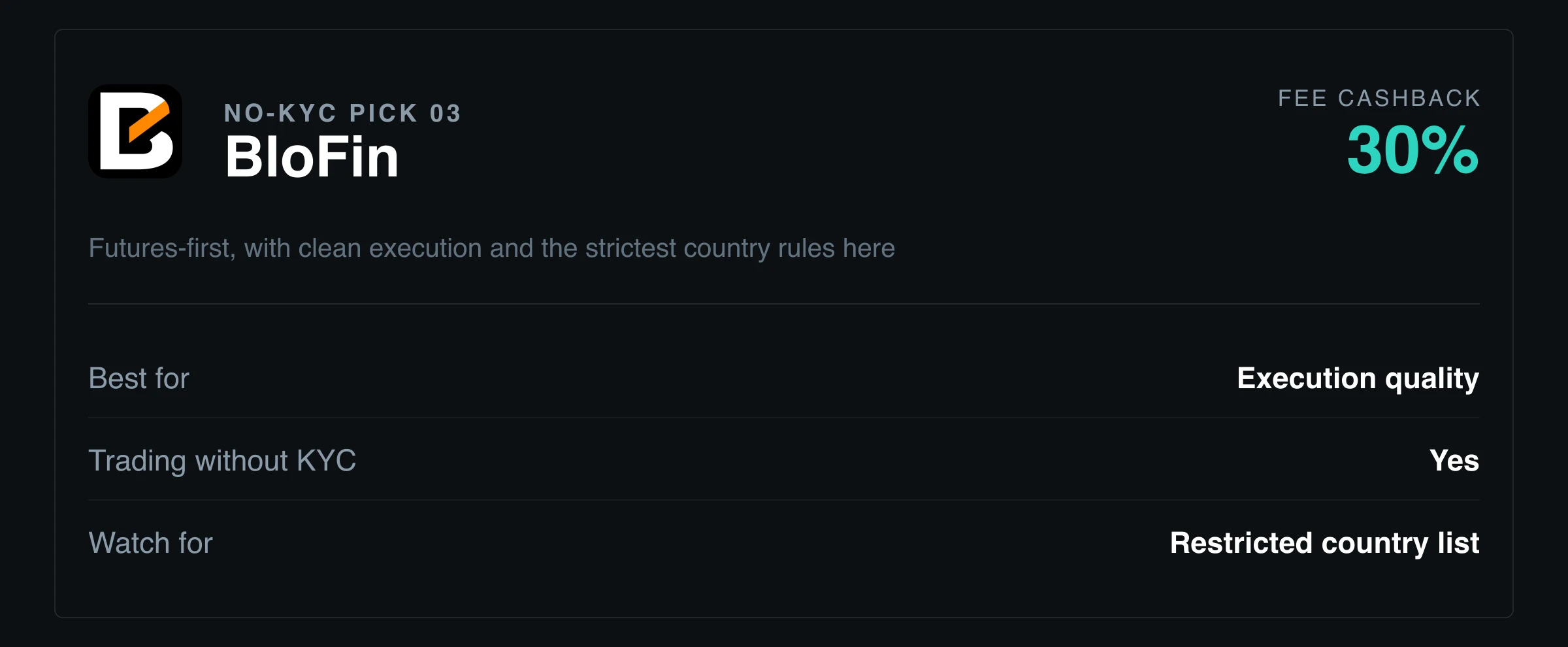
3. BloFin, the quiet professional
BloFin is the venue for traders who want no-KYC without the rough edges. It is futures-first with solid liquidity on the major pairs, the execution is clean under load, and it does not require verification to trade. It is also the most disciplined of the five about where it operates, which is a double-edged trait: you get a platform that takes compliance geography seriously, and you get a longer restricted-country list to check before you deposit.
That restriction list is enforced more strictly than on most no-KYC venues, so availability for your country is the first thing to confirm, not the last; we keep a current overview of where it works. If your jurisdiction is on the list, no amount of workaround is worth it: an account that gets restricted mid-position is a far worse outcome than paying a slightly higher fee somewhere else.
Fees are competitive rather than headline-grabbing, and cashback runs at 30%. For a trader who values execution quality over the last basis point, BloFin is the sensible pick, and the 30% back on every fill still puts its effective cost below plenty of verified accounts elsewhere.
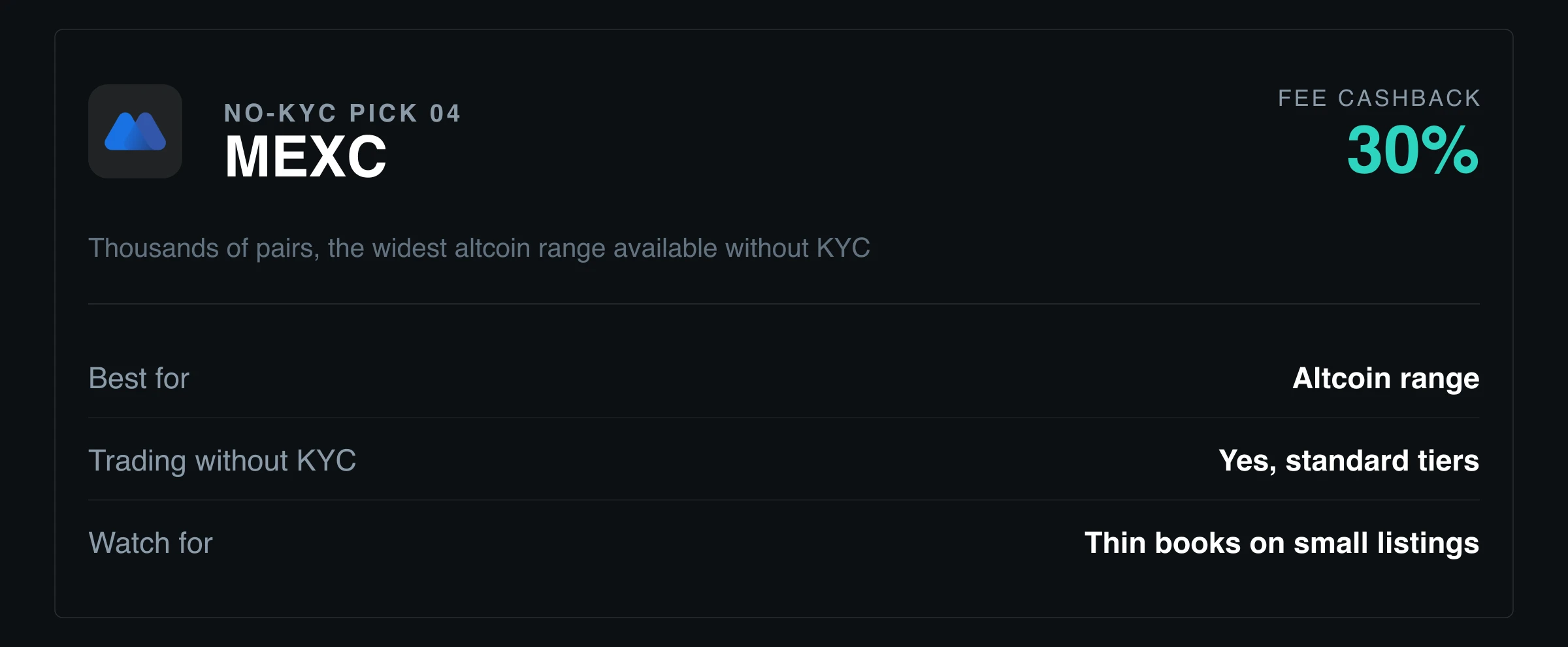
4. MEXC, the altcoin warehouse
MEXC lists thousands of pairs and offers futures without mandatory KYC at standard tiers, which makes it the widest no-KYC menu available. If a token exists and has any liquidity at all, MEXC has probably listed it, often earlier than the larger exchanges. For traders who work in the long tail, that breadth is the entire reason to have an account there.
The breadth is also the caveat, and it is a real one. Order books on small listings are thin, so a position that looks fine on the chart can cost you several percent to enter and exit. The listing bar is low enough that due diligence falls entirely on you: MEXC listing a token is not a signal about that token. Size long-tail positions on the assumption that you may be the exit liquidity.
Cashback runs at 30%, which matters more here than elsewhere precisely because the long tail carries wider spreads and higher effective costs. Getting 30% of the fee back does not fix a bad fill, but across a month of active trading it is the difference between a strategy that clears its costs and one that does not.
5. LeveX, the challenger
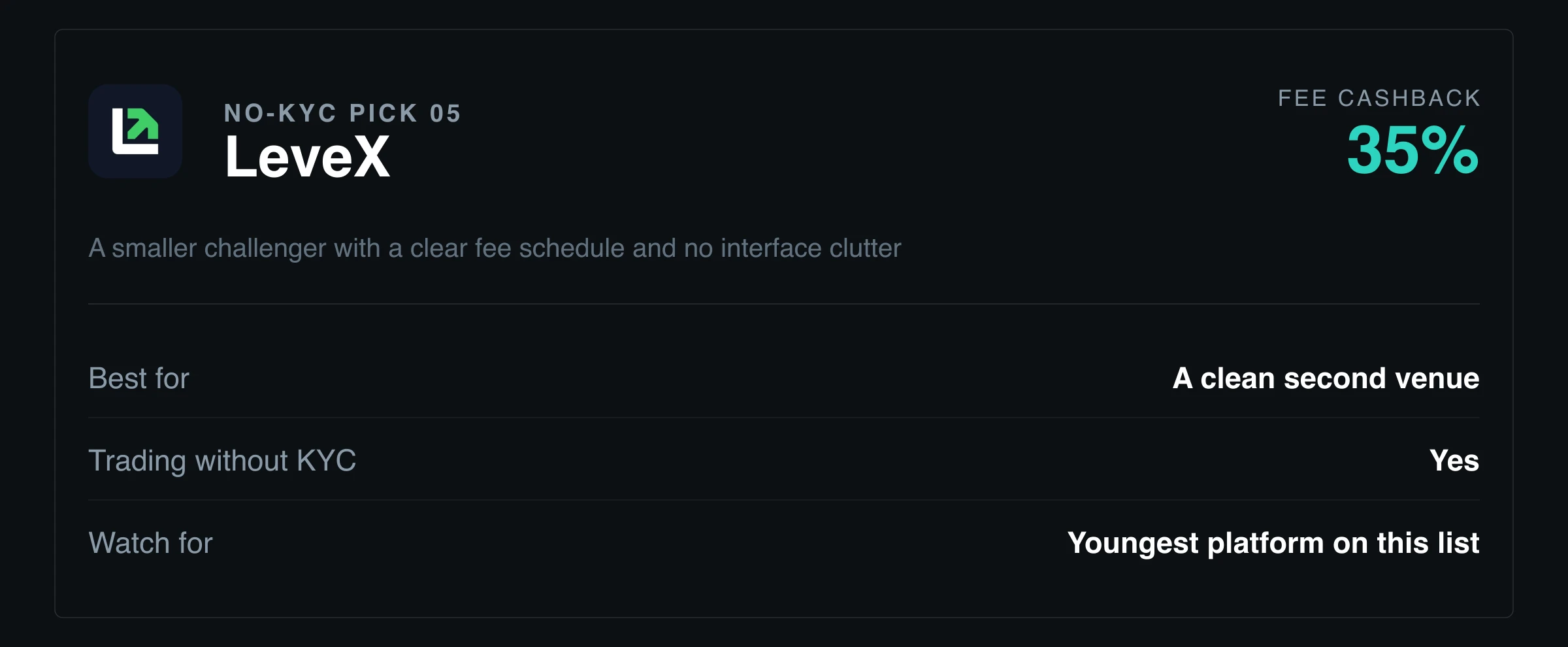
LeveX is the youngest venue on this list, and that is the first thing to price in. It offers no-KYC futures with a straightforward fee schedule and none of the interface clutter that larger platforms accumulate. For a trader who wants a clean second venue rather than a primary home, it does the job.
Being small is not automatically a flaw, but it changes how you should use it. Liquidity is thinner than on Bitunix or WEEX, so keep position sizes proportionate and avoid market orders on anything outside the majors. Treat it as a venue you route specific trades through, not one you park your working capital on.
Cashback is 35%, matching Bitunix and above MEXC and BloFin. That rate plus the clear fee table makes LeveX a genuinely reasonable secondary venue, provided you size your exposure to the platform's age rather than to its cashback rate.
What no-KYC actually gets you, and what it does not
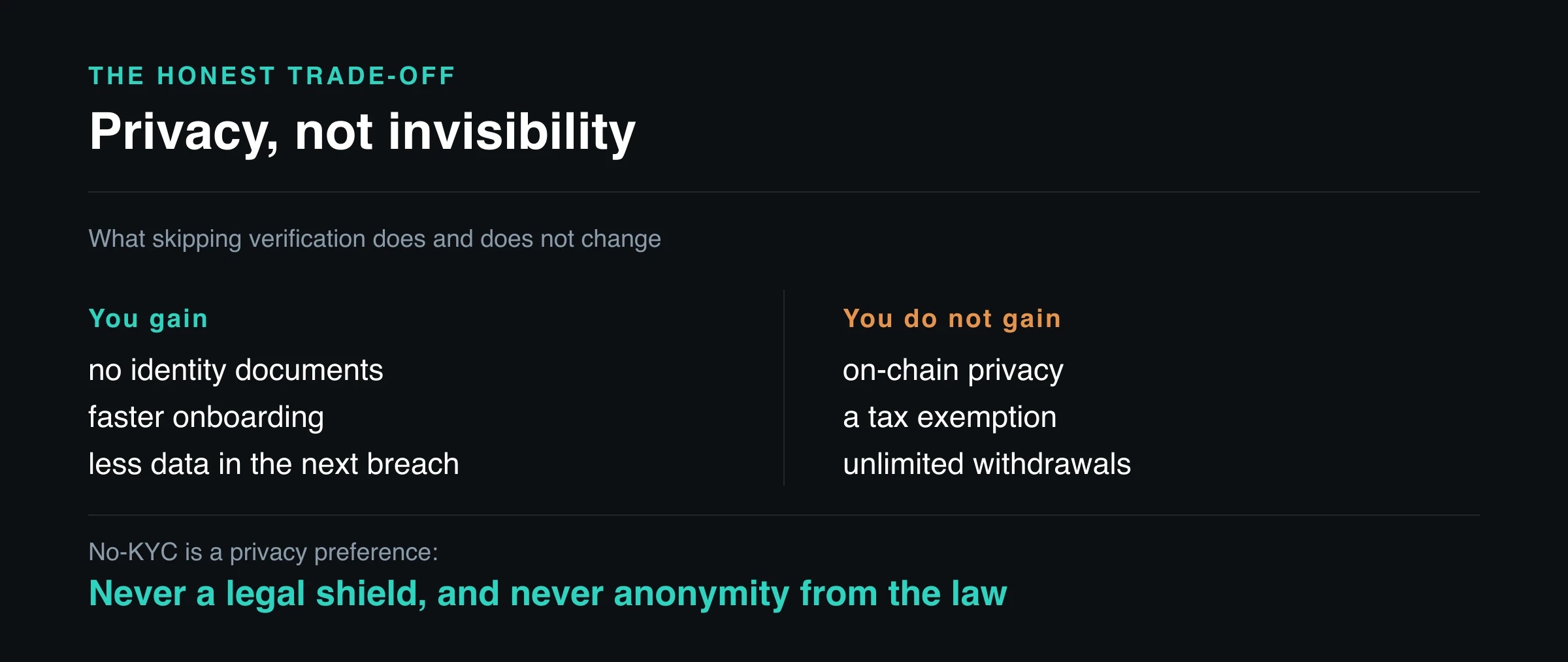
What you get: no identity documents, faster onboarding, and less personal data sitting in an exchange database waiting for the next breach. That last point is the strongest practical argument. Exchange data leaks are routine, and data you never handed over cannot leak.
What you do not get: invisibility. Deposits and withdrawals are on-chain and permanently public, blockchain analytics firms map flows as a business model, and your tax obligations do not depend on whether an exchange asked for your passport. No-KYC is a privacy preference, not a legal shield, and anyone selling it as the latter is selling you trouble.
Also expect operational limits: withdrawal caps per 24 hours below which no verification is asked, crypto-only funding (no bank rails without identity, by definition), and geo-blocks on restricted jurisdictions. The caps move. Before funding any venue on this list, check its current limit table; treat any third-party article, including this one, as a snapshot.
Fees and the cashback stack
No-KYC used to carry a fee premium; it no longer does. Taker fees on these 5 sit in the same 0.04% to 0.06% futures range as the KYC majors, and maker rates are competitive. The real difference sits one layer up: all 5 venues support fee cashback, from 30% on MEXC and BloFin, 35% on Bitunix and LeveX, to 50% on WEEX.
The mechanics matter for privacy-minded traders: cashback platforms like Trade Reclaim work from your public exchange UID, with zero access to your account and no additional identity data, and payouts accrue in USDT, withdrawable anytime. The privacy posture of your exchange account does not change.
Net effect on a concrete example: a trader doing $1 million monthly futures volume at a 0.05% taker rate pays about $500 a month in fees. On WEEX with 50% cashback, $250 of that comes back. Over a year that is $3,000 returned on an account that never uploaded a document.
Setting up a no-KYC account without shooting yourself in the foot
The most common way people lose money on a no-KYC venue has nothing to do with the venue: it is treating the exchange like a wallet. Custody risk is the dominant risk in this category, and it does not care about your verification status. Keep only working capital on the platform, move profits out on a schedule rather than when you remember, and self-custody anything you are not actively trading. If that sounds conservative, remember that the entire appeal of these venues is that they hold less of your data, not that they hold your funds more safely.
Second, test the exit before you need it. Deposit a small amount, trade it, and withdraw it, all the way to your own wallet, before you fund the account properly. A withdrawal that works today is worth more than any proof-of-reserves page, and the test costs you a network fee. Do the same again after any long gap: withdrawal processing is exactly the thing that quietly degrades before a platform gets into trouble.
Third, write down the numbers that matter for your account: the 24-hour withdrawal cap, the networks the exchange supports for your main stablecoin, and the fee tier your volume actually puts you in. All three change, and all three are cheaper to check now than during a drawdown. If you run a bot, add API-key hygiene to that list: trade permission only, never withdrawal, with IP whitelisting switched on.
Finally, set up your cashback before your first trade, not after. Cashback platforms attribute fees from the moment the account is linked, so trades you make beforehand are simply not counted. Linking is a one-time step from your public exchange UID, it needs no identity data and gives no account access, so it changes nothing about the privacy posture you chose this venue for.
Red flags on the no-KYC market
The no-KYC label attracts exit scams, because the audience self-selects for not wanting to be identifiable. Filter hard: no venue on this list is anonymous to its payment flows, and any exchange marketing itself as untouchable, unregulatable or KYC-free forever is describing its exit strategy.
Practical checks before depositing anywhere: how long has the venue operated, does it publish proof of reserves, does withdrawal actually work today (test with a small amount), and is there a real fee schedule rather than a promise. And keep balances on any exchange, KYC or not, at working-capital size. Custody risk does not care about your verification status.

When a verified account is simply the better tool
No-KYC is a preference, not an upgrade, and there are situations where insisting on it costs you more than it protects. If you need to move money between your bank and the market regularly, a verified account on a regulated venue is the only clean path: crypto-only funding means every fiat leg happens somewhere else, usually at worse rates and with more counterparties in the chain. Phemex is the clearest example of a venue that still carries a no-KYC reputation it no longer earns, as our Phemex review sets out.
Size is the second dividing line. Withdrawal caps that feel generous at retail size become a real constraint once your account grows, and discovering that during a market event is the wrong time. If your positions have outgrown the daily cap, the honest answer is either to verify or to split across venues, and splitting brings its own operational risk.
Third, consumer protection. On a regulated venue you have a complaints path, a regulator, and in some jurisdictions deposit protections. On a no-KYC venue you have the platform's goodwill and whatever leverage a public complaint gives you. For most active traders that trade-off is acceptable; for someone holding a meaningful share of their net worth, it is not.
The good news is that this is not an either-or decision. Plenty of traders run a verified account for fiat and long-term holdings and a no-KYC account for active futures trading, and cashback applies to both. Across the 9 exchanges Trade Reclaim supports, verified and unverified accounts earn the same 30 to 50% back on fees, so the choice stays about privacy and access rather than about cost.
Cashback on all 5, from your public UID
Trade Reclaim pays back 30 to 50% of every trading fee on all 5 no-KYC exchanges in this list, in USDT, withdrawable anytime. No account access, no extra data, works from the public UID.
Frequently asked questions
Which crypto exchange has no KYC in 2026?
Bitunix, WEEX, BloFin, MEXC and LeveX still offer futures trading without mandatory identity verification for standard accounts in 2026. All apply withdrawal caps and geo-restrictions, and policies change, so check the venue's current limit table before funding.
Is trading without KYC legal?
Using an exchange that does not require verification is not in itself illegal in most jurisdictions, but your local rules on exchange access and your tax obligations apply regardless. No-KYC changes what data the exchange holds about you, not what the law expects from you.
Why do no-KYC exchanges have withdrawal limits?
The limits are the compliance line: below a daily cap the venue accepts the risk without documents, above it verification kicks in. Caps differ per exchange and move over time, which is why serious no-KYC traders re-check the limit table before every large withdrawal.
Does fee cashback work on no-KYC accounts?
Yes. Cashback is calculated from trading fees tied to your exchange UID, which is public account metadata, so it requires no identity documents and no account access. Rates on the 5 exchanges in this list run from 30 to 50% of every fee, paid in USDT and withdrawable anytime.
Are no-KYC exchanges safe?
The established ones on this list have operated for years and publish fee schedules, proof-of-reserves pages and functioning withdrawals. The category still carries higher counterparty risk than regulated KYC venues: keep working capital on the exchange, custody the rest yourself, and treat any venue promising anonymity as a red flag.
How much can I withdraw from a no-KYC exchange per day?
Every venue sets its own 24-hour cap, and the caps change, so the only reliable answer is the exchange's current limit table. As a rule the caps are sized for retail activity rather than for institutional size, and crossing one triggers verification rather than blocking the withdrawal outright. Check the number before you fund the account, not when you need to exit.
Can I use a no-KYC exchange with a trading bot?
Yes, and the setup rules are the same as anywhere else: give the bot API keys with trade permission only, never withdrawal permission, and switch on IP whitelisting. Fee cashback applies to API orders exactly as it does to manual ones, which matters more for bots because they generate far more fills.
What happens if a no-KYC exchange introduces mandatory verification?
It happens regularly, and it usually applies to withdrawals first. That is why keeping only working capital on any single venue is the practical defence: if verification appears overnight, you want the decision to verify or leave to be about convenience, not about the majority of your balance being stuck behind a new requirement.
Trade Reclaim Research analyzes exchange fee schedules, rebate structures and execution costs across the 9 exchanges the platform supports. The team publishes fee math, not price predictions, and every number in this article can be checked against the linked official sources.
Trade Reclaim earns from exchange referrals and shares most of it back to you as cashback. Education, not financial advice.