
Binance Trading Fees Explained: Maker, Taker, BNB and What Comes Back
Binance's real spot and futures rates, when the BNB discount is worth holding, and the levers that cut an active trader's yearly bill.

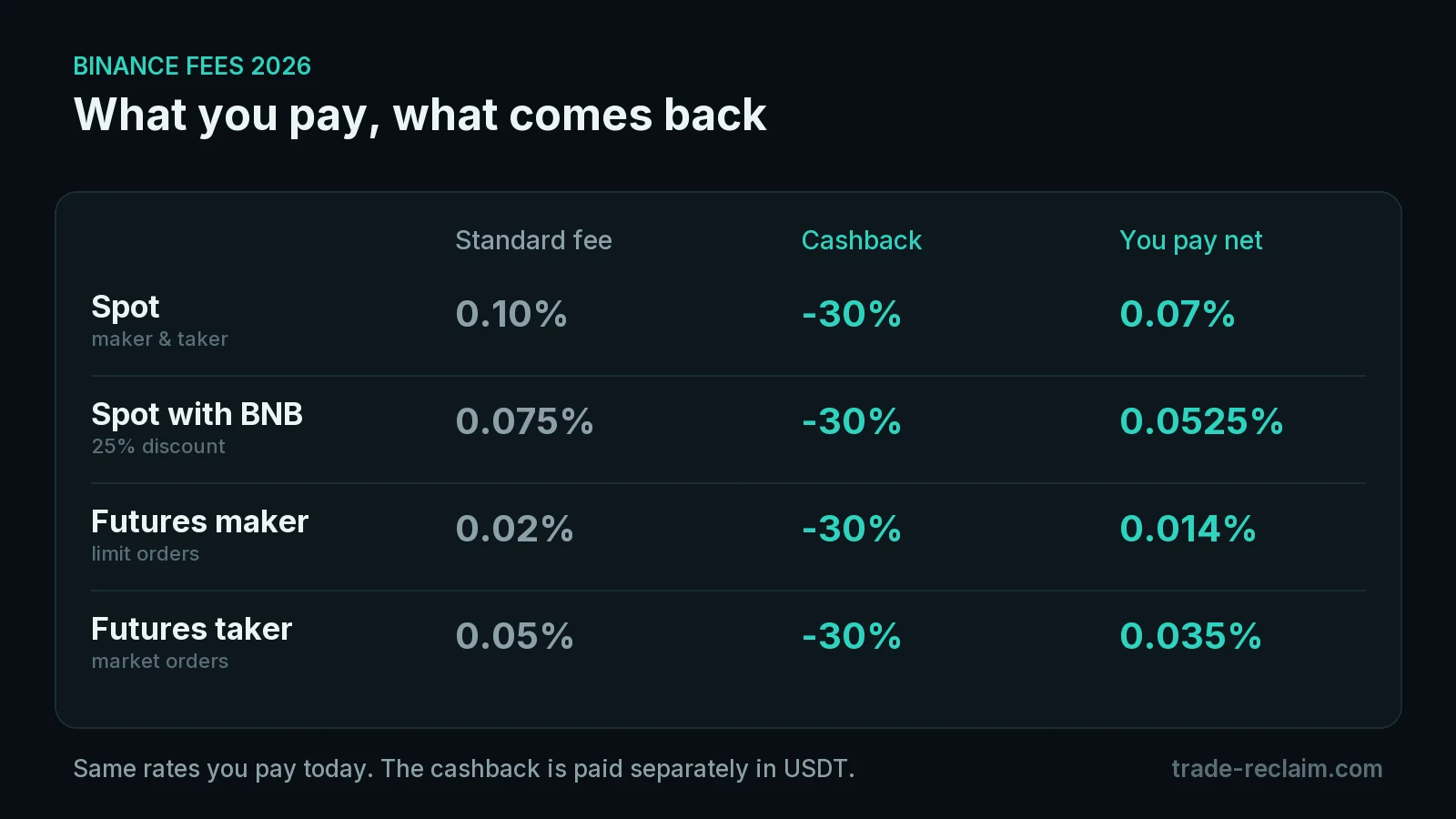
- Binance charges 0.10% per side on spot and 0.02% maker and 0.05% taker on USDT perpetuals at the regular tier.
- A trader moving 5M USDT a month pays about 30,000 USDT in taker fees per year on Binance.
- Paying fees in BNB cuts spot fees by 25% and futures fees by 10%, at the cost of holding BNB price risk.
- Trade Reclaim pays back 30% of every Binance trading fee, and it stacks with the BNB discount.
- Funding payments cannot be discounted by anyone. Trading fees are the lever that moves.
Binance advertises fees from 0.02%, but the rate an average futures trader actually pays per taker fill is 0.05%, and on spot it is 0.10%. Across an active year those basis points become a 5 figure line item. Run your own number, then look at which discounts actually stack.
What Binance actually charges
Binance charges 0.10% per side on spot, and 0.02% maker and 0.05% taker on USDT perpetuals at the regular tier.
Limit orders that rest in the book pay maker, and market orders that execute against it pay taker, and on futures the gap is 2.5x. Within the big 3, Binance's stock futures rates tie OKX for the lowest, and BNB payment is the only token discount of its kind among them. The current schedule per tier is in the official Binance fee schedule, and we maintain the full breakdown, VIP ladder included, on our Binance fees page.
Futures positions also exchange funding every 8 hours. Funding is a transfer between longs and shorts that Binance passes through, so it shows up in your PnL but cannot be discounted by any program, including BNB.
What a year of Binance trading costs
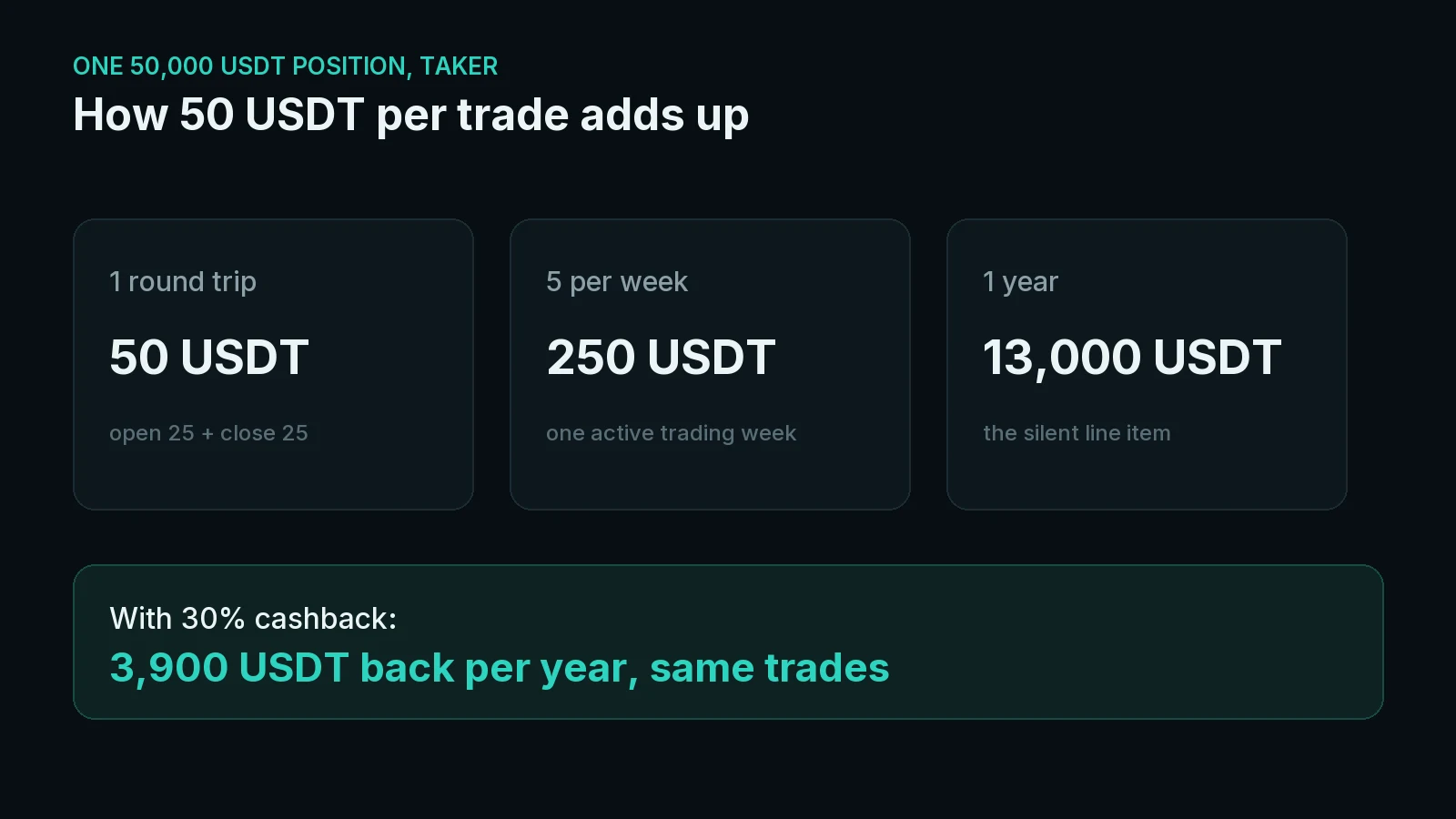
A single 50,000 USDT futures position on Binance costs 50 USDT in taker fees: 25 to open, 25 to close. That is the honest unit to think in, because nobody trades "monthly volume", they trade positions.
Scale it to your own rhythm. At 5 round trips a week, that position size burns about 250 USDT a week, roughly 13,000 USDT a year, paid silently out of your PnL. Smaller size? A 10,000 USDT position still costs 10 USDT per round trip, about 2,600 a year at the same pace. Pay fees in BNB and the numbers drop by 10% on futures and 25% on spot, before any cashback.
With 30% cashback on top, the 13,000 becomes 3,900 USDT back per year, without changing a single trade. The cashback calculator takes your position size and pace and shows the 30% line underneath.
The levers that cut your Binance bill
Four levers move what you pay on Binance: cashback, the BNB discount, maker orders, and VIP tiers.
Cashback comes first because it has no entry bar: Trade Reclaim returns 30% of every Binance trading fee from your first trade, and the setup lives on the Binance cashback page. Second is paying fees in BNB, which Binance discounts by 25% on spot and 10% on futures.
Third, maker fills price at 0.02% instead of 0.05% on futures. Fourth, the VIP ladder steps both rates down as volume grows. Every lever on this list stacks with every other one. Spot and futures trading fees step down separately, so check both tables for your VIP level rather than assuming one discount covers everything.
| Fee type | Standard | With 30% back |
|---|---|---|
| Spot maker | 0.10% | 0.07% |
| Spot taker | 0.10% | 0.07% |
| Futures maker | 0.02% | 0.014% |
| Futures taker | 0.05% | 0.035% |
| Futures taker + BNB | 0.045% | 0.0315% |
Regular tier. BNB row: 10% BNB discount applied first, then 30% cashback on the lower fee.
How the 30% cashback works
Trade Reclaim returns 30% of your Binance trading fees in USDT, withdrawable anytime once 20 USDT accumulate.
Binance pays referral commission on the fees of every referred account, and most Binance users never claim it. Coming in through the affiliate link makes Trade Reclaim that referrer, and most of the commission is routed back to you. Binance charges you exactly what it would anyway, BNB discount included. Identification runs over your UID alone: paste it in once, the affiliate dashboard picks up your trades, and the 30% starts counting. API keys or account access are never part of the setup. Details are on the how it works page.
The order of operations works in your favor: BNB lowers the fee first, then 30% of that lower fee comes back. The discounts multiply, they do not cancel each other.
Binance deposit and withdrawal fees
Crypto deposits on Binance are free, withdrawals cost a per-coin network fee, and fiat is where extra costs hide. On-chain deposits cost you only the blockchain fee. Withdrawals follow the familiar pattern: the fee depends on the coin and network, and Binance updates the values with chain conditions.
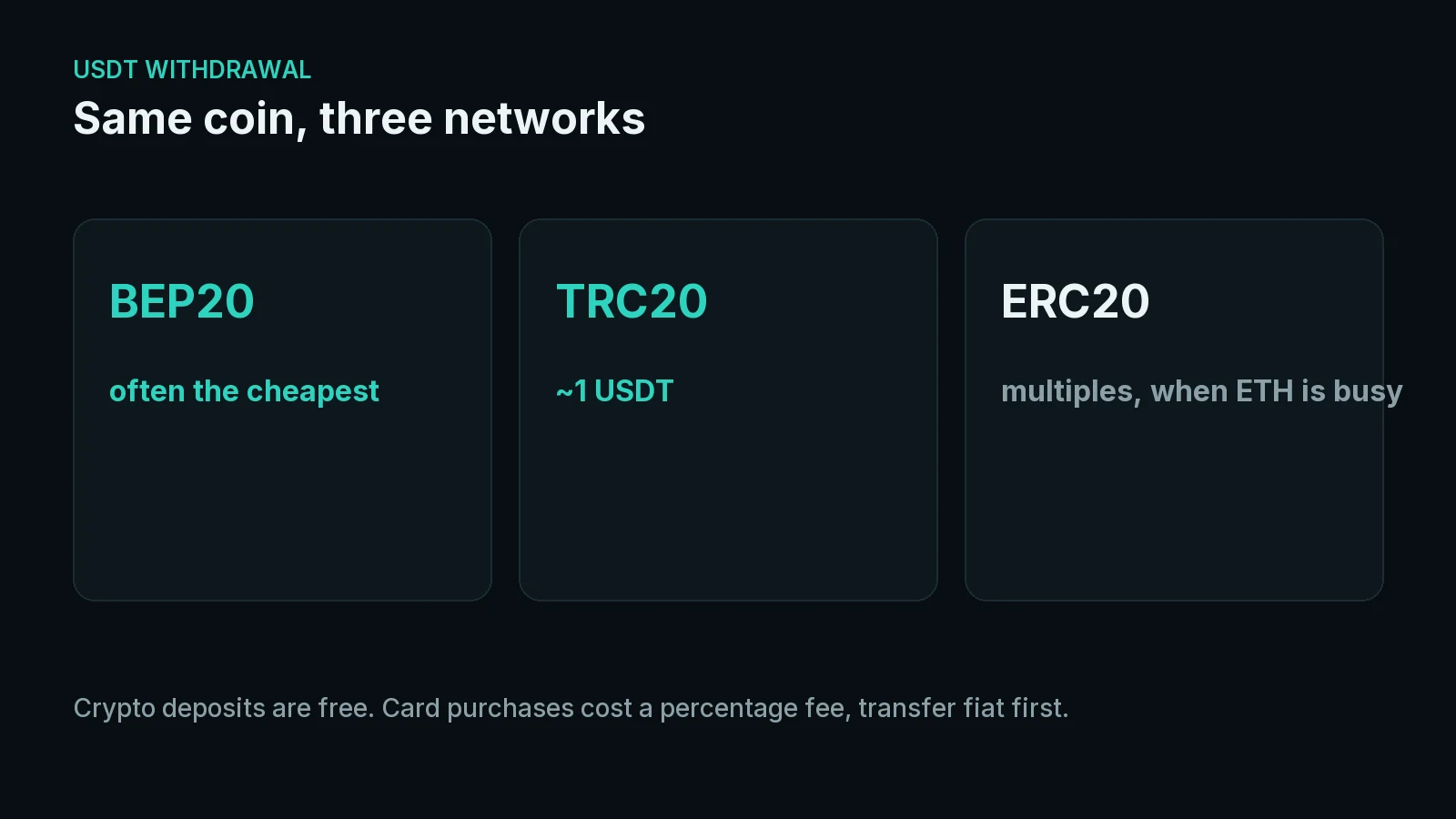
USDT is the classic case: about 1 USDT over TRC20, a multiple of that over ERC20 when Ethereum is busy. The cheap trick most people miss is BEP20: withdrawing over the BNB Smart Chain is regularly the cheapest route Binance offers when both sides support it.
Fiat is a separate story: card purchases carry a percentage fee that dwarfs any trading fee, while SEPA or ACH transfers are cheap or free depending on region. For anything beyond a first small buy, transfer fiat first and buy on spot instead of buying by card. Internal transfers between Binance accounts are free, and canceling an order costs nothing.
| Asset / network | Typical fee |
|---|---|
| USDT (TRC20) | ~1 USDT |
| USDT (BEP20) | usually the cheapest route |
| USDT (ERC20) | higher, moves with ETH gas |
| BTC / ETH | dynamic, shown at withdrawal |
| Crypto deposits | free |
Values as of July 2026. Binance adjusts network fees continuously; the withdrawal screen always shows the exact amount.
Funding, convert and other fees
Three costs sit outside the maker/taker schedule: funding, the Convert spread, and margin interest. Funding is the periodic payment between longs and shorts on perpetuals, exchanged every 8 hours. It is not Binance revenue, but for positions held across weeks it can outgrow the trading fees on the same trade.
Binance Convert shows no fee line, the cost is the spread inside the quoted rate, so past small amounts a spot limit order is usually cheaper. Margin traders pay hourly interest on borrowed funds on top of trading fees, a line item that compounds quietly. Options run on their own schedule, small per contract.
None of these appear in the fee table screenshots, which is why an active Binance month can cost more than the 0.1% headline suggests. Fiat deposits add one more variable: crypto deposits are free, while card and bank costs depend on the payment method and currency.
Binance fees vs Bybit and OKX
At the standard tier the three venues are nearly identical on paper, and Binance stops being the cheapest the moment BNB or cashback enter the math. Binance and OKX share the 0.05% futures taker rate, Bybit sits 10% above both.
The full head-to-head with VIP ladders and yearly numbers is in our Bybit vs Binance comparison. The short version: sticker rates do not decide this trio, the effective rate after BNB discounts and cashback does, and all three earn the same 30% back through one Trade Reclaim account.
| Fee type | Binance | Bybit | OKX | Binance with Trade Reclaim |
|---|---|---|---|---|
| Spot maker | 0.10% | 0.10% | 0.08% | 0.07% |
| Spot taker | 0.10% | 0.10% | 0.10% | 0.07% |
| Futures maker | 0.02% | 0.02% | 0.02% | 0.014% |
| Futures taker | 0.05% | 0.055% | 0.05% | 0.035% |
All three cut rates with VIP volume, and the BNB discount stacks on the Binance side. The last column is the effective Binance rate with 30% Trade Reclaim cashback; Bybit and OKX get the same 30% back through the same account.
When the BNB discount is worth it
The BNB discount is worth it if you would hold BNB anyway. It is a position, not free money.
Paying fees from a BNB balance cuts spot fees from 0.10% to 0.075% and futures taker fees from 0.05% to 0.045%. On 60M USDT of yearly futures volume that saves 3,000 USDT. The catch: you hold BNB to do it, and a 10% move in BNB on a 30,000 USDT balance is 3,000 USDT, the entire yearly saving, gained or lost. Stacked with cashback the chain on futures looks like this: 0.05% with BNB becomes 0.045%, and 30% back brings the net cost to 0.0315%. If you are weighing Binance against the other big venue, the Bybit vs Binance comparison runs both schedules side by side.
When cashback is not worth it
Below roughly 100,000 USDT of monthly volume, 30% back on Binance is real money but not life-changing money: about 360 USDT a year. Under 20,000 USDT a month it drops below 100 USDT a year, and nobody should restructure their trading for that.
Binance is the strictest venue we cover: the referral is welded to the account at creation and can never be changed. If you already trade on Binance without a referral, no article and no service can retrofit the cashback, and anyone claiming otherwise is describing something Binance's terms exclude. Exchanges that do allow relinking are BloFin. The limit that applies no matter which venue you pick: cashback lowers your cost per trade, it does not create an edge. It will not turn a losing strategy profitable, it only makes a working one cheaper to run.
Are Binance fees competitive in 2026?
Yes. Binance's stock rates already sit at the cheap end, and BNB plus 30% back pushes the net cost below almost everything else.
With cashback alone, effective regular rates land at 0.035% taker and 0.014% maker on futures. With BNB stacked on top, the taker net drops to 0.0315%. Where that ranks among the 9 platforms we track is in the exchange fee comparison, and the mechanics behind fee cashback are in the cashback guide. Fees are only one side of the account: whether Binance itself is safe and what its leverage tiers really cost decide the rest.
What would 30% back be worth on Binance?
Position size and trades per day in, your yearly Binance fee bill and the USDT return out.
Takes 20 seconds.
Frequently asked questions
What are Binance trading fees for regular users?
Spot costs 0.10% per side. USDT perpetuals cost 0.02% maker and 0.05% taker. BNB payment discounts these by 25% on spot and 10% on futures.
What is the Binance fee discount for BNB?
Paying fees from a BNB balance cuts spot fees by 25% (0.10% to 0.075%) and futures fees by 10% (0.05% taker to 0.045%). It requires holding BNB, which carries its own price risk.
How much are Binance withdrawal fees?
Crypto deposits are free. Withdrawals cost a per-coin network fee: about 1 USDT over TRC20, usually less over BEP20 (BNB Smart Chain), and a multiple of that over ERC20 when Ethereum is busy, as of July 2026. BTC and ETH fees are adjusted with chain conditions. The withdrawal screen shows the exact amount before you confirm.
Do BNB or VIP discounts apply to Binance funding fees?
No. Funding is exchanged between long and short traders; Binance only passes it through, so no discount touches it. Trading fees are reducible: Trade Reclaim returns 30% of them, stacking with BNB.
Is Binance cheaper than Bybit?
On futures taker fees, slightly: 0.05% versus 0.055%, with maker rates equal at 0.02% and spot equal at 0.10%. The BNB discount widens the gap for traders willing to hold BNB.
How do I get lower fees on Binance without VIP status?
Three ways work from day 1: pay fees in BNB for the 10% to 25% discount, fill orders as maker where possible, and connect your UID to Trade Reclaim for 30% of every fee back.
Are internal transfers on Binance free?
Yes. Moving assets between your own Binance accounts and sub-accounts costs nothing and settles instantly. Canceling an unfilled order is also free, a trading fee only exists once an order actually executes.
Sofia Dani is Head of Marketing at Trade Reclaim, based in Switzerland. She earned a Bachelor of Arts at the University of Lucerne and went on to complete a Master's degree. She has little patience for products that win by confusing people, and covers crypto exchanges, their products, and what trading actually costs.
Trade Reclaim earns from exchange referrals and shares most of it back to you as cashback. Education, not financial advice.