Bitget Is Leaving Japan: Deadlines, Forced Closures, and Where Traders Actually Go
Bitget stopped accepting Japanese registrations on 3 August 2026 and will force-close any remaining positions from 31 December. What decides whether this reaches you is the address on your identity verification, not the country your IP shows.

- Bitget stopped accepting registrations from Japanese residents on 3 August 2026 and will forcibly close remaining positions from 31 December.
- 1 November is the date most users will feel first: restrictions begin, and it is also the deadline to complete Level 2 verification if you were categorised as Japanese by mistake.
- Residency is decided by the address on your KYC, not by your IP. A VPN does not remove a verified Japanese address from an exchange's records.
- Bitget is the second exit in a year. Bybit finished the same wind-down on 22 July 2026, and the FSA has issued three separate warnings against Bitget entities.
- Only two venues open to Japanese residents are FSA-registered, and both are spot only. There is no regulated route to leveraged trading in Japan right now.
On 3 August 2026 Bitget published a notice to Japanese residents: it is ceasing services in Japan, registrations have already stopped, and positions still open on 31 December will be closed for you. The wire coverage focused on the dates. The part that actually decides whether this reaches you is further down the notice, and it has nothing to do with which country your connection appears to come from.
What Bitget actually announced
Bitget is withdrawing from Japan entirely, citing compliance with Japanese regulations. The notice is short and unambiguous: new registrations from Japanese residents stopped on 3 August 2026, restrictions on existing accounts begin phasing in from 1 November, and any position still open from 31 December onwards will be forcibly closed.
The mechanism for deciding who counts as a Japanese resident is the important part. Bitget says that users who received a notification and believe the categorisation is wrong must complete Level 2 identity verification, meaning proof of address, by 1 November. Miss that deadline and the account is automatically categorised as belonging to a Japanese resident.
In other words, this runs on the address in your verification file. It does not run on your IP address, and it is not something a different connection changes. Anyone who verified with a Japanese address is inside the scope regardless of where they log in from.
Bitget says detailed instructions on managing assets will follow by email. Its own notice says nothing about deposits, withdrawals or the Bitget card; reporting that mentions those details goes beyond what the company has published.
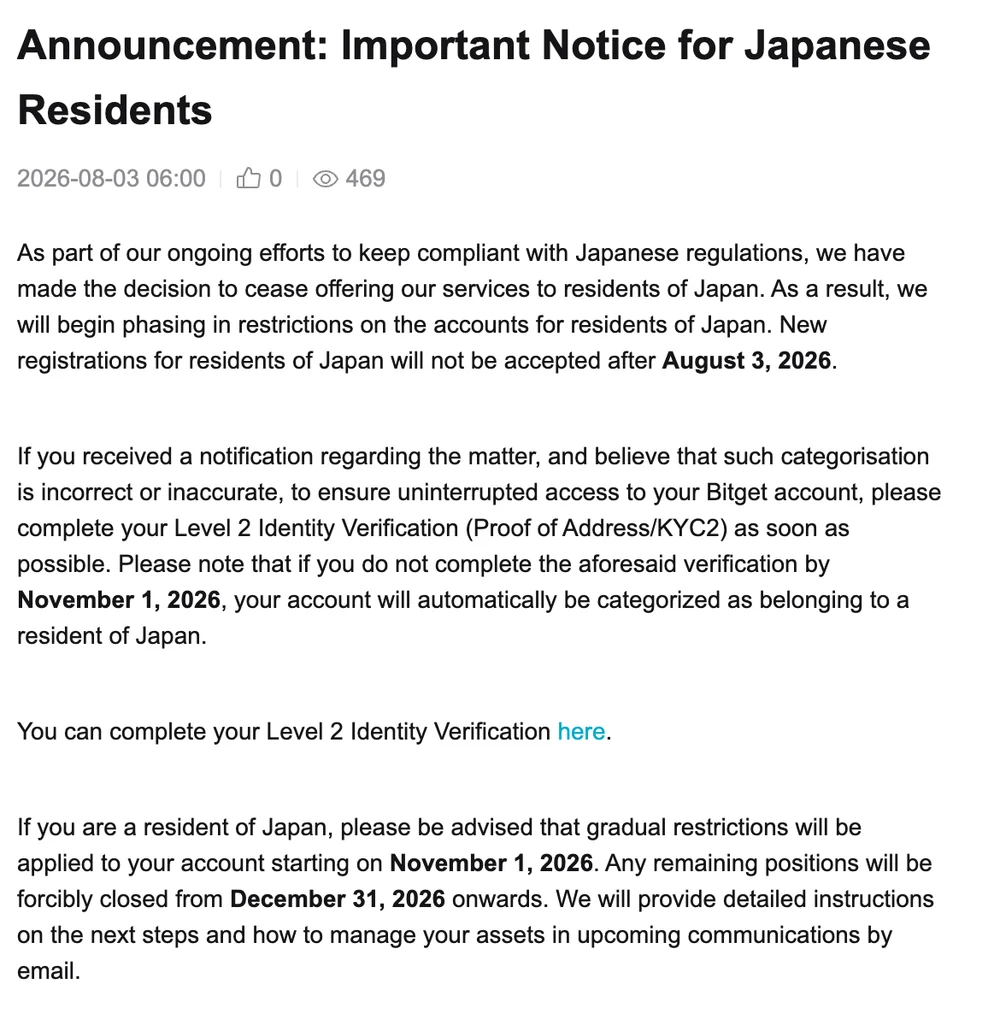
The dates, in order
Three dates matter, and the middle one is the one most people will feel first.
| Date | What happens |
|---|---|
| 3 August 2026 | New registrations from Japanese residents stop |
| 1 November 2026 | Restrictions begin phasing in. Final deadline to complete Level 2 verification if you were categorised as Japanese in error |
| 31 December 2026 | Any remaining open position is forcibly closed |
Why now, and why Bitget is not the first
Japan's regulator has been narrowing the space for unregistered exchanges for years, and Bitget was on its list three separate times. Bitget Limited appears on the FSA's warning list for unregistered crypto exchange operators in both March 2023 and November 2024. A third warning followed in June 2025, against a Bitget entity for soliciting over-the-counter derivatives without registration.
That third one is the pattern worth noticing. The escalation from crypto-exchange warnings to a derivatives warning is exactly the sequence that preceded Bybit's exit, and Bybit completed its own Japanese wind-down on 22 July 2026, six weeks before this announcement. Two of the largest offshore venues have now left the same market within a year.
Japan is also moving to reclassify crypto assets as financial instruments, which raises what is at stake for an operator serving the country without registration. From an exchange's side the calculation gets simple: leave voluntarily, or keep accumulating warnings.
The lawful options, and what they cannot do
Two venues that Japanese residents can use are properly registered with the FSA, and both of them are spot only. Binance Japan Inc. holds Kanto Finance Bureau registration and offers spot, Convert, Simple Earn and Auto-Invest. OKCoin Japan is registered as well and its published fee schedule contains no futures at all.
So if you were on Bitget for leveraged trading, there is currently no registered Japanese venue that replaces it. That is an uncomfortable sentence to write on a site that earns money when people sign up to exchanges, but it is the accurate one. Anyone telling Japanese traders that a particular offshore venue is the safe replacement is describing a venue in the same regulatory position Bitget just left.
It also has a practical consequence for us: cashback on Japan's lawful routes covers spot fees only, because futures are not on the menu there in the first place.
What traders actually do, and what it costs them
A large share of Japanese traders never used the registered venues, and they will not start now. They trade on offshore exchanges that do not list Japan as restricted, and many connect through a VPN. It is worth being straightforward about how that actually works rather than pretending it does not happen.
The decisive detail is the one from Bitget's own notice. Access was never the thing that got Japanese users removed, the verification file was. An exchange that holds a Japanese proof of address can act on it at any time, and a different connection changes nothing about a document already on file. That is why the traders who stayed reachable are the ones on venues that never asked for an address in the first place, not the ones who changed their IP.
That route has real costs, and they are worth counting before choosing it. Venues without mandatory verification cap what you can withdraw, so size becomes a problem long before you expect it. Using a venue against its own terms means an account can be closed rather than merely restricted, and there is no regulator to appeal to. And policies move: Bitunix tightened its withdrawal verification in July 2026, which is the same direction every venue eventually travels once it gets large enough to be noticed.
None of that is advice to pick one path over the other. It is the trade being made, stated plainly: the registered route costs you leverage, the offshore route costs you recourse.
What to do this week
If you hold anything on Bitget and live in Japan, the first job is not choosing a new exchange. It is getting your assets out on your own schedule rather than on the schedule of a forced close-out on 31 December.
If you received a categorisation notice and it is genuinely wrong, complete Level 2 verification before 1 November. That is a hard deadline; after it, the account is treated as Japanese whatever your actual situation.
If you are moving to another venue, the fee question outlives the migration. Whatever you trade and wherever you trade it, a share of every fee you pay is already being paid out by the exchange as affiliate commission. Our calculator shows what that is worth on your volume, and the cashback explainer covers the mechanics.
We cover several venues that remain open to Japanese residents. We are not going to tell you any of them is the regulated answer, because none of them is.
Changing exchange? Do not leave the fee rebate behind
Exchanges pay out part of every trading fee as affiliate commission. Trade Reclaim returns 30 to 50% of it to you in USDT, across 9 exchanges from one account.
Frequently asked questions
Is Bitget closing in Japan?
Bitget is ceasing services for Japanese residents. Registrations stopped on 3 August 2026, account restrictions begin on 1 November, and positions still open from 31 December 2026 are forcibly closed. The platform continues operating normally in other markets.
How does Bitget decide that I am a Japanese resident?
Through the address on your identity verification. Bitget asks users who believe they were categorised in error to complete Level 2 verification, meaning proof of address, by 1 November 2026. Without it the account is automatically treated as Japanese. It is not based on your IP address.
Does a VPN keep my Bitget account open?
No. The categorisation runs on the verification documents Bitget already holds, not on where you connect from. Changing your connection does not change a proof of address that is already on file.
What happens to my open positions?
Positions still open from 31 December 2026 will be closed for you, at whatever price the market offers at that moment. Closing them yourself beforehand is the only way to keep control of the exit price.
Which crypto exchanges are legal in Japan?
Venues registered with the Financial Services Agency, which includes Binance Japan Inc. and OKCoin Japan among the exchanges relevant here. Both are spot only. There is currently no FSA-registered route to leveraged crypto trading for Japanese residents.
Why did Bitget leave Japan?
Bitget cites compliance with Japanese regulations. The context is that the FSA named Bitget entities on its warning lists for unregistered operation in March 2023 and November 2024, and again in June 2025 over unregistered derivatives solicitation. Bybit completed the same kind of exit on 22 July 2026.
Can I still earn cashback after switching exchanges?
Yes. Trade Reclaim pays 30 to 50% of your trading fees back in USDT across 9 exchanges from a single account, and the rate does not depend on which one you use. What it cannot do is make an unregistered venue a regulated one.
Sofia runs marketing at Trade Reclaim and writes the guides she wishes existed when she started trading: no filler, real numbers, and every rate checked against the exchange's own schedule before it goes live.
Trade Reclaim earns from exchange referrals and shares most of it back to you as cashback. Education, not financial advice.