
Bybit Trading Fees 2026: Spot, Futures and What You Get Back
Bybit pairs one of the lowest maker rates with the highest taker rate of the big venues. What that does to a year of trading, and what comes back.

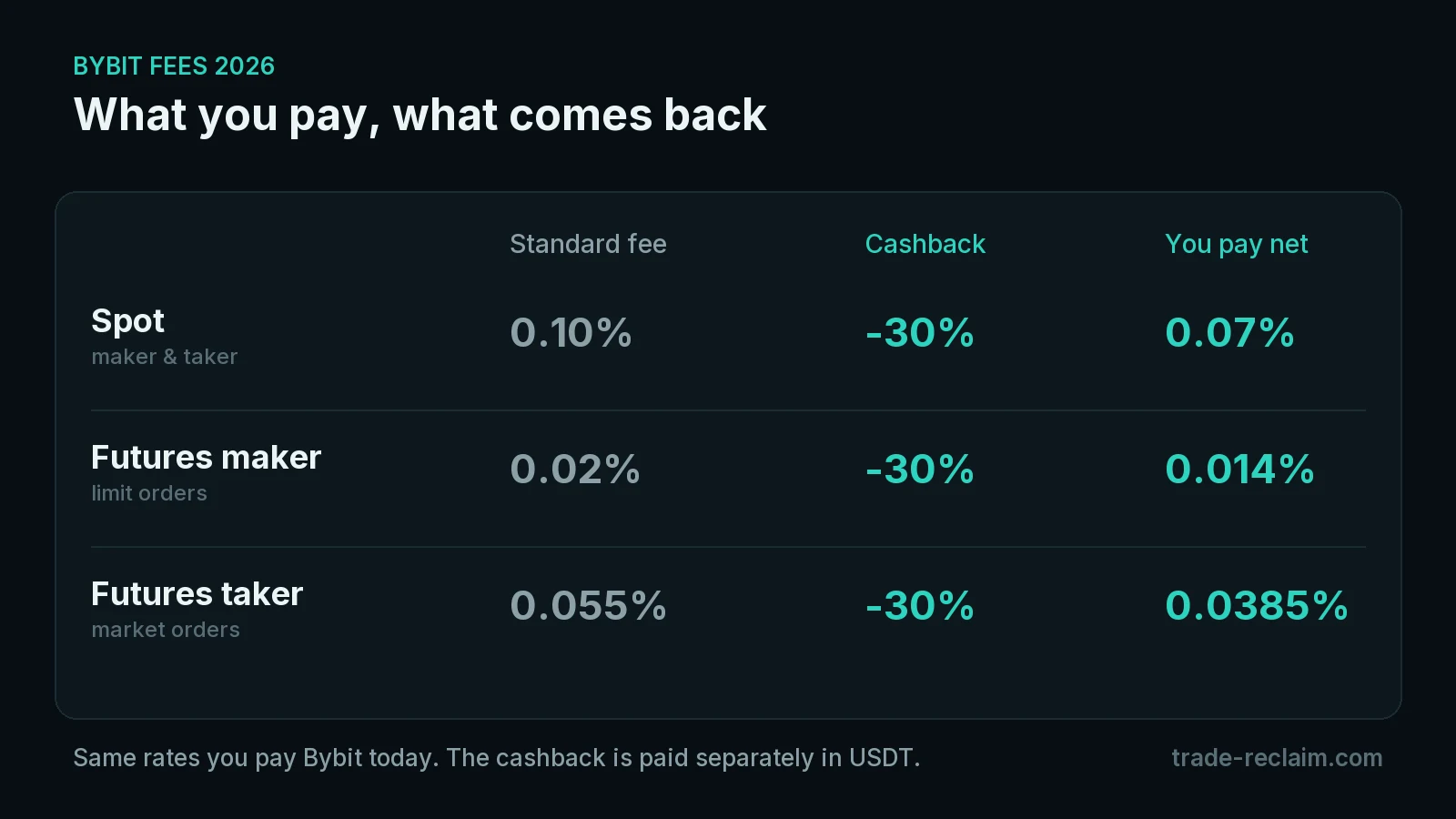
- Bybit charges 0.10% on spot for both sides, and 0.02% maker and 0.055% taker on USDT perpetuals at the regular tier.
- 5M USDT of monthly volume costs about 33,000 USDT a year in Bybit taker fees, against about 30,000 on OKX and 36,000 on Bitget.
- Maker fills cost nearly 3 times less than taker fills on Bybit futures.
- 30% of every Bybit fee flows back through Trade Reclaim, at every VIP level.
- EU residents trade on bybit.eu, Bybit's MiCA platform, which offers spot only and runs its own fee schedule.
One taker round trip on a 25,000 USDT Bybit position costs 27.50 USDT. Nobody cancels a trade over it. But at 2 or 3 trades a day, that line item compounds into more than many traders make on the trades themselves. Check your own yearly number before you read on.
What Bybit actually charges
Bybit charges 0.10% per side on spot, and 0.02% maker and 0.055% taker on USDT perpetuals at the regular tier.
Resting orders pay the maker rate, orders that fill against the book pay taker. The 0.02% futures maker rate matches the best standard rate on the market, while the 0.055% taker rate sits between OKX at 0.05% and Bitget at 0.06%. Both figures sit in the official Bybit fee schedule, and the complete ladder, VIP levels included, is on our Bybit fees page.
Perpetual positions also exchange funding every 8 hours. Funding flows between longs and shorts, Bybit only passes it through, and no discount or rebate program applies to it. Trading fees are the part of your cost stack you can actually move.
Not every contract uses the standard rate. Bybit's schedule lists separate fee groups: TradFi perpetuals at 0% maker and 0.0275% taker, Innovation Zone contracts at 0.04% and 0.11%, and Pre-listing contracts at 0.04% and 0.1%. On spot, the 0.10% applies to crypto pairs, while fiat pairs cost 0.10% to 0.15% maker and 0.12% to 0.2% taker, depending on your spot volume over 30 days.
What a year of Bybit trading costs
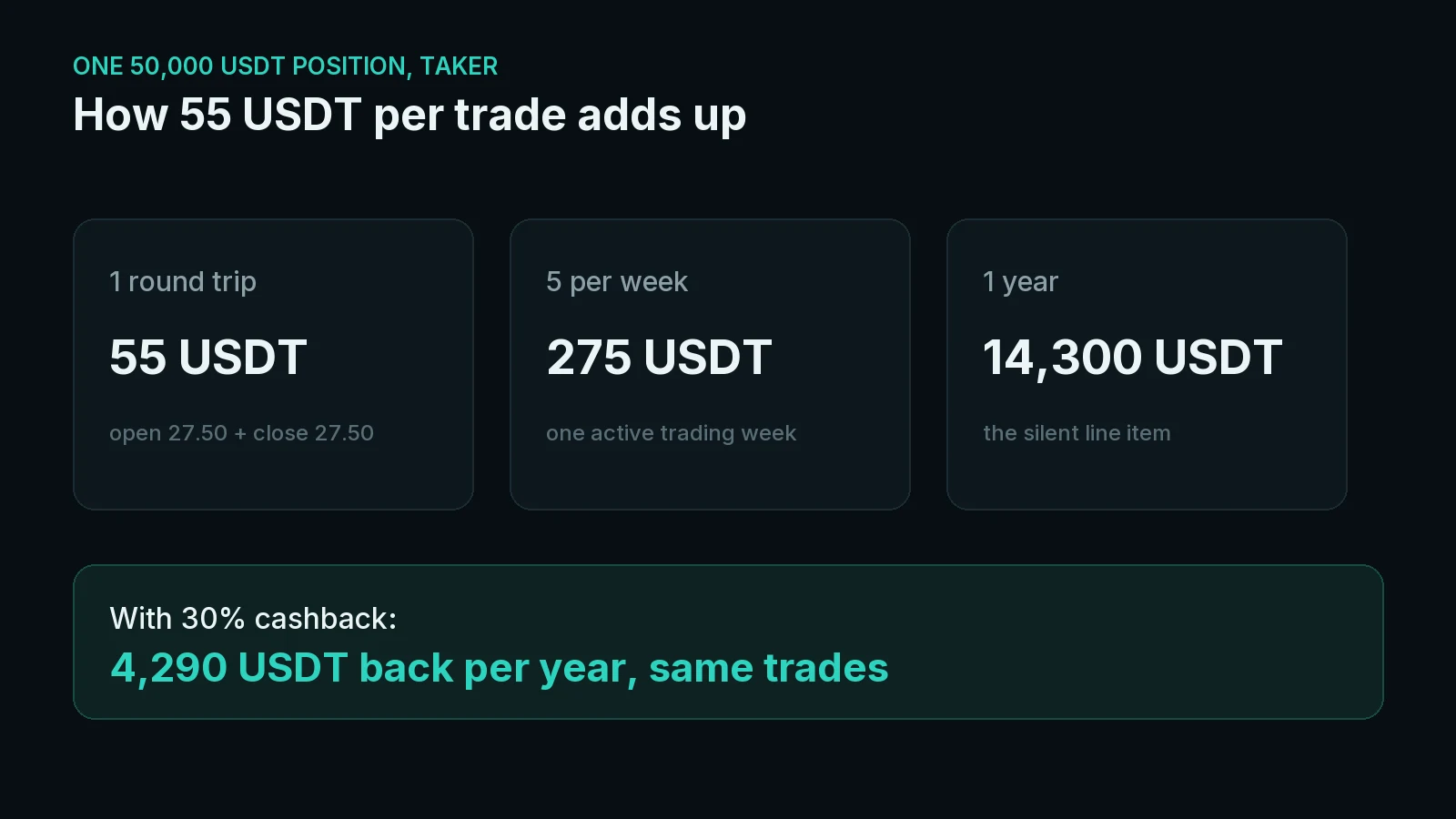
A single 50,000 USDT position on Bybit costs 55 USDT in taker fees: 27.50 to open, 27.50 to close. That is the honest unit to think in, because nobody trades "monthly volume", they trade positions.
Now scale it to your own rhythm. At 5 round trips a week, that position size burns about 275 USDT a week, roughly 14,300 USDT a year, paid silently out of your PnL. Trade smaller? A 10,000 USDT position still bleeds 11 USDT per round trip, near 2,900 a year at the same pace. Trade more often, and the line item grows past what many strategies earn. The same flow filled as maker would cost about a third.
With 30% cashback, the 14,300 becomes 4,290 USDT back per year, without changing a single trade. The cashback calculator runs this for your own position size and frequency and prints the 30% line underneath.
The 4 levers that cut your Bybit bill
Four levers move what you pay on Bybit: cashback on every trade, maker orders, VIP tiers and paying fees in MNT.
Start with the lever that needs no volume: Trade Reclaim returns 30% of every Bybit fee from the first trade. It works at VIP 0 and keeps working at VIP 5. Current rates and the setup steps are on the Bybit cashback page.
Then come the structural levers. Resting orders as maker cut the futures rate from 0.055% to 0.02%, a 64% drop for strategies that can wait in the book. The VIP ladder lowers both sides once volume or balance qualifies.
The fourth lever is Bybit's own token. If you pay trading fees in MNT, Bybit takes 25% off spot fees and 10% off futures fees, on top of your VIP rate. The MNT has to sit in your Unified Trading Account and cover the whole fee, and orders from the API, trading bots and copy trading do not qualify.
| Fee type | Standard | With 30% back |
|---|---|---|
| Spot maker | 0.10% | 0.07% |
| Spot taker | 0.10% | 0.07% |
| Futures maker | 0.02% | 0.014% |
| Futures taker | 0.055% | 0.0385% |
Regular tier, before any VIP discount. The full VIP ladder is on the Bybit page.
How the 30% cashback works
Trade Reclaim pays back 30% of every fee Bybit charges you, in USDT, with payouts available anytime from 20 USDT.
Bybit budgets affiliate commission for every referred account. Sign up through the affiliate link and that commission exists either way; Trade Reclaim hands most of it back to you instead of keeping it. Your fee schedule, VIP progress and account stay untouched. The link between the 2 accounts is your UID: enter it once, the affiliate dashboard matches your trades, done. At no point does anyone hold API keys or any form of access to your Bybit account. The how it works page walks through each step.
At 33,000 USDT of yearly taker fees, the 30% is 9,900 USDT back. The percentage keeps applying after every VIP upgrade.
Bybit deposit and withdrawal fees
Deposits on Bybit are free, and withdrawals cost a network fee per coin that Bybit shows in the withdrawal window before you confirm. When you fund the account on-chain, Bybit itself charges nothing, you only cover the blockchain cost. On the way out, the fee depends on the coin and the network you pick, and that choice matters more than most traders think.
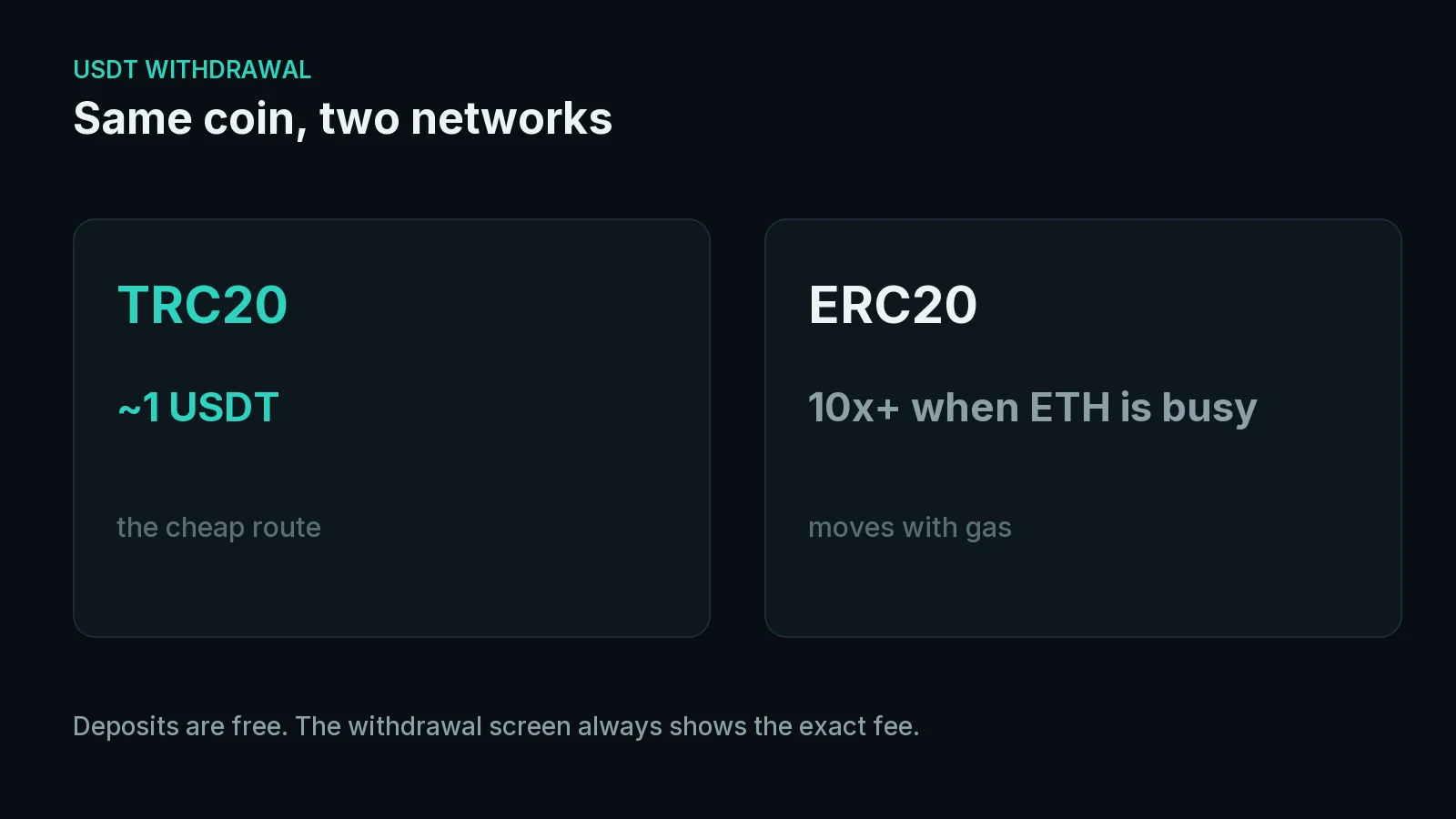
The classic example is USDT: withdrawing over TRC20 costs about 1 USDT, while the same withdrawal over ERC20 can cost a two-digit dollar amount when Ethereum is busy. Same coin, same destination, wildly different bill. If your exchange or wallet on the other side supports the cheaper network, there is rarely a reason to pay the ERC20 premium.
Internal transfers between your own Bybit accounts and subaccounts are free and instant, and canceling an order never costs anything, a fee only exists once a trade actually executes.
| Asset / network | Typical fee |
|---|---|
| USDT (TRC20) | ~1 USDT |
| USDT (ERC20) | higher, moves with ETH gas |
| BTC | ~0.000111 BTC |
| ETH (ERC20) | ~0.0015 ETH |
| Deposits (all coins) | free |
Typical values. Bybit adjusts network fees continuously; the withdrawal screen always shows the exact amount.
Funding, convert and options fees
Three costs sit outside the maker/taker schedule: funding, the Convert spread, and options fees. Funding is the periodic payment between long and short positions on perpetuals, exchanged every 8 hours. It is not revenue Bybit keeps, but for a position held over weeks it can outweigh the trading fees on the same trade.
Bybit Convert shows no fee line, which does not make it free: the cost is built into the quoted rate as a spread. For anything beyond small amounts, placing a spot limit order is usually cheaper than the convenience of Convert. Options run on their own schedule, around 0.02-0.03% per side and settled in USDC, small per contract but worth knowing before you sell your first covered call.
None of these three appear in the fee table most people screenshot, which is exactly why an active month on Bybit can cost more than the 0.055% headline suggests. Card spending is a separate product again: the Bybit Card has its own fee table and its own cashback.
Bybit fees vs OKX and Bitget
At the regular tier the three venues are close: spot costs 0.10% on Bybit and Bitget and 0.08% maker on OKX, and the futures maker rate is 0.02% everywhere. The difference sits in the futures taker rate: 0.05% on OKX, 0.055% on Bybit and 0.06% on Bitget.
The full comparisons, VIP ladders included, are in OKX vs Bybit fees and Bybit vs Bitget. All three earn 30% back through the same Trade Reclaim account, so the order of the net rates stays the same.
| Fee type | Bybit | OKX | Bitget | Bybit with Trade Reclaim |
|---|---|---|---|---|
| Spot maker | 0.10% | 0.08% | 0.10% | 0.07% |
| Spot taker | 0.10% | 0.10% | 0.10% | 0.07% |
| Futures maker | 0.02% | 0.02% | 0.02% | 0.014% |
| Futures taker | 0.055% | 0.05% | 0.06% | 0.0385% |
All three cut rates with VIP volume. The last column is the effective Bybit rate with 30% Trade Reclaim cashback; OKX and Bitget earn the same 30% back through the same account.
What EU traders get on bybit.eu
EU residents trade on bybit.eu, Bybit's MiCA platform. It offers spot only and runs its own fee schedule.
On bybit.eu there are spot and spot margin markets, no perpetuals and no options, and the standard spot fee is higher than on bybit.com. What that means for your costs and your cashback is in our Bybit EU guide. Outside Europe one country is excluded completely: Bybit does not serve the United States.
When cashback is not worth it
Below roughly 100,000 USDT of monthly volume, 30% back on Bybit is real money but not life-changing money: about 200 USDT a year. Under 20,000 USDT a month it drops below 100 USDT a year, and nobody should restructure their trading for that.
The specific catch on Bybit is timing: an account created before you had a referral cannot be relinked, so the cashback genuinely requires a new account, which is a decision worth making deliberately rather than on impulse. The limit that applies no matter which venue you pick: cashback lowers your cost per trade, it does not create an edge. It will not turn a losing strategy profitable, it only makes a working one cheaper to run.
Are Bybit fees competitive in 2026?
Mostly yes. Bybit's maker rate matches the best in class, the futures taker rate sits mid pack between OKX and Bitget, and 30% back moves both below most competitors.
With cashback, the effective regular rates land at 0.0385% taker and 0.014% maker on futures. Where that places Bybit among the 9 platforms we track is in the exchange fee comparison, and the full mechanics of fee cashback are in the cashback guide.
What would 30% back be worth on Bybit?
Position size and trades per day in, your yearly Bybit fee bill and the USDT return out.
Takes 20 seconds.
Frequently asked questions
What are Bybit trading fees for regular users?
Spot costs 0.10% per side. USDT perpetuals cost 0.02% maker and 0.055% taker. These are the rates before VIP tiers or cashback.
What are Bybit spot trading fees?
A flat 0.10% for maker and taker alike at the regular tier, one of the simplest spot schedules among major exchanges. VIP levels reduce it once volume or balance requirements are met.
How much are Bybit withdrawal fees?
Deposits are free. Withdrawals cost a network fee per coin: typically about 1 USDT for USDT on TRC20, while ERC20 is consistently the expensive route for USDT. Bybit shows the exact amount on the withdrawal screen before you confirm, because the fee moves with network conditions.
Is there a way to lower Bybit funding fees?
No. Funding moves between long and short traders and Bybit only passes it through. Trading fees are the reducible part: Trade Reclaim returns 30% of every Bybit trading fee.
Is Bybit cheaper than OKX?
On futures, OKX's taker rate is slightly lower at 0.05% against Bybit's 0.055%, while maker rates match at 0.02%. On spot, OKX charges 0.08% maker against Bybit's 0.10%, and taker is 0.10% on both. With 30% cashback on both, the futures taker rate ends at 0.035% on OKX and 0.0385% on Bybit.
What is the cheapest way to trade on Bybit without VIP status?
Rest orders as maker where the strategy allows it, which prices fills at 0.02% instead of 0.055%, and link your UID to Trade Reclaim so 30% of every fee comes back from day 1.
Are internal transfers on Bybit free?
Yes. Moving assets between your own Bybit accounts and subaccounts costs nothing and settles instantly. Canceling an unfilled order is also free, a trading fee only exists once an order actually executes.
Why is Bybit not available in the US?
Bybit's Platform Terms list the United States among the Excluded Jurisdictions, and Bybit holds no US license. Users detected in a restricted country are logged out automatically, and a false location can lead to account termination and the liquidation of open positions.
Sofia Dani is Head of Marketing at Trade Reclaim, based in Switzerland. She earned a Bachelor of Arts at the University of Lucerne and went on to complete a Master's degree. She has little patience for products that win by confusing people, and covers crypto exchanges, their products, and what trading actually costs.
Trade Reclaim earns from exchange referrals and shares most of it back to you as cashback. Education, not financial advice.