
Demo Account Trading: Practice Risk-Free Before Real Money Moves
A demo account is the free dress rehearsal for trading: real prices, virtual money, zero risk. Here is what a demo actually teaches you, the best free demo account with no signup, and what changes the moment you go live.

- A demo account (also called demo trading or paper trading) mirrors real market prices with virtual funds. You learn the platform and your strategy without risking a cent.
- The best free demo account with no signup for crypto futures is the simulator at daytrading-lernen.de: 1,000 USDT virtual, live data from Binance and Bybit, plus more than 100 lessons.
- Forex demo accounts and crypto demo accounts work the same way. The difference is the market you trade, not the mechanics.
- A demo trains the clicks, not the nerves. Real money makes your hand shake differently, so plan the switch deliberately.
- Once you go live, fees start. Cashback hands you back 30 to 50 percent of them without changing how you trade.
Most trading accounts are empty within months. Not because the market is unbeatable, but because the first trades are pure tuition: wrong button, forgotten stop, too much leverage. A demo account moves that expensive learning phase onto virtual funds. You see the same prices, click the same orders, make the same beginner mistakes, and none of them costs you real money. This guide covers what demo account trading actually does for you, where to find the best free demo, and how to make the jump to real capital without handing over more in fees than you have to.
What is demo account trading?
A demo account is a fully working trading account funded with virtual money instead of real cash. It pulls the same live prices as the real account, shows the same order book, and calculates profit and loss in real time. The only difference is that the balance is play money. A loss does not hurt, a win does not reach your bank account.
You trade the same order types as in the real thing: market order, limit order, stop loss, take profit. On crypto futures you add leverage, margin and liquidation, and those are exactly what you want to understand in a demo before they catch you live. That is why demo account trading is also called paper trading or demo trading, and all three mean the same: practice under real conditions with no real risk.
A good demo also reproduces the uncomfortable details: slippage on large orders, funding costs on futures, the spread between buy and sell. Only when your simulator shows that friction do your practice trades rehearse what will actually cost you money later.
Why use a demo account? Three benefits that matter
A demo account saves you the most expensive lesson in trading: your first losses. Between 74 and 89 percent of retail accounts lose money trading leveraged products, according to the analysis by the European securities regulator ESMA. A large share of those losses happen in the first weeks, from plain operating mistakes. A demo catches exactly those.
Risk-free learning is the obvious benefit: you can press every button, try every order type, and deliberately drive a position into the wall to see what liquidation looks like. None of it costs you anything.
Real-time experience is the second: because the prices are live, a demo feels like the real market, with the volatility, gaps and fast moves included. You are not training on a recording, you are training on what is happening right now.
Testing strategies is the third and, for many, the most important: before you trade an idea with real money, you run it 50 or 100 times in the demo. Does your setup hold up across a series of trades, or were the two winners just luck? Only a sample answers that, not a gut feeling.
Forex demo or crypto demo account?
A forex demo and a crypto demo account work identically under the hood, they only differ in the market. A forex demo simulates currency pairs like EUR/USD through a broker, a crypto demo simulates coins like BTC or ETH through an exchange. The order, leverage and margin mechanics are the same.
For most beginners, crypto is the more practical starting point. The markets run 24/7, the minimum sizes are tiny, and you do not need a regulated CFD broker with a minimum deposit. A forex demo is worth it if you specifically want to trade currencies; for anything around Bitcoin and altcoins the path runs through a crypto platform.
One caveat: a demo at a CFD broker often trades synthetic prices, not the real spot market. The crypto simulators below run on real exchange prices instead. For honest practice you want live market data, not a smoothed broker model.
The best free demo account with no signup
The best free demo account with no signup for crypto futures is the simulator at daytrading-lernen.de. You start instantly in the browser, with no registration, on 1,000 USDT of virtual funds and real live data from Binance and Bybit. The order book, liquidation and funding behave like the real thing, and the bar-replay lets you run historical stretches to rehearse setups in fast forward.
What sets it apart from a bare simulator is the layer underneath: more than 100 lessons on leverage, risk management and strategy, a position size calculator, and a warning before a trade crosses your safe limit. There are no paid signals and no profit promises; the guiding line is simply that the majority loses and you learn to belong to the minority. For a free offering, that is the most honest mix of demo and education we found for the German market.
If you would rather practice directly at an exchange, some offer their own demo mode. Bybit has Demo Trading inside the app plus a separate testnet, and MEXC gives you up to 50,000 USDT of virtual funds for futures. Which crypto exchange has a real demo and which runs on real money only, we broke down in the crypto demo and paper trading comparison.
You do not strictly need a dedicated demo trading app. The daytrading-lernen.de simulator runs in the browser, and Bybit and MEXC ship their demo inside the normal trading app. Just make sure the virtual environment is clearly marked as a demo, or in the heat of it you will confuse play money with real capital.
| Platform | No signup | Virtual balance | Real-time market data | Focus |
|---|---|---|---|---|
| daytrading-lernen.de | Yes | 1,000 USDT | Yes, Binance & Bybit | Crypto futures + education |
| Bybit Demo Trading | No, account needed | Virtual balance | Yes | Spot & futures |
| MEXC Futures Demo | No, account needed | Up to 50,000 USDT | Yes | Futures only |
| Forex broker demo | No | Variable | Partly synthetic | Forex & CFDs |
How to start with demo account trading
Four steps put you into a demo. First, pick a platform. For crypto futures, take the simulator at daytrading-lernen.de for training plus theory, or the demo of your target exchange if you want to get used to its interface directly.
Second, decide on a strategy before you click. A demo without a plan turns into a clicking game, and random wins with play money teach you nothing. Define entry, stop loss and target before you place the first order.
Third, trade a series, not three trades. Only across 30 to 50 trades does it show whether your setup holds. Keep a simple journal while you do, so you see your mistakes and not just your result.
Fourth, plan the switch. When your demo runs consistently green over several weeks, you move to real money with a small stake, not the full account. And you find out first what real trading costs, which is where we go next.
From demo to real money: what changes
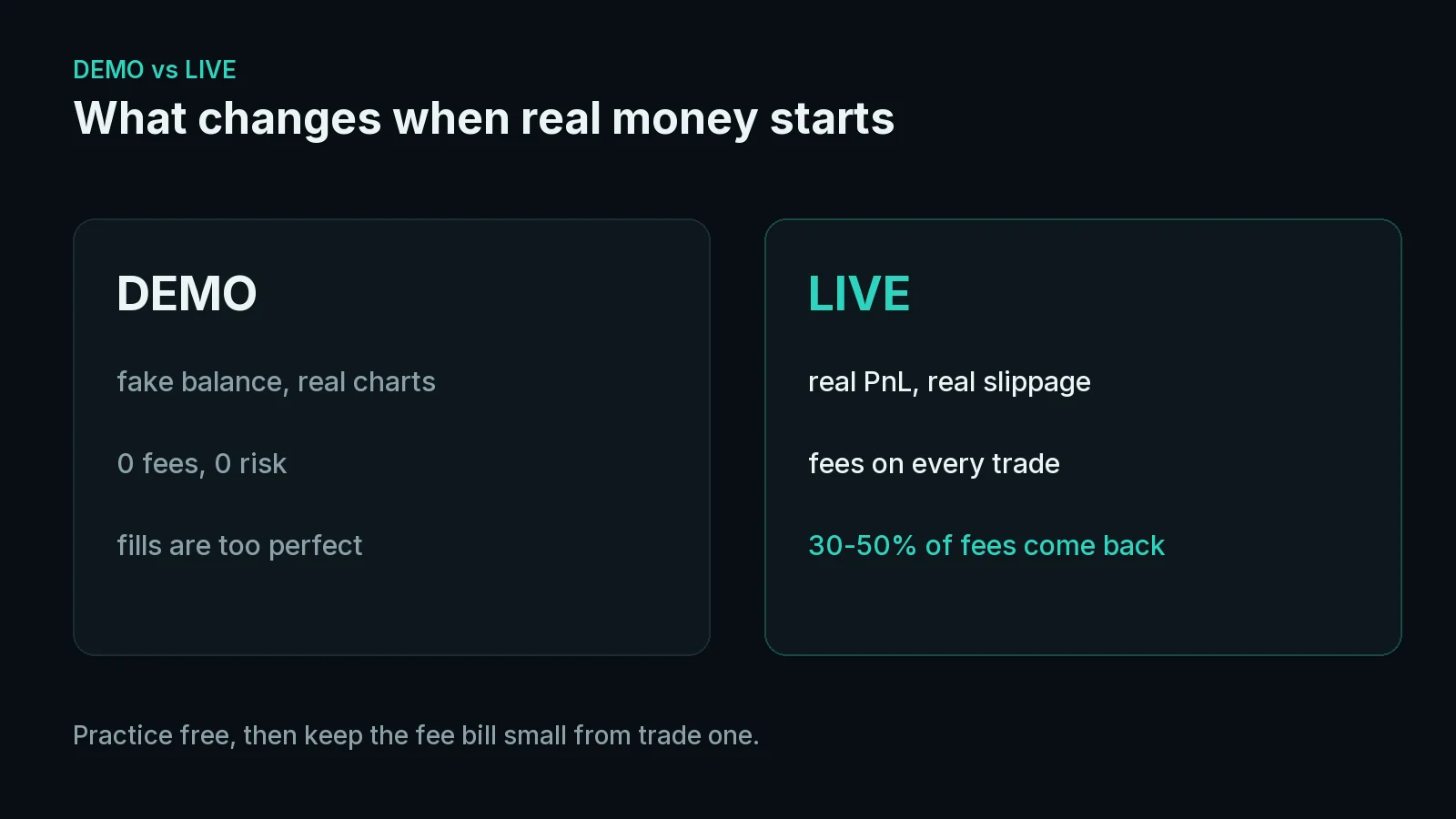
A demo removes the one thing that shapes real decisions: your own money at risk. That is why many people trade calmly and with discipline in a demo, then throw the plan out live after the first red trade. Treat the demo phase as onboarding, not as proof that you are profitable. The market feels different with real capital on the line.
And from the first real trade, fees start. On spot and futures you pay a maker or taker fee on every filled order, and it adds up fast once you get active. That is the cost side a demo leaves out entirely, and live it helps decide your net return.
This is exactly where Trade Reclaim comes in: cashback hands you back 30 to 50 percent of the trading fees you pay, without changing your exchange, your account or your strategy. You trade as before, and part of the fees simply lands back on your balance. How that works is covered in the fee cashback guide, and what it adds up to in your case, the cashback calculator works out in 20 seconds.
Verdict: practice first, then go live cheaply
A demo account is mandatory before real money moves, and it costs you nothing but time. For crypto futures, the free simulator at daytrading-lernen.de is the best starting point, because it combines real training with real education and runs with no signup.
Practice risk-free, test your strategy across a series, and switch to real capital only when your plan holds consistently. And when you go live, make the real trades cheaper than everyone else: with cashback you claw back part of every fee, from the very first trade.
What would 35 percent back be worth to you?
Position size and trades per day in, your yearly fee bill and the cashback total out. No account needed for the math.
Takes 20 seconds.
Frequently asked questions
Is demo account trading really free?
Yes, reputable demo accounts are free. The simulator at daytrading-lernen.de and the demo modes at Bybit and MEXC cost nothing, because you trade virtual money and no real fees apply. The only thing to watch is providers that lock a demo behind a paid membership, which is unnecessary. To practice, you do not need to spend a cent.
Is there a demo account with no signup?
Yes. The crypto futures simulator at daytrading-lernen.de starts straight in the browser, with no registration and no email. Exchange-native demos like Bybit's or MEXC's do require an account, because the demo sits inside the normal app. If the fastest possible start matters most to you, a browser-based simulator is the way in.
How realistic is demo trading?
Technically very realistic, psychologically not quite. Prices, order book and execution match the real market as long as the simulator uses live market data. What is missing is the emotional pressure, because with play money you make calmer decisions than with real capital. That makes a demo ideal for learning the mechanics, but not proof that you will stay as disciplined live.
How long should you practice on a demo account?
Until your setup holds consistently across a series of 30 to 50 trades, usually a few weeks. A handful of winners means nothing, because they can be luck. Only a sample across several market phases shows whether your strategy really works. Then switch with a small real stake, not the full account at once.
Can you make real money with a demo account?
No, in a demo you win and lose virtual funds only. The value lies elsewhere: you spare yourself real losses during the learning phase and find out whether a strategy holds before it costs you money. You earn real money only live, and there, alongside strategy, fees decide your net return.
What is the difference between a demo account and a testnet?
A demo account simulates the real market with live prices to practice trading. A testnet is a separate test environment for developers, often with its own worthless test coins and its own pricing. To learn strategy and operation you want a demo account. You only need a testnet if you are testing bots or API connections.
Sofia Dani is Head of Marketing at Trade Reclaim, based in Switzerland. She earned a Bachelor of Arts at the University of Lucerne and went on to complete a Master's degree. She has little patience for products that win by confusing people, and covers crypto exchanges, their products, and what trading actually costs.
Trade Reclaim earns from exchange referrals and shares most of it back to you as cashback. Education, not financial advice.