Maker vs Taker Fees in Crypto: The Difference That Decides What You Pay
Every order you place is either a maker or a taker order, and the taker side costs 2x to 4x more. Here is how the split works, the exact rates on 9 exchanges, and the 2 levers that cut both fees.

- A maker order adds liquidity to the order book and waits to be filled. A taker order fills instantly against an existing order and pays the higher fee.
- On futures, base taker fees run 0.04% to 0.08% across the 9 major exchanges while maker fees run 0.01% to 0.02%. The taker side costs 2x to 4x more.
- Market orders are always taker. Limit orders are maker only when they rest in the book first. Post-only settings guarantee maker treatment.
- Fee cashback of 30 to 50% applies to maker and taker fills alike, which shrinks the taker penalty without changing how you trade.
Two traders open the same 50,000 USDT Bitcoin position on the same exchange in the same minute. One pays 10 USDT in fees, the other pays 27.50 USDT. Same trade, same platform, a 175% difference in cost. The only thing separating them is whether their order added liquidity to the book or removed it.
What is a maker and what is a taker?
A maker creates liquidity by placing an order that sits in the order book. A taker removes liquidity by filling an order that is already there. Every fill on a crypto exchange has one of each: the resting order that waited (the maker side) and the incoming order that matched it (the taker side). Exchanges price the 2 roles differently because a full order book is what keeps their market usable.
The names have nothing to do with skill or account size. A beginner placing a patient limit buy 50 USDT below the market is a maker. A fund firing a 2,000,000 USDT market buy is a taker. The book does not care who you are, only whether your order waited or took.
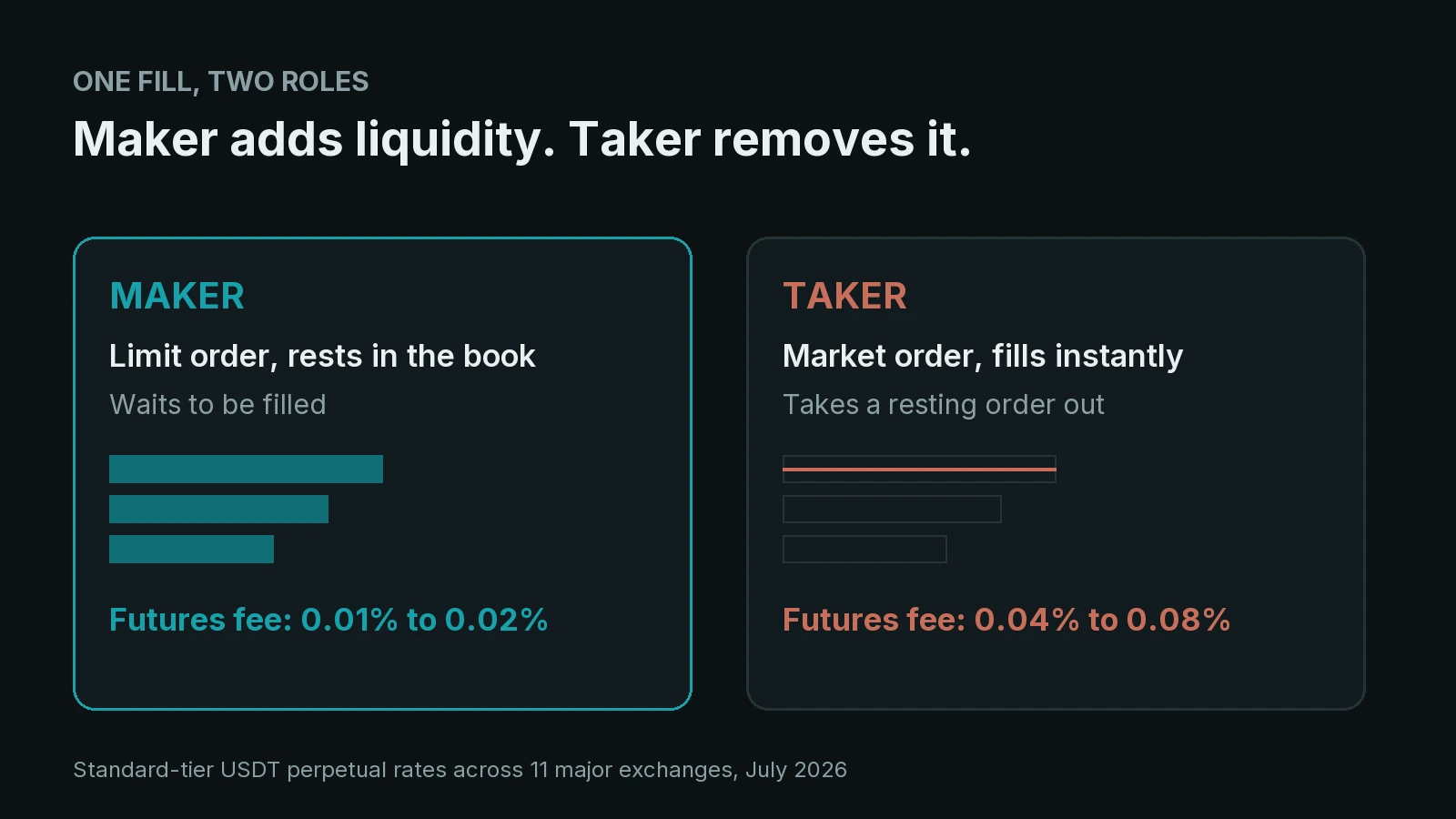
Market order vs limit order: which one makes you a maker?
Market orders are always taker orders. Limit orders are maker orders only when they rest in the book before filling. That second part trips up most traders: a limit buy placed above the current ask fills immediately against existing sell orders, and the exchange charges it as a taker fill even though you used a limit order.
The full mapping: a market order takes. A resting limit order makes. A marketable limit order takes. A stop order takes when it triggers, because it converts into a market or marketable order. A post-only order either makes or gets cancelled, never takes. If guaranteed maker pricing matters to you, post-only is the switch that enforces it, and every major futures venue offers it.
Why takers pay more
Takers pay more because they consume the one thing an exchange cannot manufacture on its own: standing liquidity. Deep order books keep spreads tight and let a 500,000 USDT market order fill near the quoted price. So exchanges subsidise the traders who provide that depth and charge the traders who use it up. Traditional venues push the same logic further, some as far as paying makers rebates, the model CME Group documents as maker-taker pricing.
Economics uses price maker vs price taker for a related but different idea: a price maker has enough market power to influence the price of what it sells, a price taker accepts the market price as given. Crypto fee schedules borrow the vocabulary and mean something narrower. You are a fee maker or fee taker per order, not per account, and a normal trading day contains both.
Maker vs taker fees on 9 crypto exchanges
Base futures maker fees cluster at 0.01% to 0.02% while taker fees run 0.04% to 0.08%, so the taker side costs 2x to 4x more on every major venue. The table shows standard non-VIP rates for USDT perpetual futures, plus what the taker rate becomes after fee cashback.
Two things stand out. MEXC's 0.04% taker undercuts every other base tier, and the gap between the cheapest and the most expensive taker rate doubles your cost for identical trades. Per-exchange detail, spot rates included, lives in our full fee comparison.
| Exchange | Maker | Taker | Taker after cashback |
|---|---|---|---|
| MEXC | 0.01% | 0.04% | 0.028% |
| OKX | 0.02% | 0.05% | 0.035% |
| Bybit | 0.02% | 0.055% | 0.0385% |
| Bitunix | 0.02% | 0.06% | 0.039% |
| LeveX | 0.02% | 0.06% | 0.039% |
| Bitget | 0.02% | 0.06% | 0.042% |
| BloFin | 0.02% | 0.06% | 0.042% |
| Phemex | 0.01% | 0.06% | 0.042% |
| WEEX | 0.02% | 0.08% | 0.040% |
How VIP ladders change the maker-taker math
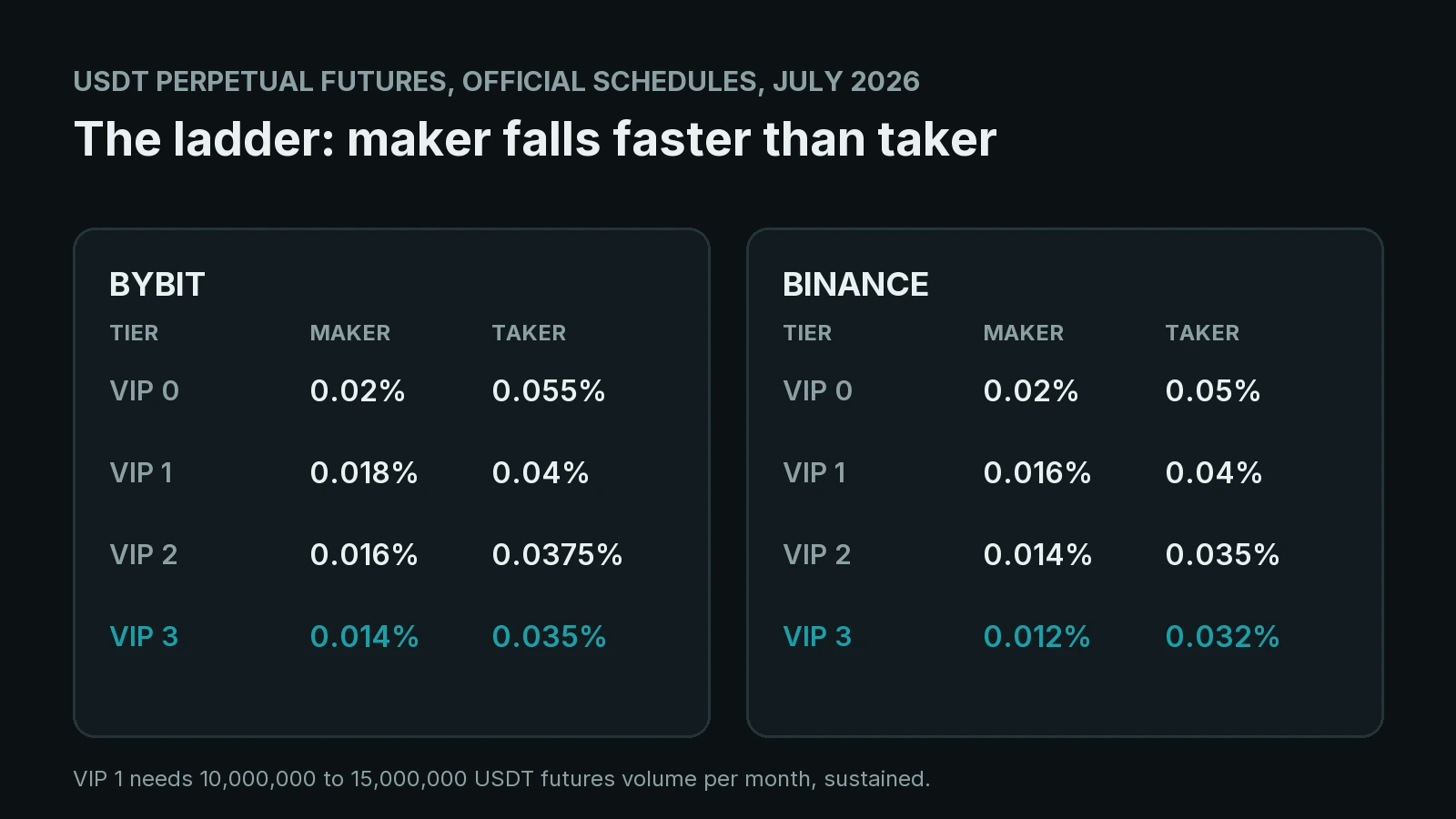
VIP tiers narrow the gap from both sides, and the maker rate falls faster at every step. Bybit's ladder moves from 0.02%/0.055% at base to 0.018%/0.04% at VIP 1 (10,000,000 USDT monthly futures volume) and 0.014%/0.035% at VIP 3 (50,000,000). OKX goes from 0.02%/0.05% to 0.016%/0.045% at VIP 1 (5,000,000 USD) and 0.01%/0.028% at VIP 3 (50,000,000). Verified against both exchanges' official schedules, October 2026.
Read those thresholds again before planning around them. VIP 1 needs 5,000,000 to 10,000,000 USDT of volume every single month, which at a 50,000 USDT position size means 50 to 100 round trips. Most retail traders never hold a tier month over month, and a missed month resets the rate. That is the practical difference between the 3 fee levers: VIP rewards volume you must sustain, token discounts require holding an asset, cashback pays from the first trade with no threshold.
For the traders who do qualify, the 2 systems compound: the tier lowers the printed maker and taker rate, and cashback returns its percentage of the lower fee. A VIP 1 Bybit taker paying 0.04% with 30% cashback lands at an effective 0.028%, half of what a base-tier market order costs.
The taker's second bill: spread and slippage
The taker fee is the visible half of what a market order costs. The invisible half is the spread you cross and the depth you consume. A market buy fills at the ask, not at the mid price, so you pay half the spread on entry before any fee. On BTC perpetuals at a liquid hour that is 0.005% or less and barely matters. On a thin altcoin pair, crossing a 0.10% spread costs twice as much as the taker fee itself.
Size makes it worse. A 200,000 USDT market order on a book with 80,000 USDT resting at the best ask walks through 3 price levels, and the average fill lands measurably above the quote. Makers sit on the other side of both effects: the resting limit order earns the spread instead of paying it and never consumes depth. When you compare 0.02% maker against 0.055% taker, the honest gap is wider than the printed 2.75x, because only one of the 2 orders also pays for immediacy.
The practical rule that follows: judge every taker fill by fee plus expected slippage, not fee alone. On liquid majors during liquid hours, taker costs are close to the schedule. On thin pairs, at news spikes, or at size, the schedule is the floor, not the price.
How to pay the maker fee more often
Enter positions with resting limit orders, switch on post-only, and stop paying the taker premium on trades that were never urgent. Most entries do not need to happen this second. Placing your buy slightly below the market and letting price come to you converts a 0.055% fee into a 0.02% fee, and across 10 entries a week that discipline compounds into real money.
Exits are different. A stop-loss must fire as a taker order, that is its job, and closing a winner into strength is often worth the taker fee. The practical split disciplined futures traders land on: maker entries, taker exits when speed matters, and no market orders out of boredom.
Which maker-taker mix fits your trading style
Scalpers live on taker fees, swing traders can run almost pure maker, and day traders sit in between at 30 to 70% taker. A scalper taking 30 fills a day cannot wait for resting orders; the strategy pays the taker schedule as rent, which is why scalpers gain the most from the cashback and VIP levers and from picking the venue with the lowest taker rate outright. Our day trading guide runs that venue math in detail.
Swing traders hold for days and enter at planned levels, which is exactly what resting limit orders are for. A swing trader who insists on market orders donates the maker-taker spread on every position for no speed benefit worth having. Day traders split the difference: maker entries at planned levels, taker exits when a move demands it. Match the mix to your style before optimising anything else, because the mix decides which column of the fee table you actually live in.
The full discount stack: cashback, VIP, token
3 levers cut crypto trading fees, and they stack: cashback (30 to 50% of every fee back, no threshold), VIP tiers (lower printed rates, monthly volume requirements), and exchange-token discounts (pay fees in the native token for a percentage off). MEXC takes 20% off fees paid in MX and Bitget discounts through BGB. On Bitget the token discount applies before the cashback is calculated.
The order of operations matters for your math: the exchange first applies your VIP tier, then the token discount, then pays commission on the fee you actually paid, and the cashback percentage comes out of that. The stack rewards doing all 3, but the effort is not equal. Token discounts need capital parked in an exchange token that moves like the exchange's fortunes. VIP needs sustained volume. Cashback needs a one-time signup. Start with the lever that costs nothing and layer the others when your size justifies them.
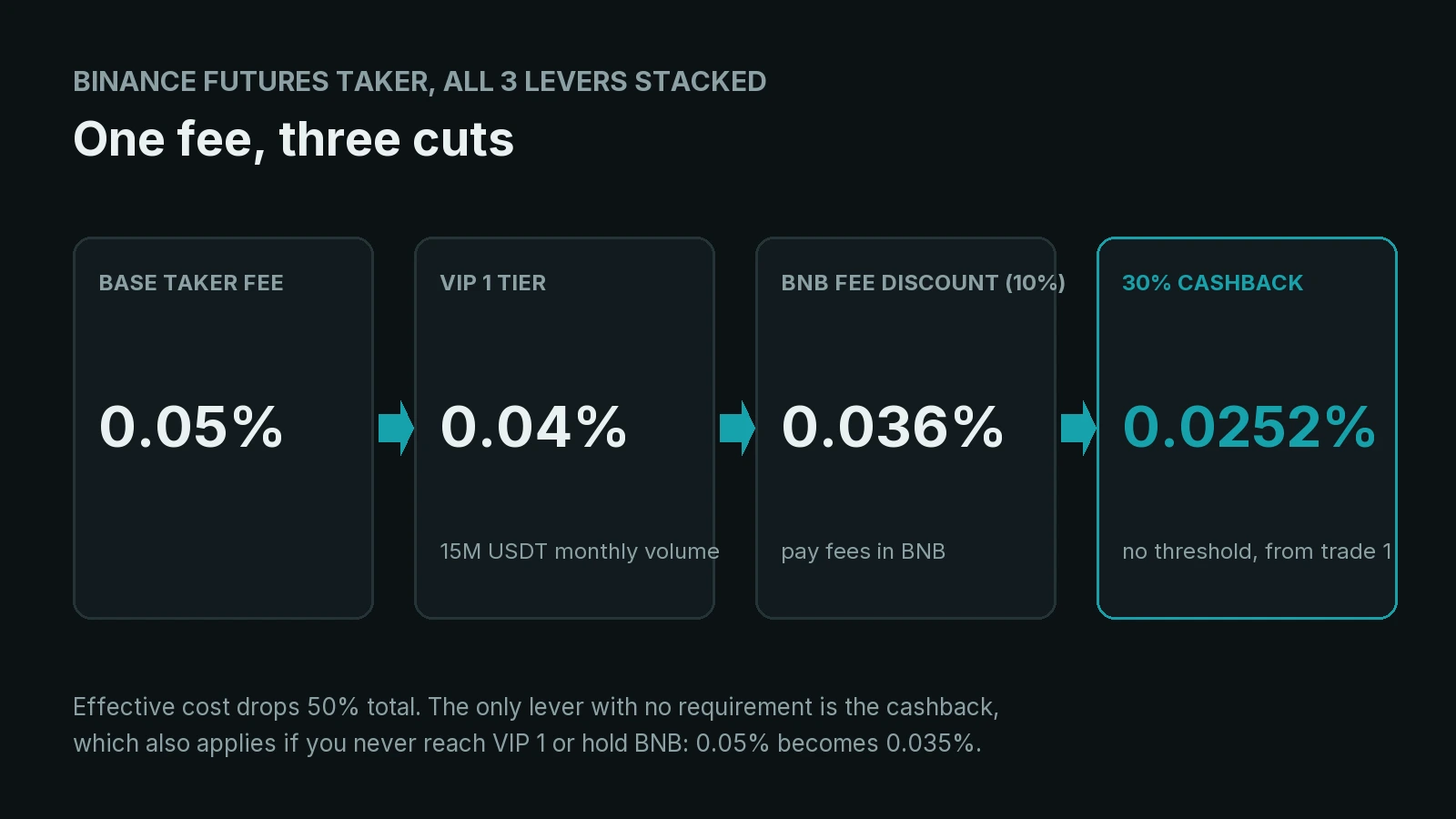
The lever that cuts maker and taker fees at once
Fee cashback returns 30 to 50% of every trading fee you pay, and it applies to maker and taker fills alike. Exchanges pay partners a share of the fees their referred traders generate, and Trade Reclaim passes most of that share back to the trader. Bybit's 0.055% taker becomes an effective 0.0385%, its 0.02% maker becomes 0.014%, paid back in USDT. It stacks on top of VIP and token discounts, and it is the only fee lever that requires zero change to how you trade.
It does not make the maker-taker gap disappear. A cashback-boosted taker fill still costs more than a cashback-boosted maker fill, so order discipline keeps paying. The 2 levers work best together: route what you can through maker orders, then let cashback compress whatever fees remain.
What a 50,000 USDT round trip actually costs
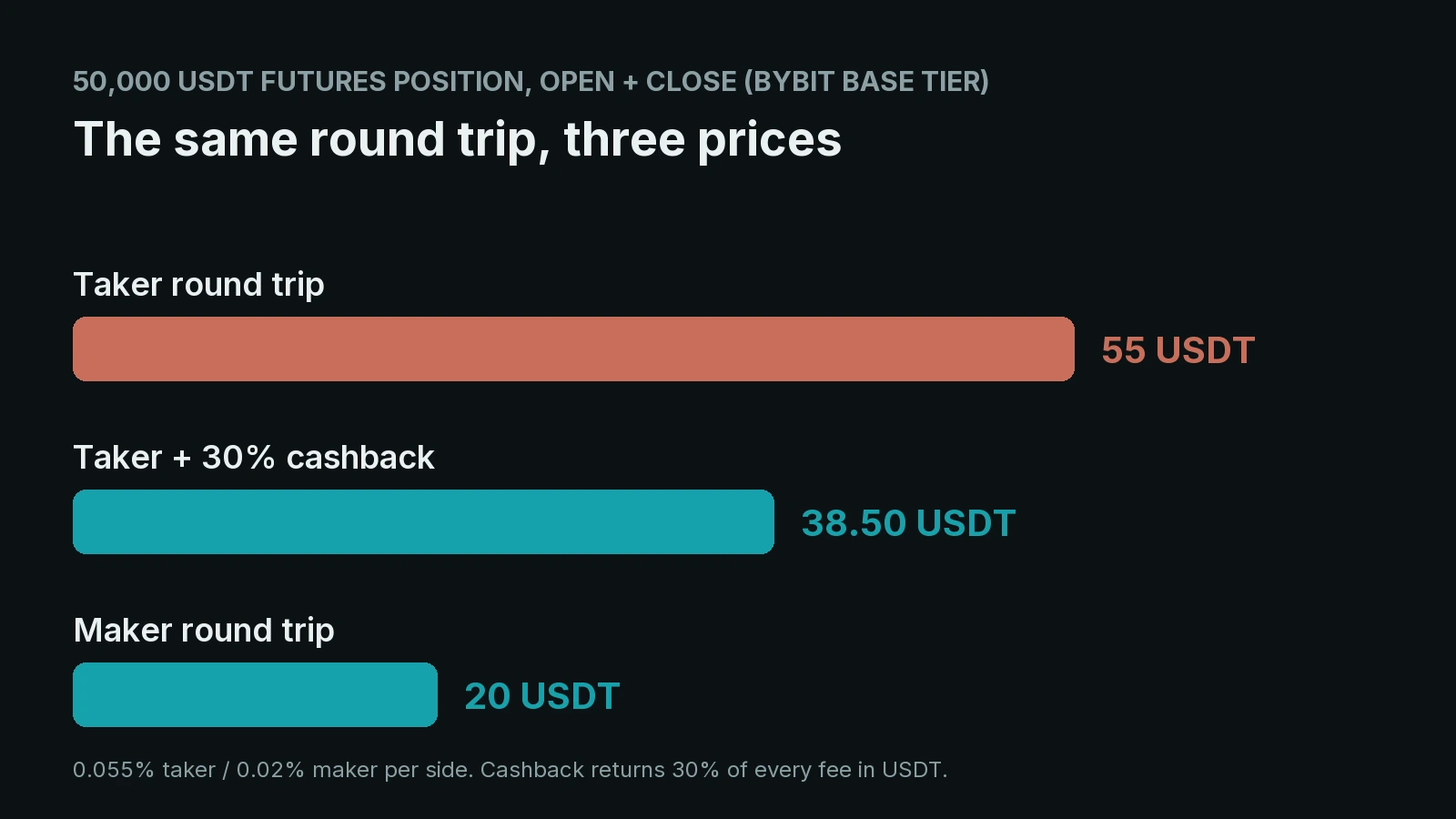
On Bybit's base tier, a 50,000 USDT futures position costs 55 USDT in fees as a pure taker round trip, 20 USDT as a pure maker round trip, and 38.50 USDT as a taker round trip with 30% cashback. Open and close with market orders and you pay 27.50 USDT per side. The same entries as resting limit orders cost 10 USDT per side. With cashback on top, the taker case lands at 38.50 and the maker case at 14.
Scale that to an active month of 20 round trips and the spread becomes 1,100 USDT (all taker, no cashback) against 280 USDT (all maker, with cashback). Same positions, same exchange, nearly 4x apart. Run your own volume through the cashback calculator to get the number that matters: yours.
When chasing maker fees costs you money
A missed fill can cost more than a year of fee savings on that trade. Price does not owe your resting order a visit. In a fast market, the entry you priced below the move never fills, and watching a planned winner run without you costs more than any taker fee. Scalpers who need instant fills, and anyone trading news, will keep paying taker rates as a cost of doing business.
That is the honest frame for the maker-taker decision: it trades price certainty against execution certainty, it is not a free discount. Take the maker fee when patience is cheap, pay the taker fee when it is not, and let cashback work on both.
See what your fees return at your real volume
Enter your monthly volume and your exchange. The calculator shows your yearly fee bill next to what 30 to 50% cashback returns, whatever your maker and taker mix. Takes 2 minutes, no account needed.
Frequently asked questions
Are maker fees always lower than taker fees?
On the 9 major futures exchanges we track, the base maker fee is lower than the taker fee in every single case, with gaps from 2.5x (OKX, 0.02% vs 0.05%) up to 6x (Phemex at 0.01% vs 0.06%). Some traditional equity venues invert the model and pay makers rebates, but no major crypto exchange charges makers more at standard tiers. VIP ladders keep the ordering intact: maker rates fall faster than taker rates as your volume rises.
Do maker and taker fees apply to spot trading too?
Yes, spot markets use the same maker-taker split, just at different levels. Spot fees on most major exchanges run 0.08% to 0.10% per side at base tier, with MEXC as the outlier at 0% maker and 0.05% taker, and several venues charge maker and taker the same there (Bybit, Bitget and Phemex all start at 0.10% flat), while futures schedules price the 2 roles apart. The mechanics are identical on both markets: resting orders make, immediate fills take.
What decides whether my order is a maker or a taker order?
One test decides it: did your order rest in the book before filling? An order that fills the moment it arrives took liquidity and pays the taker fee, regardless of its type. That is why a limit buy placed above the current ask is charged as a taker fill, it executed instantly. The post-only flag exists exactly for this: it cancels your order instead of letting it execute immediately, guaranteeing maker treatment on every fill you get.
What is a price maker vs a price taker in economics?
In economics, a price maker is a market participant with enough power to influence the price of what it sells, a monopolist being the extreme case, while a price taker must accept the market price as given. Crypto fee schedules borrow the words for something narrower: maker and taker describe whether a single order added or removed order-book liquidity. The same trader is both, many times a day, and neither role implies market power.
Does fee cashback apply to maker fees or only taker fees?
Cashback applies to both sides. The exchange pays commission on the total fees your account generates, maker and taker together, spot and futures, and Trade Reclaim returns 30 to 50% of that depending on the exchange. A maker-heavy strategy earns less cashback in absolute USDT simply because it pays less in fees to begin with, which is the better outcome anyway.
Do VIP tiers change maker and taker fees?
Yes, and the maker side falls faster. Bybit's VIP ladder takes futures maker fees from 0.02% at base down to 0% at the top tiers, while taker fees bottom out near 0.03%. OKX's first futures VIP tier starts at 5,000,000 USD in 30-day volume, Bybit's at 10,000,000, and the other majors set their ladders in the same range. VIP discounts and cashback stack: the tier lowers the printed fee, cashback returns a share of whatever you still pay.
Trade Reclaim Research tracks trading fees, VIP schedules and rebate programs across 9 crypto exchanges. Every rate in our articles comes from the exchange's official fee schedule and is re-verified on publication. The team trades on the platforms it writes about.
Trade Reclaim earns from exchange referrals and shares most of it back to you as cashback. Education, not financial advice.