
OKX Fees Explained: Maker, Taker and What You Get Back
What OKX charges on spot and futures, what an active year costs, and which of the 3 discounts you actually qualify for.

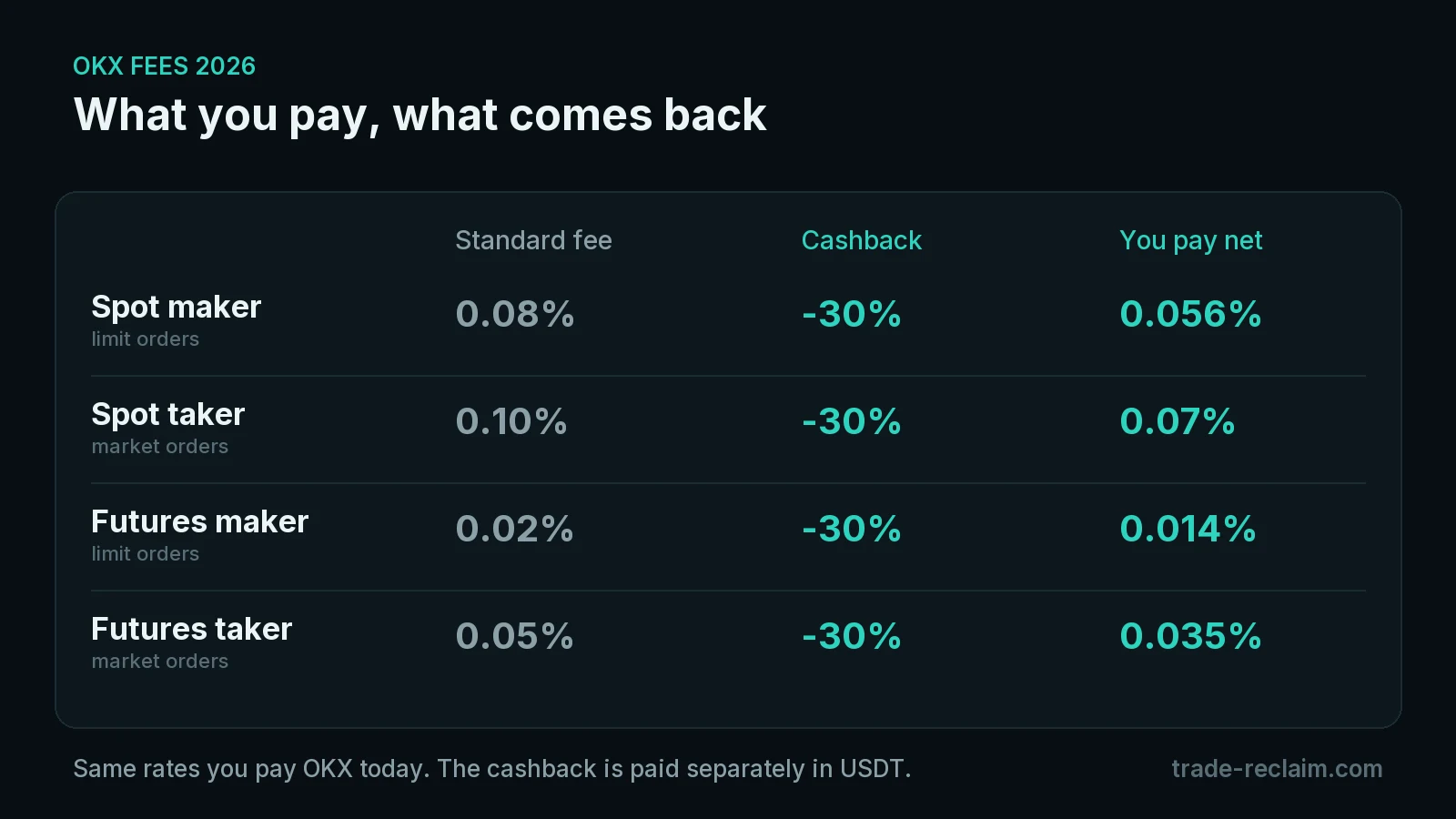
- OKX charges 0.08% maker and 0.10% taker on spot, 0.02% maker and 0.05% taker on USDT perpetuals at the regular tier.
- A trader moving 5M USDT a month pays about 30,000 USDT in taker fees per year on OKX.
- VIP tiers only start moving once you trade 5M USDT a month or park large balances on the exchange.
- Trade Reclaim pays back 30% of every OKX trading fee, on top of any VIP discount you reach.
- Funding payments cannot be discounted by anyone. Trading fees can, and they are the bigger lever for most styles.
A single OKX trade feels cheap: 25 USDT in fees on a 25,000 USDT position. Run 2 or 3 of those a day for a year and the bill quietly reaches 5 figures. Most traders never add it up. Run your own number first, then read what you can do about it.
What OKX actually charges
OKX charges 0.08% maker and 0.10% taker on spot, and 0.02% maker and 0.05% taker on USDT perpetuals at the regular tier.
Maker orders sit in the order book and wait. Taker orders fill instantly against the book and pay the higher rate. The split matters because the taker rate on futures is 2.5 times the maker rate. One detail stands out: the 0.08% spot maker rate undercuts the 0.10% standard most major venues still charge. The numbers come from the official OKX fee schedule, and we track every tier, including VIP rates, on our OKX fees page.
Perpetual traders also pay funding every 8 hours. Funding is a payment between longs and shorts that OKX passes through, not a fee the exchange keeps. It belongs in your cost math, but no discount program touches it.
What a year of OKX trading costs
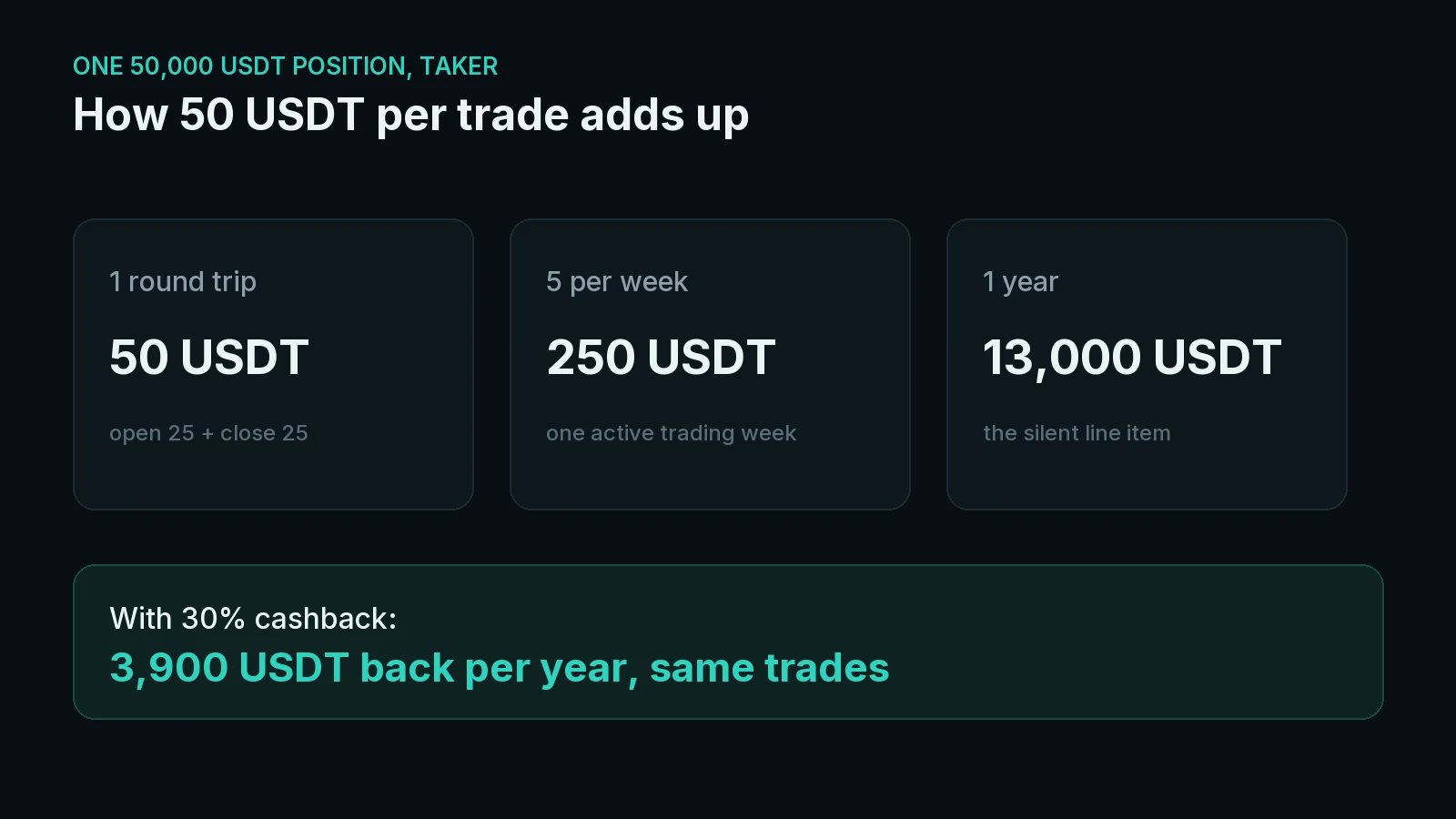
A single 50,000 USDT futures position on OKX costs 50 USDT in taker fees: 25 to open, 25 to close. That is the honest unit to think in, because nobody trades "monthly volume", they trade positions.
Scale it to your own rhythm. At 5 round trips a week, that position size burns about 250 USDT a week, roughly 13,000 USDT a year, paid silently out of your PnL. Smaller size? A 10,000 USDT position still costs 10 USDT per round trip, about 2,600 a year at the same pace. And on the spot side the same logic applies to simple purchases: buying 1,000 USDT of BTC as a taker costs 1 USDT, invisible once, very visible across a year of stacking.
With 30% cashback, the 13,000 becomes 3,900 USDT back per year, without changing a single trade. The cashback calculator takes your position size and pace and shows the 30% line underneath.
The 3 levers that cut your OKX bill
Three levers move what you pay on OKX: cashback on every trade, maker orders, and VIP tiers.
Lever 1 is cashback. Trade Reclaim returns 30% of every trading fee you pay on OKX, from your first trade, with no volume requirement. It is the only lever that works at every account size, and it stacks with the other two. The current rate and setup steps are on the OKX cashback page.
Lever 2 is order type. Filling as maker instead of taker cuts the futures fee from the 0.05% taker rate to the 0.02% maker fee, a 60% reduction for traders whose strategy survives resting orders. Lever 3 is the VIP ladder: from 5M USDT monthly volume or large asset balances, both maker and taker rates step down. All three combine. None of them excludes another.
| Fee type | Standard | With 30% back |
|---|---|---|
| Spot maker | 0.08% | 0.056% |
| Spot taker | 0.10% | 0.07% |
| Futures maker | 0.02% | 0.014% |
| Futures taker | 0.05% | 0.035% |
Regular tier, before any VIP discount. The full VIP ladder is on the OKX page.
How the 30% cashback works
Trade Reclaim returns 30% of what OKX charges you, in USDT, withdrawable anytime from 20 USDT.
Run a month as an example: 2,500 USDT in fees means 750 USDT back. The money is OKX's affiliate commission. OKX pays a share of your fees to the partner that referred you, and Trade Reclaim passes most of that share on to you. Nothing about your own schedule changes. Setup is one field: sign up through the affiliate link, drop your UID into Trade Reclaim, and from then on the affiliate dashboard recognizes your trades. No API keys, no passwords, no access to your OKX account, ever. The full mechanics are on the how it works page.
VIP and cashback do not compete. Climb a tier and the 30% simply applies to the smaller fee you now pay.
OKX deposit and withdrawal fees
Deposits on OKX are free, and withdrawals cost a per-coin network fee that OKX adjusts with chain conditions. Funding the account on-chain costs you only the blockchain fee, OKX itself adds nothing. On the way out, the fee depends on the coin and the network, and OKX tunes those values continuously rather than fixing them for months.
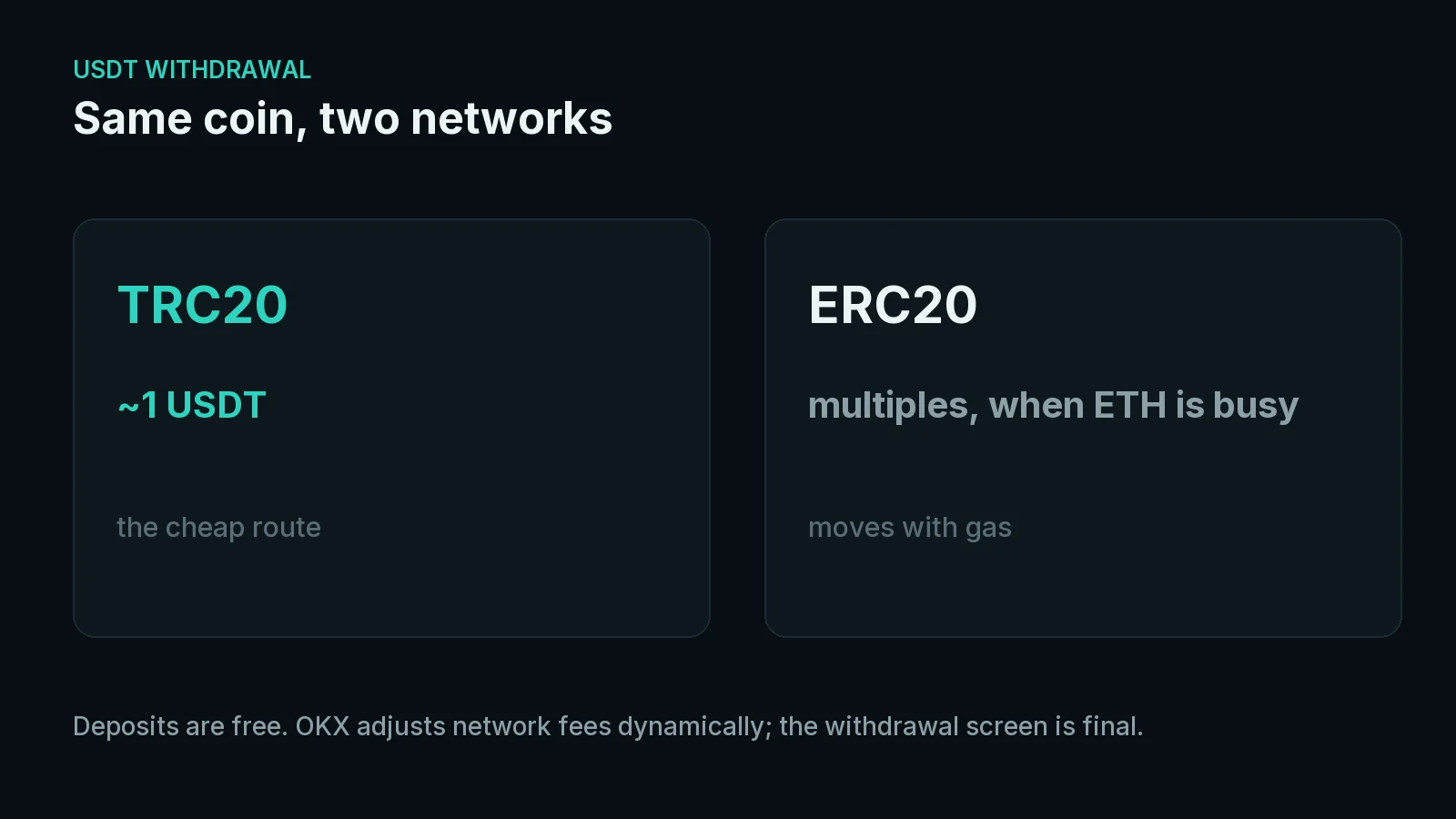
The pattern is the same as everywhere: USDT over TRC20 costs about 1 USDT, the same withdrawal over ERC20 costs a multiple of that when Ethereum is busy. If the wallet or exchange on the other side accepts the cheaper network, the ERC20 premium buys you nothing.
Internal transfers between OKX main and sub-accounts are free and instant, and canceling an unfilled order costs nothing, a fee only exists once a trade executes.
| Asset / network | Typical fee |
|---|---|
| USDT (TRC20) | ~1 USDT |
| USDT (ERC20) | higher, moves with ETH gas |
| BTC / ETH | dynamic, shown at withdrawal |
| Deposits (all coins) | free |
OKX recalculates network fees with chain congestion instead of fixing them, so the withdrawal screen is the only number that counts.
Funding, convert and options fees
Three costs live outside the maker/taker schedule: funding, the Convert spread, and options fees. Funding is the periodic payment between longs and shorts on perpetuals, settled every 8 hours on OKX. It is not revenue OKX keeps, but on a position held for weeks it can outgrow the trading fees of the same trade.
OKX Convert quotes a rate with no fee line, which means the cost is the spread inside that rate. Past small amounts, a spot limit order is usually the cheaper path. Options trade on their own schedule, in the 0.02-0.03% per side range, small per contract but a real line item for anyone writing them weekly.
None of the three show up in the fee table screenshots, which is why an active OKX month can cost more than the 0.05% headline suggests.
OKX fees vs Bybit and Binance
OKX starts with a small edge on paper: the lowest spot maker rate of the three and a futures taker rate that matches Binance. The gap to Bybit shows on the futures taker side, where Bybit charges 10% more per fill.
The differences at the standard tier stay small, which is exactly the point: no venue in this trio wins on sticker rates alone. The effective rate after cashback decides it, and all three earn the same 30% back through one Trade Reclaim account.
| Fee type | OKX | Bybit | Binance | OKX with Trade Reclaim |
|---|---|---|---|---|
| Spot maker | 0.08% | 0.10% | 0.10% | 0.056% |
| Spot taker | 0.10% | 0.10% | 0.10% | 0.07% |
| Futures maker | 0.02% | 0.02% | 0.02% | 0.014% |
| Futures taker | 0.05% | 0.055% | 0.05% | 0.035% |
All three cut rates with VIP volume. The last column is the effective OKX rate with 30% Trade Reclaim cashback; Bybit and Binance get the same 30% back through the same account.
Do OKX VIP tiers beat cashback?
Below 5M USDT a month, cashback moves your bill more than tier hunting. Above it, you take both.
OKX VIP tiers ask for sustained trading volume over a rolling 30 days, or 6 figure balances, before rates improve. A trader below those thresholds gets nothing from the ladder, while 30% cashback applies from the first trade. Once your volume qualifies, the question disappears: the tier lowers the rate, the cashback returns 30% of what remains. There is no scenario where using one blocks the other.
When cashback is not worth it
Below roughly 100,000 USDT of monthly volume, 30% back on OKX is real money but not life-changing money: about 360 USDT a year. Under 20,000 USDT a month it drops below 100 USDT a year, and nobody should restructure their trading for that.
OKX already runs one of the lower base schedules at 0.08% maker, which cuts both ways: your fee bill is smaller to begin with, so the absolute rebate at small size is smaller too. The cashback earns its keep on OKX through frequency and futures, not through the headline rate. The limit that applies no matter which venue you pick: cashback lowers your cost per trade, it does not create an edge. It will not turn a losing strategy profitable, it only makes a working one cheaper to run.
Are OKX fees competitive in 2026?
Yes. OKX sits in the cheaper half of major exchanges, and with 30% coming back it beats most stock rates.
With cashback, the effective regular rates land at 0.035% taker and 0.014% maker on futures. Few exchanges get there without VIP status. How that compares across the 9 platforms we track is in the exchange fee comparison, and the mechanics behind fee cashback are in the cashback guide.
What would 30% back be worth on OKX?
Position size and trades per day in, your yearly OKX fee bill and the USDT return out.
Takes 20 seconds.
Frequently asked questions
What are OKX trading fees for regular users?
Spot trades cost 0.08% maker and 0.10% taker. USDT perpetuals cost 0.02% maker and 0.05% taker. These are the rates before any VIP tier or cashback.
What is the OKX spot fee?
0.08% for maker orders and 0.10% for taker orders at the regular tier. VIP tiers lower both, starting at 5M USDT monthly volume or qualifying balances.
Does OKX charge withdrawal fees?
Deposits are free. Withdrawals cost a per-coin network fee that OKX adjusts dynamically with chain conditions: USDT over TRC20 runs about 1 USDT, ERC20 costs a multiple of that when Ethereum is busy, and BTC or ETH fees are recalculated continuously. The withdrawal screen shows the exact amount before you confirm.
Can OKX funding fees be reduced?
No. Funding is a payment between long and short traders that OKX passes through, so no program discounts it. Trading fees are different: Trade Reclaim returns 30% of every OKX trading fee.
How do I get lower fees on OKX without VIP status?
Two ways work from day 1: fill orders as maker, which cuts the futures rate from 0.05% to 0.02%, and connect your UID to Trade Reclaim, which returns 30% of every fee you pay regardless of volume.
Do OKX fees differ between spot and futures?
Yes. Spot costs 0.08% maker and 0.10% taker, while USDT perpetuals cost 0.02% maker and 0.05% taker. Futures rates are lower per fill, but leverage and frequency usually make futures the bigger annual cost.
Are internal transfers on OKX free?
Yes. Moving assets between your OKX main account and sub-accounts costs nothing and settles instantly. Canceling an unfilled order is also free, a trading fee only exists once an order actually executes.
Sofia Dani is Head of Marketing at Trade Reclaim, based in Switzerland. She earned a Bachelor of Arts at the University of Lucerne and went on to complete a Master's degree. She has little patience for products that win by confusing people, and covers crypto exchanges, their products, and what trading actually costs.
Trade Reclaim earns from exchange referrals and shares most of it back to you as cashback. Education, not financial advice.