
Bitunix vs Bybit: Which Platform Offers the Best Trading Experience?
Two futures-first crypto trading platforms, two very different philosophies: Bitunix keeps sign-up light and leverage high, Bybit brings licences, deep liquidity and a real demo account. Here is the honest head-to-head on fees, features and user experience.
- Fees are close but not equal: both charge 0.02% maker on futures, Bybit takes 0.055% taker against Bitunix's 0.06%, while Bitunix undercuts on spot with 0.08% maker vs Bybit's 0.10%.
- Bitunix offers up to 200x leverage on BTC perpetuals and sign-up without upfront KYC; Bybit caps BTC at 100x and makes identity verification mandatory.
- Bybit is the safer institution: MiCA-licensed in the EU, regulated in Dubai, monthly proof of reserves, and it survived the largest hack in crypto history in 2025 with every user made whole.
- Only Bybit has an official demo account (50,000 USDT in virtual funds). Bitunix documents no demo mode, whatever third-party sites claim.
- Neither exchange serves US residents, and both restrict several other regions. Check the lists before you sign up.
- Trade Reclaim pays back 35% of every Bitunix fee and 30% of every Bybit fee in USDT, from your public UID, which narrows whatever fee gap the schedules leave.
Comparisons between crypto trading platforms usually crown a winner in the first paragraph. This one will not, because Bitunix vs Bybit is a genuine trade-off: the challenger is cheaper on spot, lighter on onboarding and more aggressive on leverage, while the incumbent brings licences, liquidity and the kind of crisis record that actually proves custody. Which side wins depends entirely on what you trade and where you live.
Bitunix overview: features and user experience
Bitunix is the younger platform, founded in 2021 and grown to a claimed 5 million users with a clear identity: a futures-first exchange that gets out of your way. Registration takes an email, and trading works without upfront identity verification; withdrawal capabilities expand as you verify, so treat KYC as optional at the door rather than absent. The market coverage is genuinely deep for its age: about 670 USDT-margined perpetuals and 840 spot pairs, with leverage up to 200x on BTC, twice what most majors offer. Copy trading is built in, the fee schedule starts at 0.08% maker / 0.10% taker on spot and 0.02% / 0.06% on futures, and the mobile apps hold strong ratings (4.5 to 4.6) on both stores. Security posture: proof of reserves with Hacken audits, a stated 1:1 reserve policy and an insurance fund, though with a shorter track record and no tier-1 licence to lean on. The full picture, including what we could not verify, is in our Bitunix review and the Bitunix fee guide.
Bybit overview: features and user experience
Bybit is one of the largest derivatives venues in the world, and it increasingly competes on trust rather than just size. It is MiCA-licensed in the EU through its Austrian entity, licensed in Dubai, and publishes monthly proof of reserves audited by Hacken. Its defining moment came in February 2025, when it absorbed the largest hack in crypto history, roughly 1.5 billion USD in ETH, closed the gap within days and made every user whole; the full story is in our Is Bybit safe deep dive. Day to day, Bybit trades about 600 spot pairs and 685 perpetuals with some of the deepest orderbooks in the market, caps BTC leverage at a saner 100x, and requires KYC for everyone. Two features stand out for newer traders: an official demo account loaded with 50,000 USDT in virtual funds, and mature copy trading with a 10% base profit share for lead traders. Fees sit at 0.10% both sides on spot and 0.02% maker / 0.055% taker on futures, dissected in our Bybit fee guide. App ratings are excellent at 4.6 to 4.7 across more than a million reviews.
Bitunix vs Bybit: the trading fees comparison
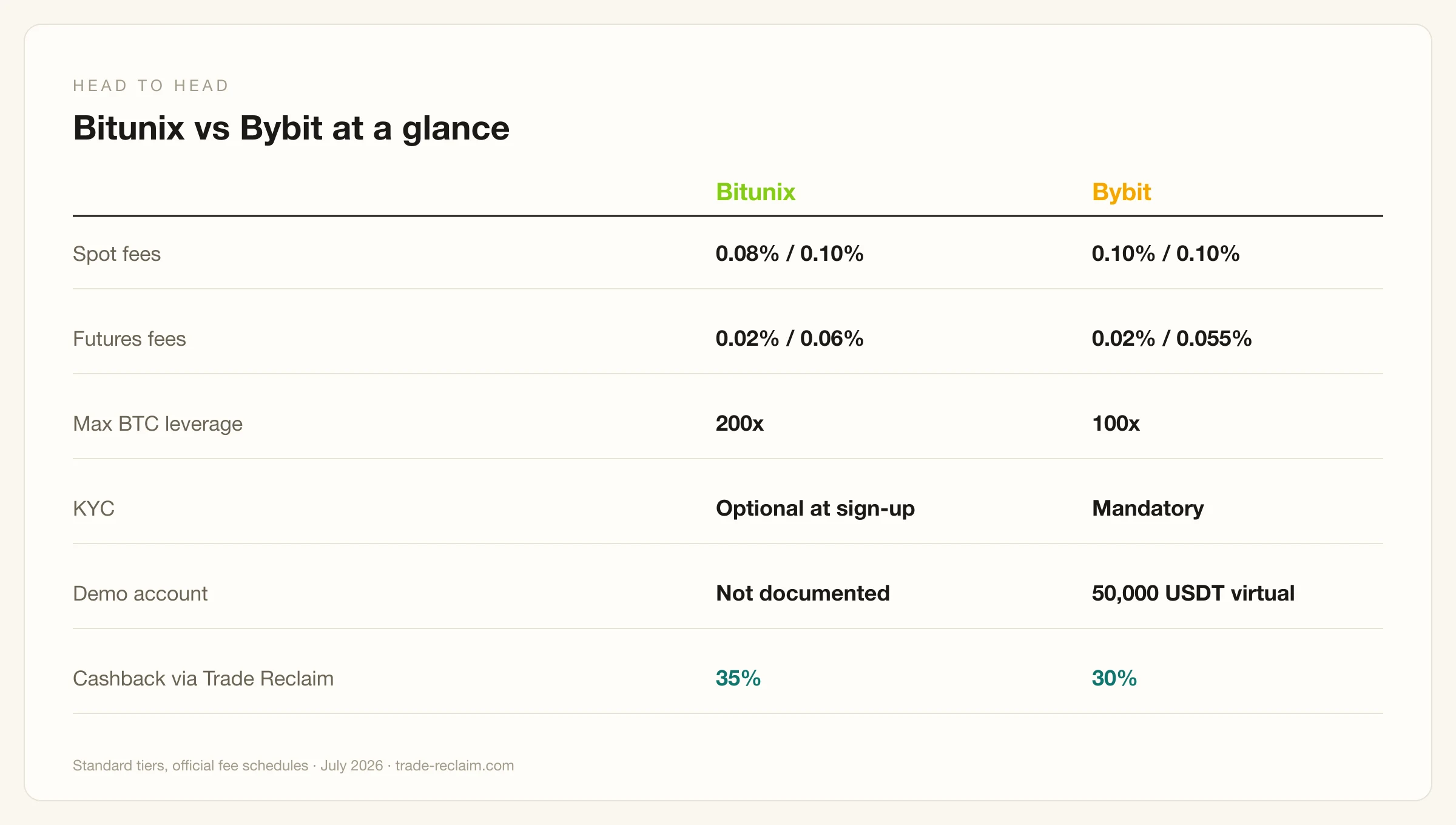
Put the schedules side by side and the pattern is clear: Bitunix wins spot on price, Bybit edges futures taker, and everything else is a philosophy choice. The table shows the standard tier for both venues; VIP ladders lower both as volume grows, and the last row is the one most comparisons skip: the cashback rate that applies to every fee on the schedule.
| Criteria | Bitunix | Bybit |
|---|---|---|
| Spot fees (standard) | 0.08% maker / 0.10% taker | 0.10% maker / 0.10% taker |
| Futures fees (standard) | 0.02% maker / 0.06% taker | 0.02% maker / 0.055% taker |
| Max BTC leverage | 200x | 100x |
| Markets | ~840 spot / ~670 perpetuals | ~600 spot / ~685 perpetuals |
| KYC | Optional at sign-up | Mandatory |
| Demo trading | Not documented | Official, 50,000 USDT virtual |
| Licences | None (offshore) | MiCA (EU), Dubai VARA / UAE SCA |
| US residents | Not served | Not served |
| Cashback via Trade Reclaim | 35% of every fee | 30% of every fee |
Centralized platforms vs decentralized exchanges: where these two fit
Both Bitunix and Bybit are centralized exchanges, and it is worth being precise about what that means before comparing them to decentralized exchanges. A CEX holds custody of your funds, runs an orderbook with professional market makers, and charges fixed or volume-tiered fees; a DEX leaves keys in your wallet, replaces the orderbook with liquidity pools, and adds a blockchain gas fee to every swap. For leveraged futures with tight spreads and instant execution, centralized venues still dominate on cost and depth, which is why this comparison exists at all. The honest counterpoint: custody is the price. Bybit answers that with licences, monthly reserve audits and a proven crisis response; Bitunix answers with audits and a 1:1 reserve claim but a shorter history. On either platform, the working rule is the same: keep long-term holdings in self-custody and treat exchange balances as trading capital.
Trading strategies for beginners: which platform supports you better?
For a first year of trading, the platform matters less than the habits it enables, and here the two differ sharply. Bybit is the better classroom: the official demo account lets you rehearse entries, stops and position sizing with 50,000 virtual USDT before a cent is at risk (why that matters is covered in our demo trading guide), and mandatory KYC plus conservative leverage caps remove some of the ways beginners hurt themselves. Bitunix is the sharper tool: 200x leverage and instant onboarding are exactly what an experienced futures trader wants and exactly what a beginner should not touch in month one. Copy trading exists on both, and the same warning applies on both: a busy lead trader generates fees on every mirrored position, so vet track records over months, not weeks. Whatever strategy you run, start with maker orders where your setup allows, keep leverage far below the maximum, and let the fee schedule, not the adrenaline, pick your order types.
When Bybit is the better call
Bitunix wins this comparison on fees and on no-KYC access, but Bybit is the better home for two kinds of trader. If you need deep order books on majors at size, Bybit's liquidity is in a different class and the slippage you avoid outweighs the fee gap. If you are an EU resident who wants a MiCA-regulated venue, Bybit's migration to bybit.eu gives you something Bitunix does not offer at all. The reverse is just as true and worth saying: if your priority is starting without identity verification, or your position sizes are modest enough that liquidity depth never binds, the fee advantage is real and Bitunix is the rational pick. Neither answer is universal, it depends on which constraint actually binds for you.
Verdict: who should pick which?
Pick Bybit if you want the institution: licences, liquidity, a real demo and a custody record proven under fire. Pick Bitunix if you want the edge: cheaper spot, 200x leverage and sign-up without upfront KYC. Neither serves US residents, so for American readers this comparison is academic; both also restrict several other regions, so check the official lists against your passport before funding anything. And whichever side you land on, the fee schedules above are not the end of the story: through Trade Reclaim, 35% of every Bitunix trading fee comes back in USDT, and on Bybit it is 30%, working from your public UID with no API keys and no account access. Run your own numbers in the cashback calculator and let the net rate, not the sticker rate, decide.
Trading on either one? Get a share of every fee back
Connect Bitunix or Bybit to Trade Reclaim with your public UID and every trading fee earns cashback in USDT: 35% on Bitunix, 30% on Bybit, withdrawable anytime. No API keys, no account access, and it stacks with VIP tiers.
Frequently asked questions
Is Bitunix or Bybit cheaper?
On spot, Bitunix: 0.08% maker against Bybit's 0.10%. On futures they match at 0.02% maker, and Bybit takes 0.055% taker against Bitunix's 0.06%. After cashback the net rates move again: 35% back on Bitunix versus 30% on Bybit, so run both through the calculator for your own mix of maker and taker flow.
Which is safer, Bitunix or Bybit?
Bybit has the stronger case: a MiCA licence in the EU, Dubai regulation, monthly audited proof of reserves and a 2025 hack it absorbed without any user losing funds. Bitunix publishes Hacken-audited reserves and claims 1:1 backing, but has a shorter history and no tier-1 licence. Neither replaces self-custody for long-term holdings.
Does Bitunix require KYC like Bybit does?
No. Bybit makes identity verification mandatory for all products. Bitunix lets you register and trade without upfront KYC, but since 1 July 2026 withdrawals require completing identity verification, so plan to verify before cashing out.
Can US traders use Bitunix or Bybit?
No. Both exchanges exclude the United States in their terms, alongside several other regions (both also exclude mainland China, Singapore and Hong Kong; Bitunix additionally excludes Canada, the UAE and France). US readers looking for regulated venues should compare CFTC-regulated platforms instead.
Which platform is better for beginners?
Bybit, mostly because of the official demo account with 50,000 USDT in virtual funds and its more conservative leverage caps. Bitunix's 200x leverage and instant onboarding suit experienced futures traders, not first-year accounts.
How does cashback work on these two exchanges?
Sign up through Trade Reclaim's link, paste your public UID once, and every trading fee earns cashback in USDT: 35% on Bitunix, 30% on Bybit, withdrawable anytime. No API keys, no account access, and it works with copy trading and bots too.
Trade Reclaim earns from exchange referrals and shares most of it back to you as cashback. Education, not financial advice.