
Bybit vs Bitget: Which Platform Fits Your Trading?
Two top-five derivatives venues, one real regulatory gap between them, and a copy-trading crown that belongs clearly to one side. Here is the honest head-to-head on fees, licenses, security records and demo accounts, plus the cashback layer that applies to both.
- Futures fees are nearly level: 0.02% maker on both, with Bybit's 0.055% taker just under Bitget's 0.06%; spot is 0.10% both sides on both venues.
- The regulatory gap is real in 2026: Bybit holds a MiCA license and serves the EU via bybit.eu, while Bitget has only applied in Austria and lost access to French users in March 2026.
- Bitget counters with copy trading, its flagship discipline, a Protection Fund it keeps at $300 million or more, and 125x max BTC leverage versus Bybit's 100x.
- Both publish monthly proof of reserves, both require KYC for trading, and both run official demo modes with roughly 50,000 in virtual funds.
- Both have been hacked, and both absorbed the loss: Bybit took crypto's largest-ever hack in 2025 and made every user whole; Bitget lost $388 million from hot and warm wallets in September 2026, covered it from its Protection Fund and says user balances were not affected.
- Trade Reclaim pays 30% of trading fees back in USDT on both exchanges, from your public UID, so the net-cost race stays as close as the sticker race.
Bybit vs Bitget is closer than most comparisons admit, and the differences that matter are not the ones in the headline fee table. One of these exchanges can legally serve the whole EU in 2026 and the other currently cannot, one holds the clear copy-trading crown, and both will hand a third of your trading fees back if you set the account up right. Here is the whole picture.
Bybit in brief: features and user experience
Bybit is one of the world's largest derivatives venues and increasingly competes on trust rather than just scale. It is MiCA-licensed through its Austrian entity and serves the EU on bybit.eu, holds a full virtual-asset license from the UAE's SCA, and publishes monthly Hacken-audited proof of reserves. Its defining moment came in February 2025, when it absorbed the largest hack in crypto history, roughly $1.5 billion in ETH, closed the gap within days and made every user whole; the full story is in our is Bybit safe analysis. Day to day, Bybit runs around 600 spot pairs and roughly 685 perpetuals with some of the deepest order books in the market, caps BTC leverage at a saner 100x, and requires KYC for everyone. Its demo account loads 50,000 virtual USDT plus BTC and ETH, rechargeable whenever the balance runs low. Fees sit at 0.10% both sides on spot and 0.02%/0.055% on futures, dissected in our Bybit fees guide. App ratings run 4.7 on the App Store across some 47,000 reviews.
Bitget in brief: features and user experience
Bitget, founded 2018 and claiming over 120 million users, built its identity around one discipline: copy trading, where it is the market's reference platform, letting newcomers mirror elite traders and letting those traders earn a share of copied profits. Around it sits a serious exchange: 800+ spot pairs, deep perpetual markets, up to 125x leverage on BTC, a monthly Merkle-tree proof of reserves that targets ratios above 100%, and a Protection Fund it keeps at $300 million or more. Security record: on 24 September 2026 attackers drained about $388 million from Bitget's hot and warm wallets. Bitget covered the loss from the Protection Fund, says user balances were not affected and had reopened all withdrawals by 2 October, as our Bitget withdrawal guide explains. Earlier, in 2025, a group of user accounts manipulated the VOXEL pair, which Bitget rolled back within 24 hours while compensating affected users. KYC has been mandatory since late 2023, an official futures demo with virtual USDT is auto-enabled for every account, and the BGB token cuts spot fees by 20%, to 0.08%, though notably not futures fees. Standard fees are 0.10% both sides on spot and 0.02%/0.06% on futures, covered in our Bitget review and Bitget fees guide. The honest 2026 caveat: MiCA. Bitget has only applied for authorization in Austria, and French users lost access to the global platform in March 2026 while the application is pending. New sign-ups from Germany have been closed since 16 January 2026.
Bybit vs Bitget: the numbers side by side
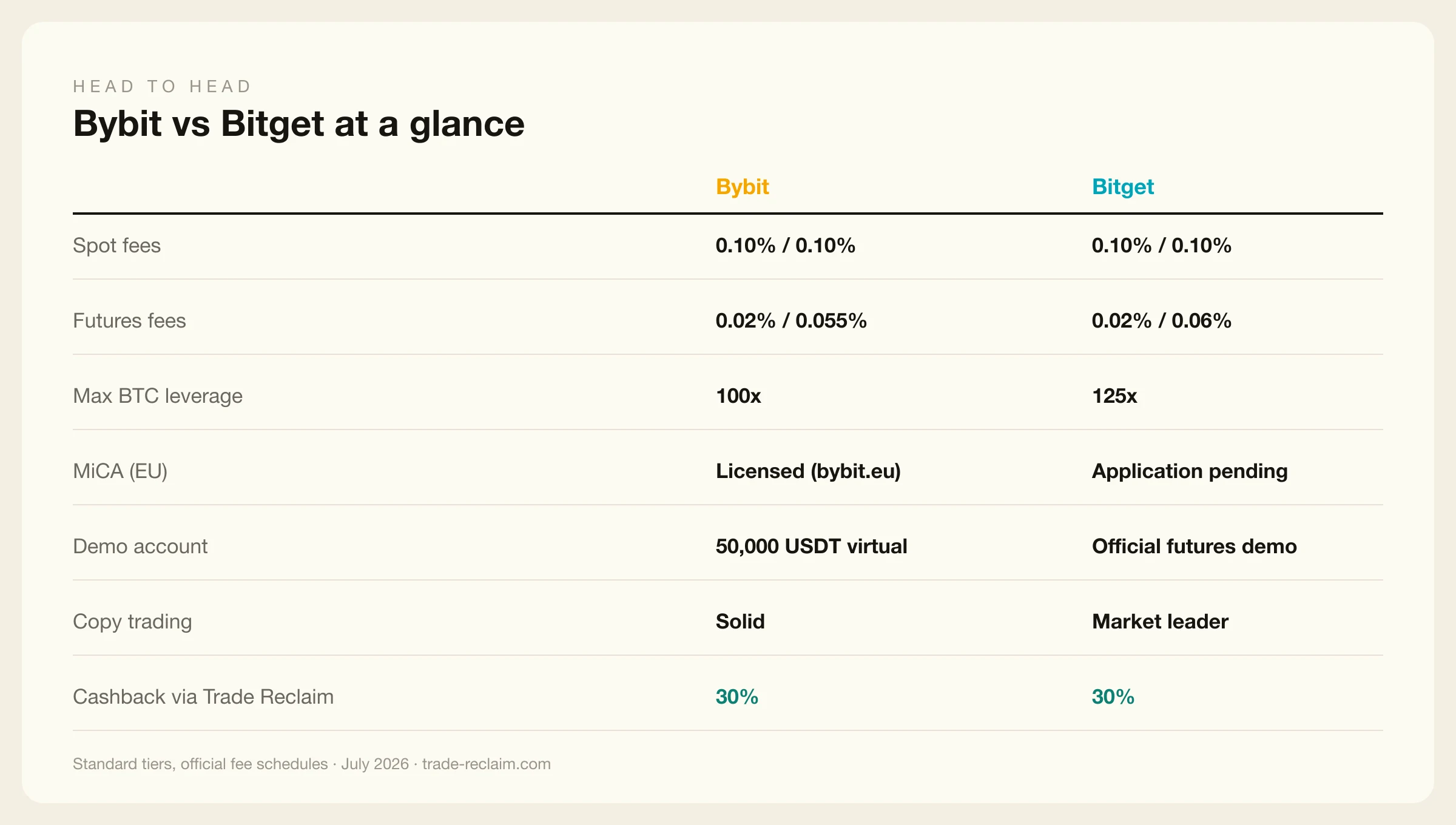
Put the schedules next to each other and the pattern is clear: the sticker prices are nearly identical, so the decision lives in licenses, copy trading and leverage, not fees. The table shows both venues' standard tiers; VIP ladders lower both as volume grows, and the last row is the one most comparisons skip: the cashback rate that applies to every fee on the schedule.
| Criteria | Bybit | Bitget |
|---|---|---|
| Spot fees (standard) | 0.10% maker / 0.10% taker | 0.10% maker / 0.10% taker (0.08% with BGB) |
| Futures fees (standard) | 0.02% maker / 0.055% taker | 0.02% maker / 0.06% taker |
| Max BTC leverage | 100x | 125x |
| Markets | ~600 spot / ~685 perpetuals | 800+ spot pairs |
| MiCA (EU) | Licensed (Austria), bybit.eu | Application pending; France blocked, no new sign-ups from Germany |
| Demo trading | Official, 50,000 virtual USDT | Official futures demo, virtual USDT |
| Copy trading | Solid, 10% base profit share | Market leader, flagship feature |
| KYC | Mandatory | Mandatory |
| Cashback via Trade Reclaim | 30% of every fee | 30% of every fee |
Copy trading: the discipline that separates them
If copy trading is why you are choosing, this section is the comparison. Bitget made it the center of the product: the largest elite-trader pool in the market, granular stats on every lead trader, and tooling refined over years as the company's flagship feature. Bybit's copy trading is competent and integrated well with its deeper derivatives books, with lead traders earning a base 10% share of copied profits, but it is one feature among many rather than the product's identity. Two honest warnings apply to both platforms equally. First, a busy lead trader generates a fee on every mirrored entry and exit, so check a leader's trade frequency before copying, and judge track records in months, not weeks. Second, copied volume is still your volume, which cuts both ways: it accumulates toward VIP tiers, and every fee it generates earns cashback, so a copy-trading account connected to Trade Reclaim quietly claws back 30% of costs the copying creates.
For beginners: which platform teaches you faster?
Both run official demo modes, which already puts them ahead of much of the market, so the beginner question is about guardrails and graduation. Bybit's case: a demo account preloaded with 50,000 virtual USDT that recharges when depleted (why that matters is in our demo trading guide), a more conservative 100x leverage ceiling, and the deepest liquidity for clean fills when you go live. Bitget's case: the demo is equally official, and copy trading offers a middle rung between simulation and solo trading, letting you risk small amounts while studying how experienced traders size and exit positions, discipline you cannot learn from a chart alone. Whichever you pick: start on maker orders where your setup allows, keep leverage far below the ceiling either venue advertises, and let the fee schedule, not adrenaline, choose your order types.
When Bitget is the better call
Bybit takes this on raw liquidity, but Bitget is the better platform if copy trading is central to how you operate. Bitget's copy-trading product is deeper, has a longer track record and a larger pool of lead traders, and if you are allocating to other people's strategies that matters far more than a fractional difference in taker fees. Bitget also earns the nod if you want one venue for both spot and derivatives without switching interfaces, and its promotional calendar tends to be more generous to smaller accounts. Pick Bybit when you are placing your own orders at size; pick Bitget when you are following, learning, or splitting capital across strategies.
Verdict: who should pick which?
Pick Bybit if regulation, liquidity depth or EU residence matter: it is the one with a MiCA license today, the deeper books, and a custody record proven under the worst fire in crypto history. Pick Bitget if copy trading is your strategy or you want the higher leverage ceiling and the BGB spot discount. EU readers barely have a choice for now: until Bitget's Austrian application lands, Bybit is the compliant path, and French users cannot access Bitget's global platform at all. Neither serves US residents. And whichever side you land on, the sticker fees are not the end of the story: through Trade Reclaim, 30% of every trading fee comes back in USDT on both exchanges, from your public UID, with no API keys and no account access. Run your own numbers in the cashback calculator and let the net rate, not the brand, decide.
Trading on either one? Get a share of every fee back
Connect Bybit or Bitget to Trade Reclaim with your public UID and every trading fee earns 30% cashback in USDT, withdrawable anytime. No API keys, no account access, and it stacks with VIP tiers and the BGB discount.
Frequently asked questions
Which is cheaper, Bybit or Bitget?
They are nearly identical on paper: spot is 0.10% both sides on both, futures makers pay 0.02% on both, and takers pay 0.055% on Bybit versus 0.06% on Bitget. BGB holders get spot down to 0.08% on Bitget, futures excluded. With 30% cashback on both via Trade Reclaim, the net gap stays as thin as the sticker gap.
Which is safer, Bybit or Bitget?
Both publish monthly proof of reserves and require KYC. Bybit holds more licenses, including MiCA, and proved its custody by absorbing crypto's largest-ever hack in 2025 with every user made whole. Bitget lost $388 million from hot and warm wallets in September 2026, covered the loss from its Protection Fund, which it keeps at $300 million or more, and says user balances were not affected. Neither replaces self-custody for long-term holdings.
Can EU residents use Bitget?
Only partially right now. Bitget has applied for MiCA authorization in Austria but is not yet licensed, and French users lost access to the global platform in March 2026. Bybit, by contrast, is MiCA-licensed and serves the EU through bybit.eu.
Which platform is better for copy trading?
Bitget, and it is not close: copy trading is its flagship discipline with the market's largest elite-trader pool. Bybit's implementation is solid and benefits from deeper derivatives liquidity, but it is a feature, not the product's identity. On both, check a lead trader's fee-generating trade frequency before copying.
Do Bybit and Bitget have demo accounts?
Yes, both officially. Bybit preloads a demo with 50,000 virtual USDT plus BTC and ETH and recharges it on request; Bitget auto-enables a futures demo with virtual USDT for every user. That makes either a reasonable place to practice before going live.
How does cashback work on these two exchanges?
Sign up through Trade Reclaim's link and enter your public UID once per exchange. Every trading fee then earns 30% back in USDT, withdrawable anytime. No API keys and no account access are needed, and copied trades count too.
Trade Reclaim earns from exchange referrals and shares most of it back to you as cashback. Education, not financial advice.