What Is AI Arbitrage? The Honest Math Behind the Hype
AI arbitrage means 2 different things depending on who is selling it to you: a trading strategy and a business model. Here is what each one actually is, the math that decides whether the trading version makes money, and the red flags that mark the scam version.

- AI arbitrage has 2 meanings: using machine-learning models to find and trade price differences across markets, and reselling existing AI tools to businesses as a service (the agency model).
- In the trading sense, the AI finds inefficiencies faster than a human. It does not remove the 2 costs that decide profitability: fees and slippage.
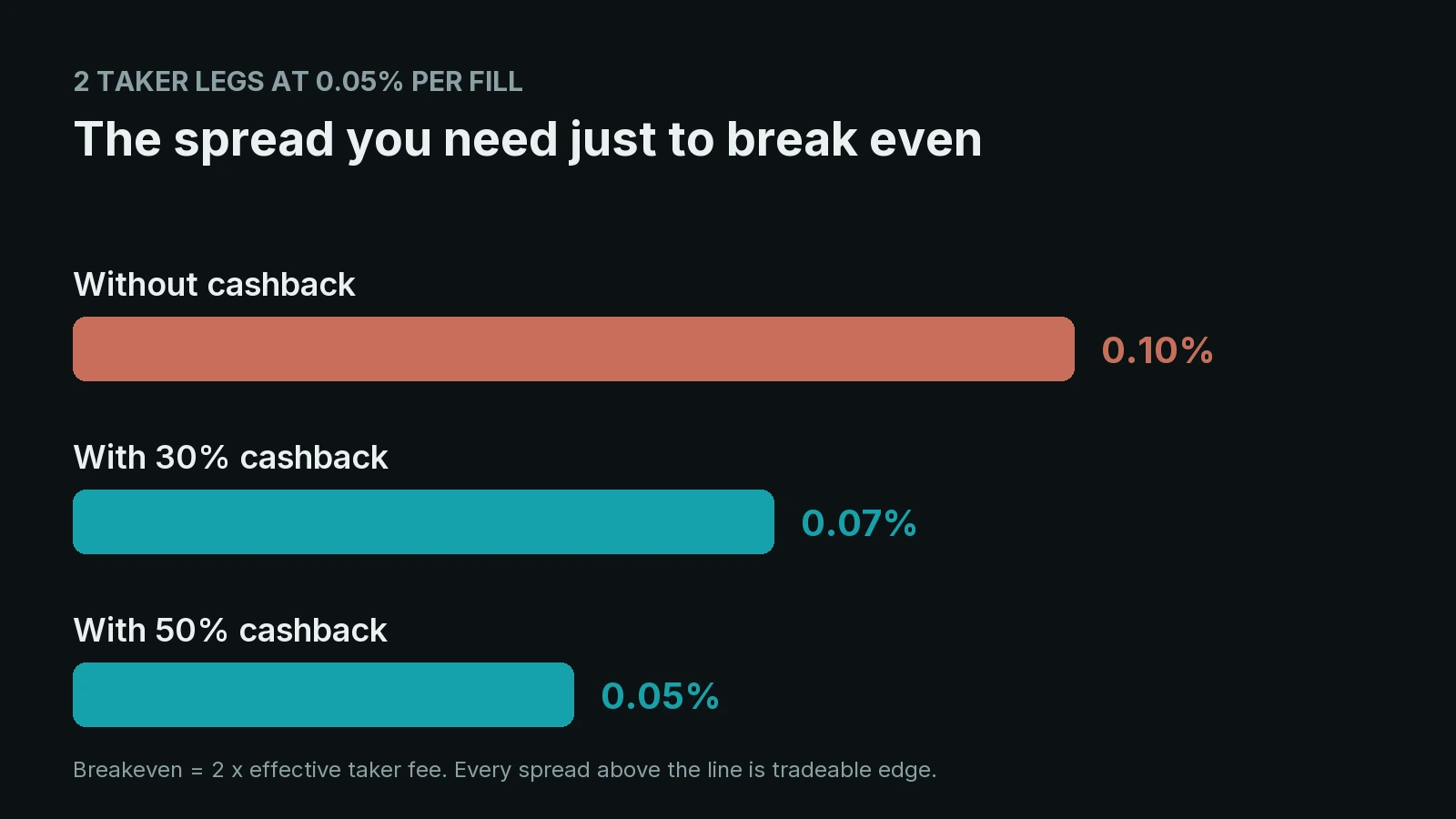
- A cross-exchange trade with 2 taker legs at 0.05% each needs a 0.10% spread to break even before slippage. 30 to 50% fee cashback lowers that bar to 0.07% or less.
- Any AI arbitrage offer that wants your deposit on a third-party platform and promises fixed daily returns follows the scam pattern. Real bots trade on your own exchange account.
Somewhere in your feed right now, an account is promising that its AI arbitrage bot pays 2% a day, risk-free, if you deposit USDT with them. Meanwhile, real arbitrage desks fight over price gaps of 0.2% and lose that fight whenever fees eat the spread. Both worlds call themselves AI arbitrage. Only one of them is trading.
What is AI arbitrage?
AI arbitrage is the use of machine-learning models to spot and exploit price differences for the same asset across markets, faster and at larger scale than a human could. The model scans prices on dozens of venues at once, flags the moment Bitcoin trades at 100,000 USDT on one exchange and 100,250 on another, and fires both legs of the trade before the gap closes. Arbitrage itself is as old as markets. The AI part is the speed and the pattern recognition.
A second, unrelated thing is sold under the same name: the AI arbitrage business or agency, meaning buying access to existing AI tools and reselling them to companies as a packaged service. That model is consulting, not trading, and never touches a market. This article covers the trading meaning, and one section below covers how to tell either apart from the scams that borrow the label.
The 3 real forms of AI arbitrage trading
Cross-exchange, triangular and statistical arbitrage cover practically everything real that trades under the AI arbitrage label. Cross-exchange (spatial) arbitrage buys an asset where it is cheap and sells it where it is expensive, across 2 venues at once. Triangular arbitrage rotates through 3 pairs on 1 exchange, USDT to BTC to ETH and back to USDT, when the 3 prices briefly disagree. Statistical arbitrage trades the historical relationship between correlated assets, betting that a stretched spread snaps back.
All 3 share one profile: tiny edges, high frequency, and profitability that lives or dies on execution costs. A model that finds 40 opportunities a day at 0.15% gross edge produces nothing if each trade costs 0.12% to execute. That cost structure, not the intelligence of the model, is where most retail arbitrage dies.
The 4th form: funding-rate arbitrage
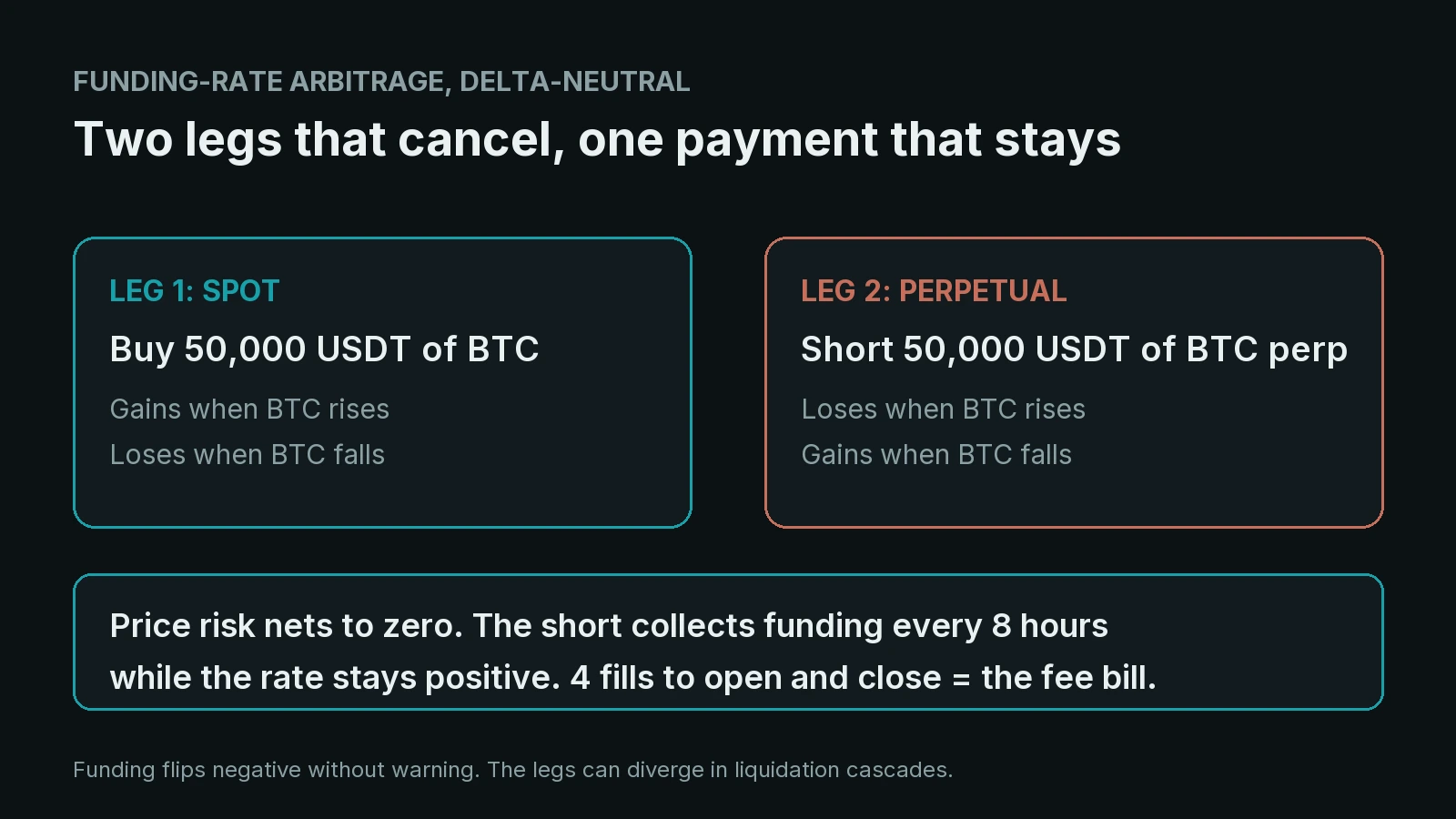
Funding-rate arbitrage holds a spot position against an opposite perpetual position and collects the funding payments, and AI models increasingly pick which pairs and hours to run it. When a perpetual trades above its index, longs pay shorts a funding fee, every 8 hours on most exchanges. Buy 50,000 USDT of BTC spot, short 50,000 USDT of the BTC perpetual, and the price risk nets out while the funding accrues to you for as long as the rate stays positive.
It is the slowest and most retail-viable of the 4 forms, and it is not free money. Opening costs 4 fills (spot buy, perp short, and 2 more to unwind), funding flips negative without asking, and the 2 legs can diverge during liquidation cascades. The fee math is the same as everywhere else in this article: 4 fills at taker rates start you 0.20% behind on the position, which is 2 to 3 weeks of typical funding income, and cashback claws back 30 to 50% of exactly that cost.
What the AI actually does, and what it cannot do
The model widens your search and shortens your reaction time. It cannot negotiate your fees, remove slippage, or create spreads that are not there. Machine learning earns its keep in 3 places: scanning more venues and pairs than any human dashboard, judging which gaps are real versus stale order-book data, and sizing trades against the liquidity that is actually available. Those are real advantages.
What the marketing leaves out: professional desks run the same models against the same gaps, with faster connections and lower fees than any retail setup. The gaps that survive long enough for a retail bot to catch are small and shrink every year. Whatever edge remains after that competition is then split with your exchange through fees, which is why the cost side deserves more of your attention than the model.
The math: fees decide whether AI arbitrage is profitable
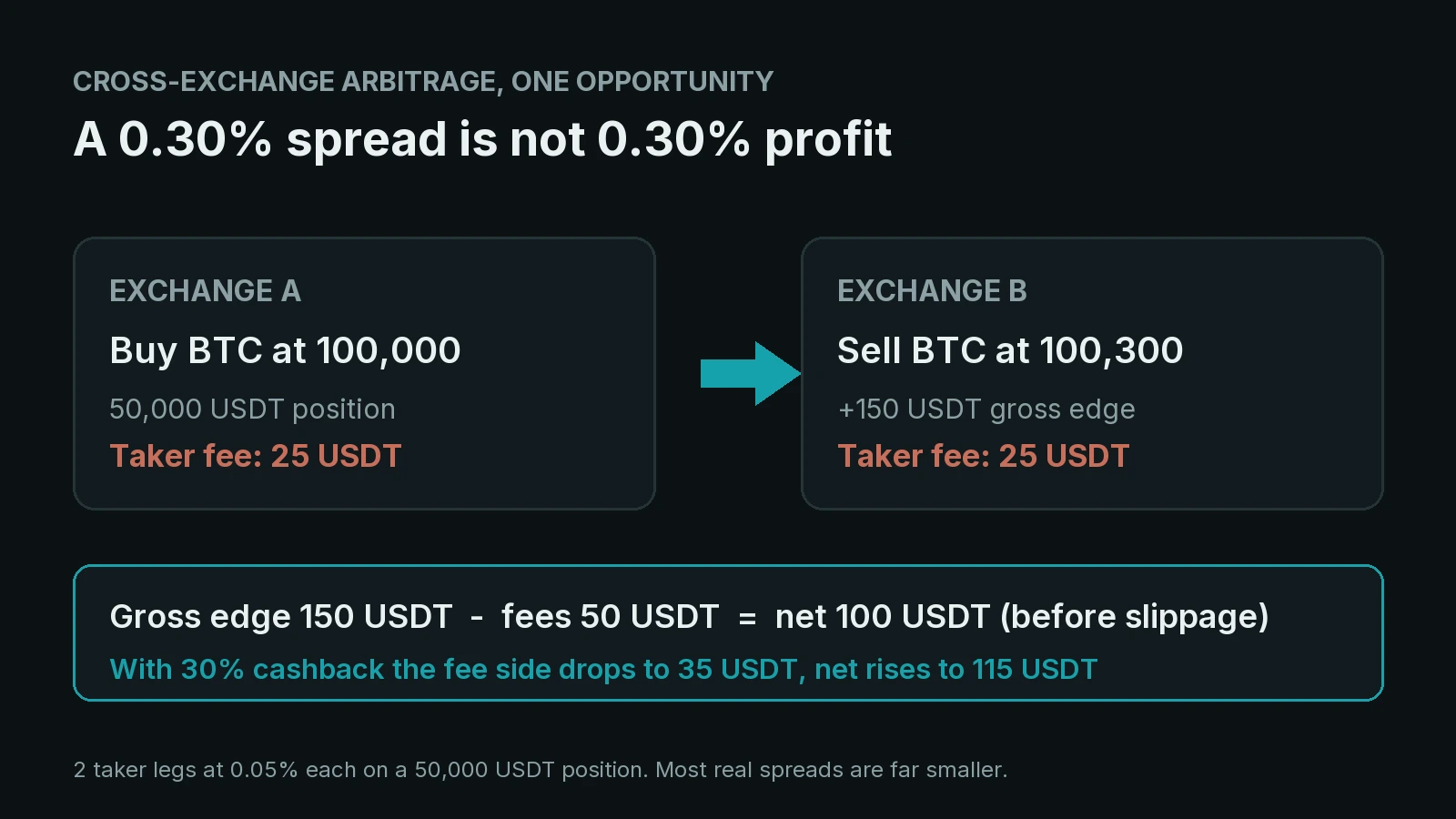
A 2-leg cross-exchange trade at 0.05% taker per fill needs a 0.10% price gap to break even on fees alone, before slippage and transfer costs. Say the model spots BTC at 100,000 USDT on exchange A and 100,300 on exchange B, a 0.30% spread. Buying 50,000 USDT worth on A costs 25 USDT in taker fees, selling on B costs another 25. That is 50 USDT of the 150 USDT gross edge gone to fees, a third of the profit, on a spread far wider than what the model finds on most days.
Now run the same trade on the spreads that actually appear. At 0.12% gross, fees take 0.10 of the 0.12 and slippage eats the rest. This is why arbitrage operators obsess over fee tiers before they touch model quality, and why 30 to 50% cashback on every fill moves the breakeven line itself: 2 taker legs at an effective 0.035% each (after 30% cashback on a 0.05% fee) break even at 0.07% instead of 0.10%. Every spread between those 2 lines is profit that only exists on the lower cost base.
A realistic month of AI arbitrage, in numbers
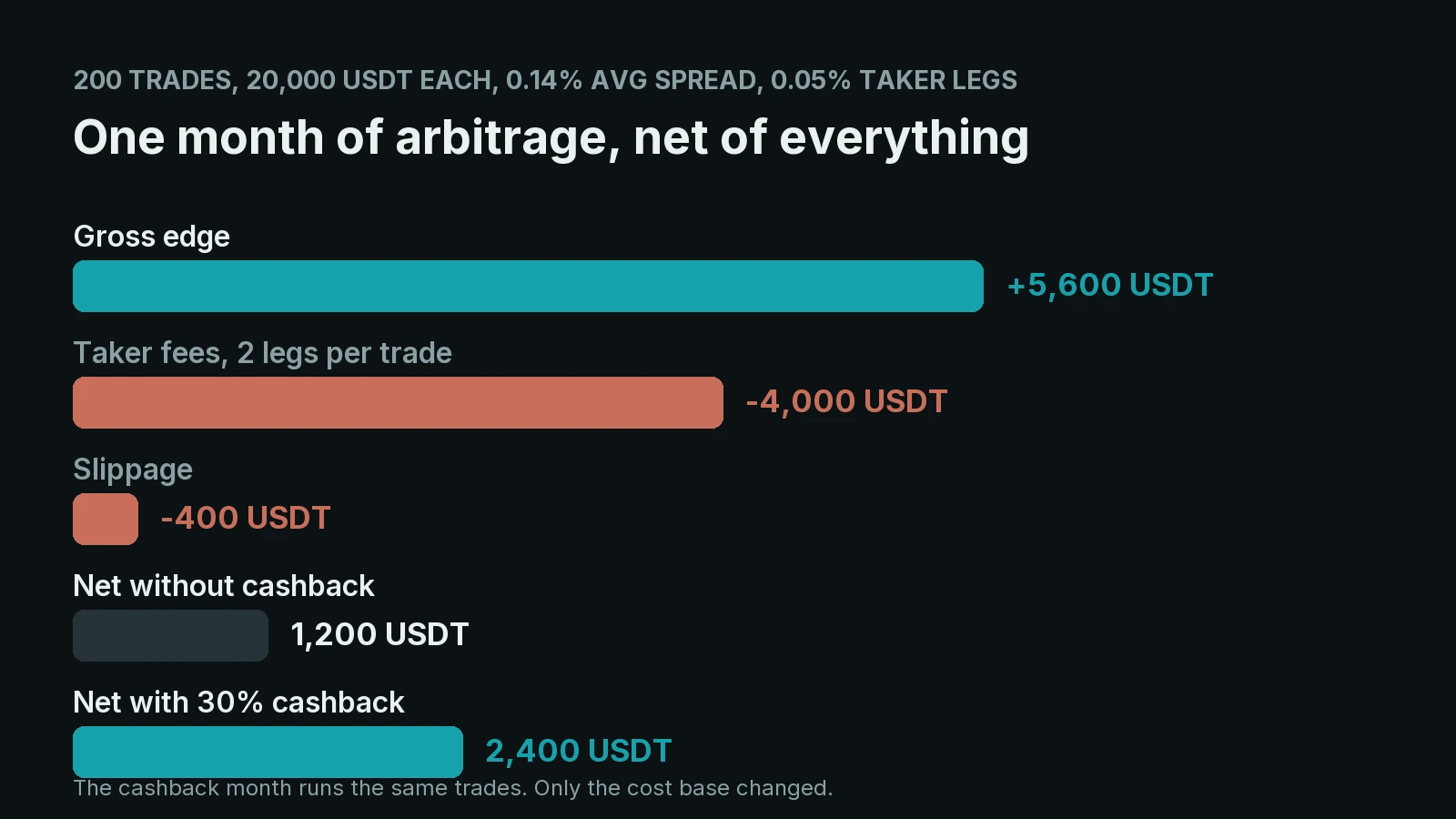
Run the whole strategy on paper before running it live: 200 executed opportunities at 0.14% average gross spread, 2 taker legs each at 0.05%, on 20,000 USDT per trade. Gross edge: 200 x 20,000 x 0.14% = 5,600 USDT. Fees: 200 x 2 legs x 20,000 x 0.05% = 4,000 USDT. Slippage at a conservative 0.01% average per opportunity takes another 400. Net before infrastructure: 1,200 USDT on 4,000,000 USDT of executed volume.
Now the same month with 30% cashback: the 4,000 USDT fee bill returns 1,200 USDT, doubling the net to 2,400. That is the entire argument for treating fees as the first variable in arbitrage, not the last: in a business where fees consume 70% of gross edge, a 30% rebate on fees is worth as much as the strategy's whole first-pass profit. The model found identical opportunities in both months. The cost base decided the outcome.
Change any assumption and the numbers move hard: at 0.06% taker legs the strategy loses money before cashback, and at 0.10% average spreads it prints. That sensitivity, not any single month's result, is the real finding. Fee tier, venue choice and rebates are not optimisations of an arbitrage business, they are the business.
How to tell real AI arbitrage from a scam
The test is custody: real arbitrage runs on your own exchange account, scam arbitrage asks you to send funds to theirs. The pattern is consistent enough that the SEC published an investor alert on AI-branded investment fraud: a platform demonstrates an AI bot with promised daily returns of 1 to 3%, lets you withdraw small amounts early to build trust, then blocks withdrawals once the deposits get large. The AI in these schemes is a login screen.
The checklist that filters nearly all of it: fixed or promised returns mean scam, because real arbitrage profit varies daily and is sometimes negative. Deposits to a third-party platform mean scam, because legitimate bots trade through API keys on your own account. Unverifiable track records mean scam. Pressure to recruit friends means the arbitrage is you. Nothing about a legitimate setup requires your money to leave your own exchange account.
The other AI arbitrage: the agency model
The AI arbitrage agency model has nothing to do with trading: it means buying access to existing AI tools and reselling them to businesses as a managed service. The pitch runs on the gap between what AI tooling costs (subscriptions in the low hundreds per month) and what businesses pay for outcomes (marketing packages in the thousands). The arbitrage is the margin between those 2 numbers, plus your time.
Judged as a business, it is service reselling with an AI label, legitimate, competitive, and entirely dependent on sales skill rather than any algorithm. Judged as what the courses selling it imply, an automated income stream, it is oversold: the recurring revenue claims in AI arbitrage course marketing are the course seller's arbitrage, not yours. If you searched for AI arbitrage meaning this model, the honest summary is: real, hard work, unrelated to markets, and nothing on this page's fee math applies to it.
What you need to run AI arbitrage legitimately
Accounts on 2 or more exchanges, API keys with trade-only permissions, software you control, and the lowest taker fees you can get. Tooling ranges from open-source frameworks to commercial bots, and our guide to trading bot profitability covers the fee side of running any of them. Pre-fund both venues so you never wait on transfers, start on paper trading, and measure everything net of fees from day 1.
Then work the cost base in order: pick venues by taker fee (our fee comparison lists all 10 majors side by side), check whether your volume reaches a VIP tier, and put cashback under all of it, 30 to 50% of every fill back, maker and taker. An arbitrage operation is a fee-management business that happens to trade. Treat it that way and the model gets a chance.
The honest odds for retail AI arbitrage
Most retail AI arbitrage setups lose money net of fees, and the ones that work tend to work small. You are competing with desks that co-locate servers next to exchange matching engines, pay negative maker fees, and spend engineering payroll on microseconds. What survives for retail: slower statistical strategies, less crowded pairs, venues with genuinely different liquidity profiles, and relentless cost control. What does not survive: paying 0.06% taker against professionals paying 0.01%.
If you want the space anyway, go in with capital you can afford to lose while it teaches you, expectations set by the math above, and zero deposits to anyone promising returns. The one edge you control from day 1 is cost, and cost compounds in your favour on every single fill.
Cut the cost side before you trust any model
Whatever bot or strategy you run, 30 to 50% of every trading fee comes back with cashback, on maker and taker fills, across all 9 supported exchanges. See what your volume would return.
Frequently asked questions
Is AI arbitrage legit?
AI arbitrage is a legitimate trading approach when it means running software you control against exchange accounts you own; market makers and quant funds have traded this way for decades. The same label is also the most common wrapper for deposit scams, which is why the SEC published an investor alert on AI-branded investment fraud. The custody test separates the 2 in seconds: if your money stays on your own exchange account and the bot only holds trade-permission API keys, it is a strategy. If your money moves to their platform, it is a bet on their honesty, not on any algorithm.
Is crypto arbitrage still profitable in 2026?
For most retail traders, no, not after fees. Spreads on liquid pairs across major exchanges sit under 0.10% most of the day, which is exactly the round-trip fee cost of 2 base-tier taker fills, so the gross edge and the cost cancel out before slippage. What remains profitable concentrates in less liquid pairs, smaller venues, moments of volatility, and operators with a materially lower fee base through VIP tiers and cashback. The strategy is not dead, but the margin now lives in the cost side.
Is arbitrage legal?
Yes. Buying an asset on one market and selling it at a higher price on another is legal in essentially every jurisdiction, and economists treat it as useful because it pushes prices back into line across venues. What is illegal is the fraud that borrows the name: platforms taking deposits for fake AI arbitrage returns. Separately, regional rules still decide which exchanges you may legally use, so the legs of your trade have to run on venues available in your country.
How much capital does AI arbitrage need?
Cross-exchange arbitrage needs capital parked on at least 2 venues at the same time, because the opportunity closes faster than any transfer settles. With a realistic net edge of 0.05% per completed trade, 1,000 USDT of working capital earns 0.50 USDT per opportunity, which is why serious attempts start in the tens of thousands. Triangular arbitrage on a single exchange needs less standing capital but faces the same fee math on 3 legs instead of 2.
Can an AI arbitrage bot steal my funds?
A bot connected through API keys with trade-only permissions cannot withdraw your funds, exchanges separate trade, read and withdrawal rights exactly for this reason. Keep withdrawal permission disabled, restrict the key to whitelisted IPs where the exchange offers it, and revoke keys you stop using. The real theft risk sits with platforms that hold your deposit: once your USDT is on their books, no API setting protects you.
Which fees matter most for arbitrage?
Taker fees, because arbitrage fills have to execute immediately or the gap is gone, and every opportunity costs 2 to 4 of them. At 0.05% per leg, a 2-leg trade starts 0.10% behind; at 0.06% it starts 0.12% behind. The 3 levers that lower the bar, in order of effort: fee cashback (30 to 50% of every fill back, no volume threshold), venue choice (base taker rates range from 0.04% to 0.08% across the majors), and VIP tiers once your volume qualifies.
Trade Reclaim Research tracks trading fees, VIP schedules and rebate programs across 9 crypto exchanges. Every rate in our articles comes from the exchange's official fee schedule and is re-verified on publication. The team trades on the platforms it writes about.
Trade Reclaim earns from exchange referrals and shares most of it back to you as cashback. Education, not financial advice.