Best Crypto Trading Bot in 2026: An Honest Ranking
Most "best bot" lists are affiliate pages that promise profits. This one starts from the uncomfortable truth: no bot is profitable out of the box. Here is what the good ones actually do, what they cost, and how to judge them.

- No bot is profitable by itself. A bot executes your strategy 24/7; if the strategy loses, the bot just loses faster and more consistently.
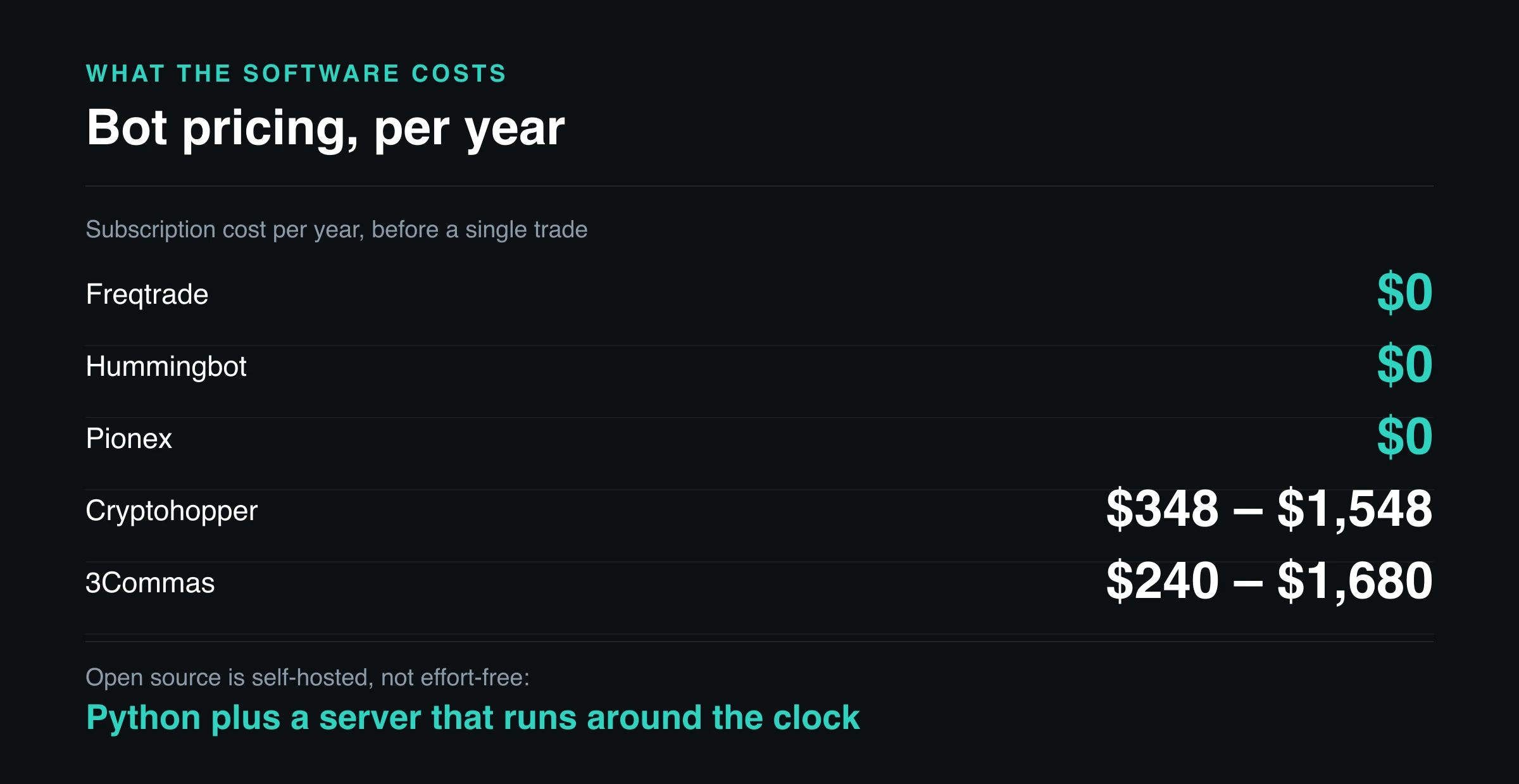
- Open-source bots (Freqtrade, Hummingbot) are free, transparent and self-hosted. Subscription platforms charge $20 to $140 per month before you have earned anything.
- Bots multiply your trade count, so they multiply fee drag. A strategy that survives backtests often dies once real maker/taker fees are applied.
- Any bot, marketplace strategy or Telegram signal that advertises fixed returns is a red flag, not an investment.
- The only edge a bot user can lock in with certainty is lower net fees: maker orders where possible, and cashback on every fill.
Search for the best crypto trading bot and you will find page after page of rankings that all end the same way: a signup link and a promised return. Here is the honest version. There is no bot that reliably makes money out of the box. If one existed, its owner would not sell it to you for $29 a month. What does exist is good software: bots that execute a strategy you define, around the clock, without emotion. This ranking judges them as software, on tooling, transparency, security and cost, and is blunt about where the profit actually comes from, and where it leaks away.
The short answer before the ranking
The best crypto trading bot for most self-directed traders in 2026 is Freqtrade, because it is free, open source and forces you to test your strategy before it can spend your money. If you cannot or do not want to run Python, Pionex gives you exchange-hosted grid and DCA bots with no subscription, and 3Commas is the most complete paid terminal. None of them changes the underlying math of your strategy.
That order is the opposite of what most rankings tell you, and the reason is simple: the less a bot costs and the more it exposes its logic, the higher the chance that what you earn stays yours. A $140 per month subscription needs to clear $1,680 a year in extra profit before it has paid for itself.
Judge every bot on 4 things: can you backtest honestly, can you read or at least fully configure the logic, does it hold your API keys safely, and what does it cost per year including the fees it generates. The ranking below scores exactly that.
The ranking: 5 bots worth your time
1. Freqtrade (free, open source)
A Python framework with backtesting, hyperparameter optimization and dry-run mode, controlled via Telegram or web UI. It has the largest open-source bot community, with over 48,000 GitHub stars after 9 years of development. The honest catch: you need basic Python and a server that runs 24/7. That barrier is a feature. It filters out everyone who wants a magic box, and it makes you test before you trade.

2. Hummingbot (free, open source)
The standard for market making and cross-exchange strategies, with over $34 billion in reported volume across more than 140 venues. Market making is the one bot niche with a real, explainable edge (earning the spread and maker rebates), and also the one where fee tiers decide everything. Same catch as Freqtrade: self-hosted, technical, no hand-holding.

3. Pionex (free bots, exchange-level fees)
16 built-in bots (grid, DCA, arbitrage) hosted directly on the exchange, so there is no subscription and no API-key handling. The trade-off: you are locked to one venue, the strategy logic is a black box, and you pay the exchange's trading fees on every fill, which is where a busy grid bot quietly gets expensive.

4. 3Commas (from $20 to $140 per month)
The most complete multi-exchange terminal: DCA, grid and signal bots, smart orders and portfolio tracking across 15+ exchanges via API keys. It is good software with a real cost problem: the current plans run $240 to $1,680 per year, which a small account cannot realistically out-trade. After a 2022 API-key leak the platform overhauled its key security; treat exchange-side IP whitelisting as mandatory anyway.

5. Cryptohopper (from $29 to $129 per month)
A cloud bot platform known for its strategy designer and its marketplace, where you can rent other people's strategies and signals. The plans cost $348 to $1,548 per year. Be careful with the marketplace: past performance of a rented strategy is marketing material, not evidence, and the sellers earn from subscriptions whether you profit or not.
Why "is it profitable" is the wrong question
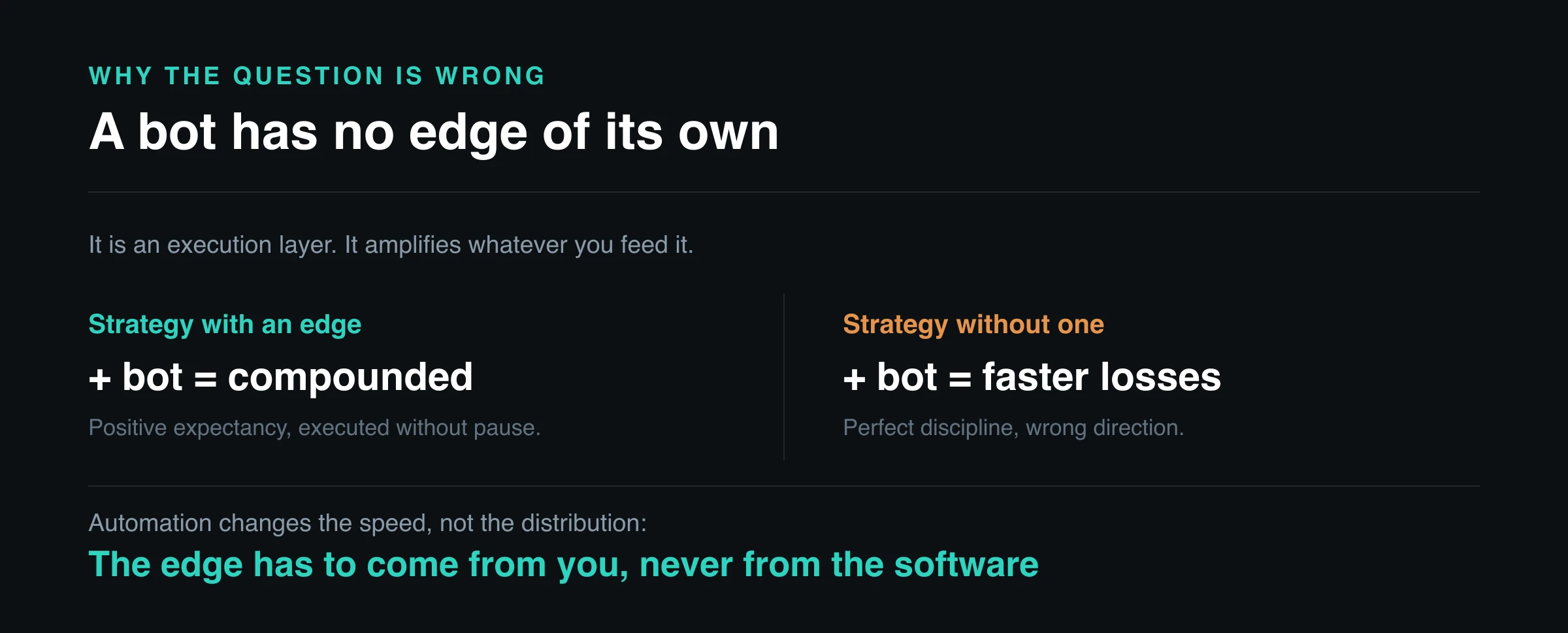
A bot has no edge of its own. It is an execution layer: it does exactly what your strategy says, faster and more consistently than you would. If the strategy has positive expectancy after costs, a bot compounds that. If it does not, the bot executes your losses with perfect discipline, 24 hours a day.
That is why you know no consistently profitable off-the-shelf bot, and neither do we. Public retail studies keep finding the same thing: the large majority of active day traders lose money over time, and automation does not change the distribution, it only changes the speed. Anyone selling you a bot with a published monthly return is selling you the return, not earning it.
What bots are genuinely good at is narrower and still valuable: removing emotion from execution, running range-bound strategies like grids through the night, dollar-cost averaging without forgetting, and market making where the edge is structural. Buy them for that, never for a promised curve.
The real cost: subscriptions plus fee drag
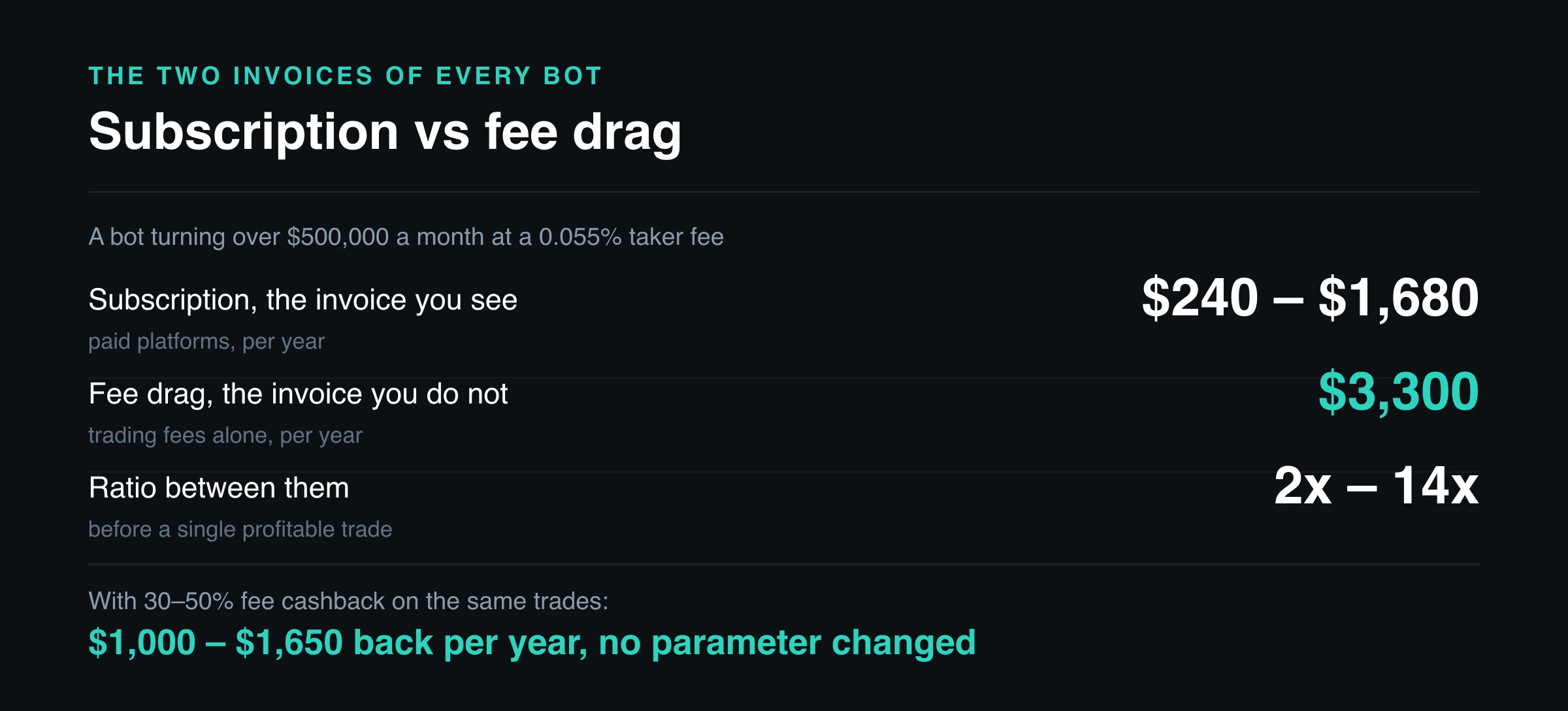
Every bot has two invoices. The visible one is the subscription: $0 for open source, $240 to $1,680 per year for the paid platforms. The invisible one is fee drag, and for an active bot it is the bigger number. A bot that turns over $500,000 a month at a 0.055% taker fee pays about $275 a month, $3,300 a year, in trading fees alone, before it has made a single profitable trade.
Fee drag scales with exactly the thing bots are built to do: trade more. A grid bot in a tight range can fill dozens of times a day. Each fill is a fee. This is why a strategy that looks profitable in a zero-fee backtest so often bleeds out live, and why serious bot runners obsess over maker/taker rates before they obsess over indicators.
You can cut that second invoice without touching the strategy: prefer maker (limit) orders where the strategy allows it, check the fee schedule of Bybit, Bitget or whichever venue your bot trades on, and route the volume through a cashback layer. Trade Reclaim pays back 30 to 50% of every trading fee your API orders generate, in USDT, withdrawable anytime. On the $3,300 example above that is roughly $1,000 to $1,650 a year returned, which is more than most subscriptions cost, earned without changing a single parameter.
Red flags: how bot scams dress up
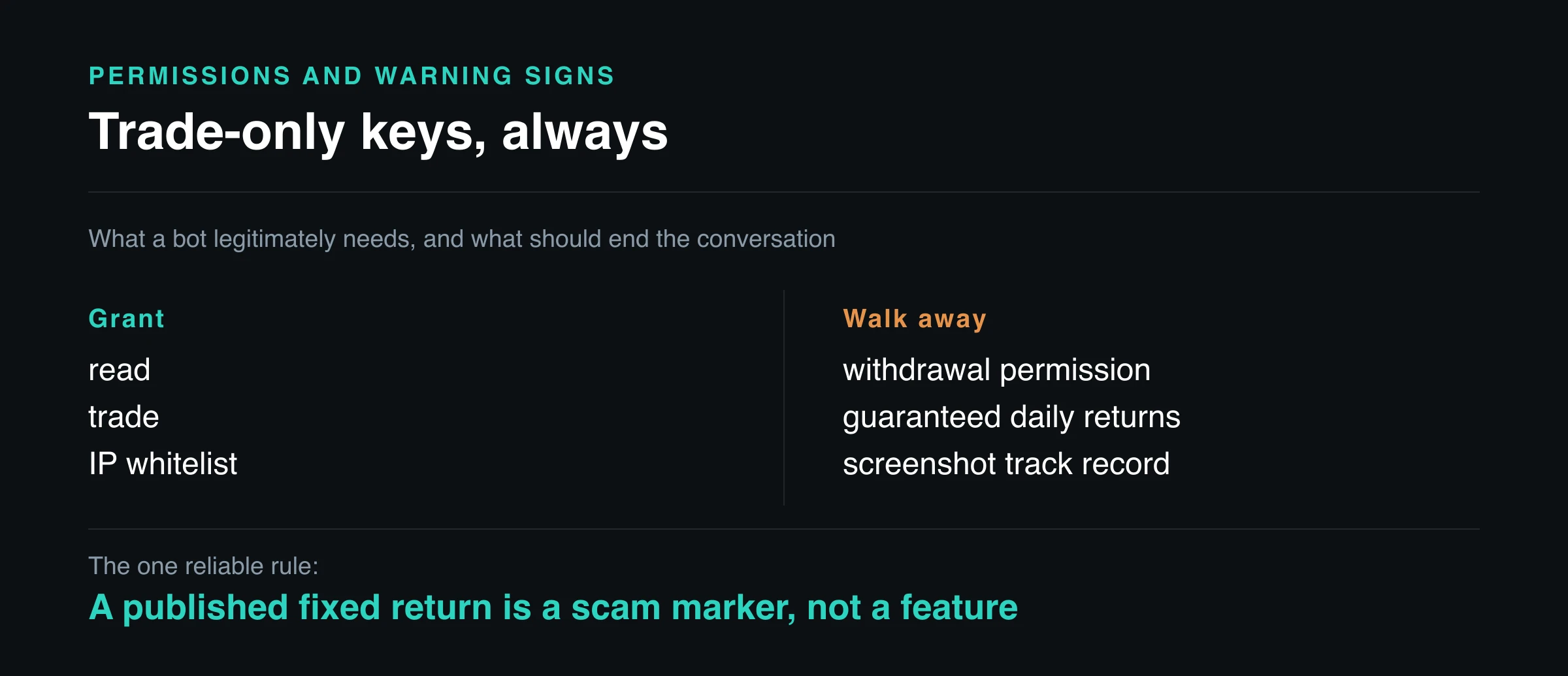
The one reliable rule: a published fixed return is a scam marker. "1 to 2% daily", "guaranteed monthly profit", "AI that never loses": real strategies have drawdowns, and real operators publish risk, not promises. This applies to bots, marketplace strategies, Telegram signal groups and "AI trading" apps equally.
Second tier of warning signs: the bot asks for withdrawal-enabled API keys (execution needs trade permission only, never withdrawal), the operator is anonymous, the "track record" is a screenshot instead of a verifiable exchange statement, or the main product is recruiting other users rather than trading. Any one of these is enough to walk away.
The subtler trap is overfitting: a backtest tuned until it looks perfect on past data and falls apart on new data. Honest tooling shows out-of-sample results and includes fees and slippage in the test. If a platform's backtester assumes zero fees, its results are fiction by design.
How to choose in 10 minutes
Match the bot to what you already have, not to what the landing page promises. You can code or want to learn: Freqtrade, and Hummingbot if market making interests you. You want zero setup and zero subscription: Pionex's built-in bots. You trade actively on several exchanges and want one terminal: 3Commas, on the cheapest plan that covers your exchanges.
Then run the same checklist whatever you picked: paper-trade or dry-run for at least a month, backtest with real fees and slippage switched on, give the bot trade-only API keys with IP whitelisting, start with money you can lose entirely, and write down the kill criteria that make you switch it off.
And before the first live trade, fix the fee side once: maker orders where the strategy allows, a venue whose fee tier fits your volume, cashback on top. It is the only part of bot trading where the outcome is guaranteed.
Cut your bot's biggest cost
Whatever bot you run, every order it fires pays exchange fees. Trade Reclaim pays 30 to 50% of those fees back, in USDT, withdrawable anytime. Connect the exchange account your bot trades on once, and the cashback accrues on every fill, fully automatic.
Frequently asked questions
Is there any crypto trading bot that is actually profitable?
No bot is profitable by itself. A bot is software that executes a strategy; profitability comes from the strategy's edge after fees, which most retail strategies do not have. Bots with published "guaranteed" returns are scams by definition. What a good bot does deliver is disciplined 24/7 execution of whatever edge you bring.
What is the best free crypto trading bot?
Freqtrade for strategy trading and Hummingbot for market making. Both are open source, free to self-host and include honest backtesting. Pionex is the no-code alternative: its 16 bots are free to use and you only pay the exchange's trading fees on fills.
Do trading bots pay higher exchange fees than manual trading?
No. Orders placed via API are charged the same maker/taker rates as manual orders on every major exchange. Bots feel more expensive because they trade more often, so the same rates compound into a bigger fee bill. Fee cashback applies to API orders exactly as it does to manual ones.
Are marketplace strategies and signal subscriptions worth it?
Treat them as entertainment, not investment. Sellers earn from your subscription regardless of your results, displayed track records are rarely verifiable, and strategies tuned on past data routinely fail on new data. If you still try one, size it like a bet you expect to lose.
Can I run a trading bot and still get fee cashback?
Yes. Cashback platforms work at the account level, so every fee your account generates counts, whether a human or a bot placed the order. For high-frequency bots this is usually the single largest cost reduction available: 30 to 50% of every fee back, in USDT, withdrawable anytime.
Trade Reclaim Research analyzes exchange fee schedules, rebate structures and execution costs across the 9 exchanges the platform supports. The team publishes fee math, not price predictions, and every number in this article can be checked against the linked official sources.
Trade Reclaim earns from exchange referrals and shares most of it back to you as cashback. Education, not financial advice.