Is Binance Safe in 2026? What the Record Actually Shows
Binance holds more customer crypto than any other exchange and has paid the largest corporate penalty in the industry's history. Both facts are true at once. Here is what backs your balance, what the enforcement record says, and the European problem that appeared in June 2026.

- Binance is a real exchange with verifiable reserves, not a scam. Its proof-of-reserves system combines a Merkle tree with zk-SNARK proofs, and the SAFU fund held around 1 billion dollars in February 2026.
- It is also the company that agreed to a 4.32 billion dollar penalty with the US Department of Justice in 2023 and accepted an independent compliance monitor for three years.
- European traders have a live problem: Binance withdrew its MiCA licence application in June 2026 and appears in no EU register, so EU clients currently sit outside MiCA's client-asset protections.
- SAFU is narrower than it sounds. It covers losses caused by a failure in Binance's own systems, and Binance decides which claims qualify.
- The settings in your own account do more for you than any fund: withdrawal whitelist, passkey two-factor, anti-phishing code.
- Cost is the part you fully control. Spot is 0.10%, futures 0.02% and 0.05%, BNB takes 25% and 10% off, and 30% of what remains comes back through Trade Reclaim.
"Is Binance safe" is really three questions wearing one coat: will the exchange still be standing tomorrow, will it hand your coins back when you ask, and is anyone holding it to account. Binance answers the first two better than most exchanges and the third one worse than it should. This is the honest version, with the documents.
Is Binance safe? The short answer
Binance is safe in the operational sense and unresolved in the regulatory one. The exchange publishes proof of reserves, runs a billion-dollar loss fund, and has not lost customer money in a hot-wallet breach since 2019. It also pleaded guilty to US anti-money-laundering failures, paid 4.32 billion dollars, and is currently operating in the European Union without MiCA authorisation. Neither half cancels the other.
For an active trader the practical answer is that custody risk on Binance is comparable to any large centralised exchange, and the risk that actually bites you is the one nobody markets against: your own account being taken over, and your fees quietly compounding. Both of those you can fix in an afternoon.
What follows is the record, in order: what backs your balance, what has gone wrong, what regulators concluded, where Europe stands now, and what it all costs you per trade.
What actually backs your balance
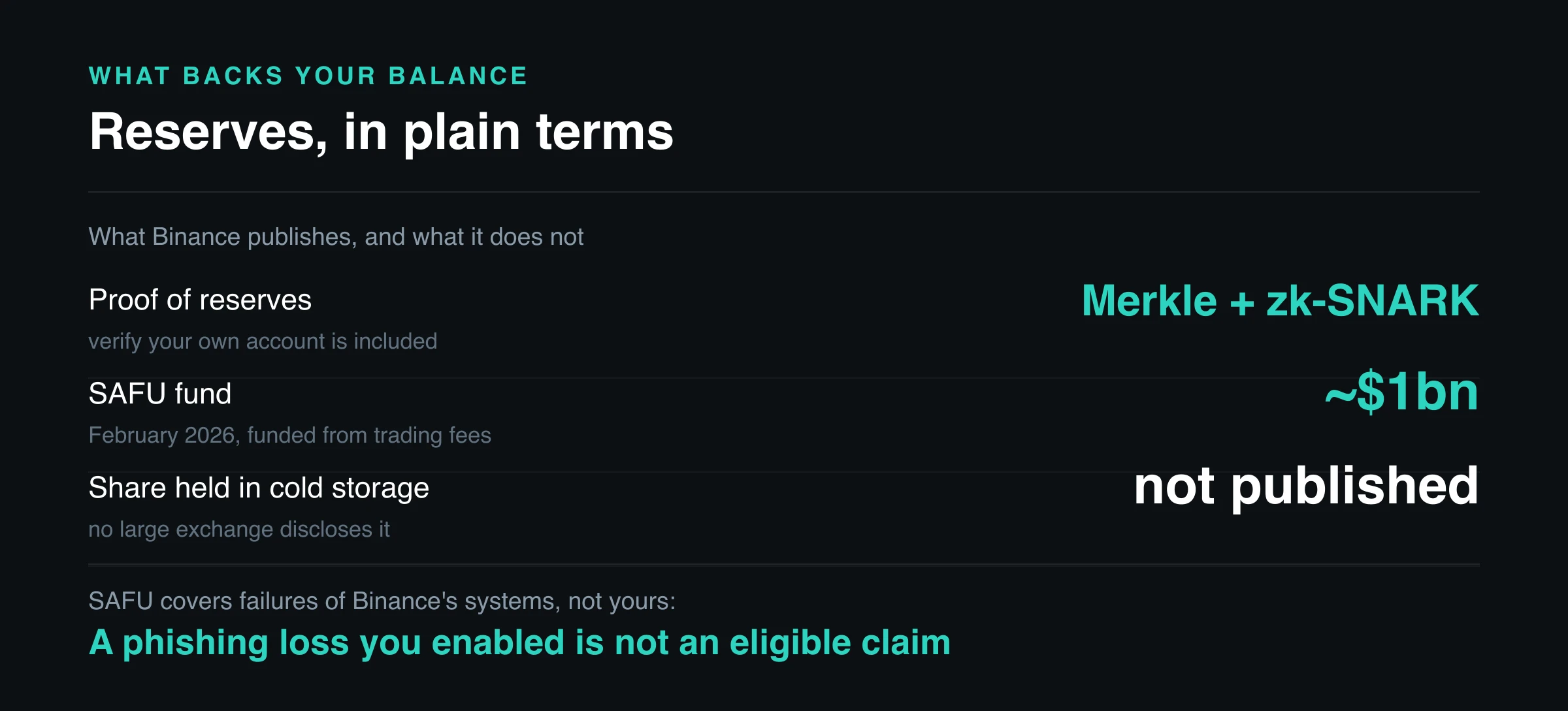
Binance's proof-of-reserves system is the strongest publicly verifiable claim it makes. It combines a Merkle tree, which lets you confirm your own account was included in the total, with zk-SNARK proofs that show every account's net balance is non-negative without exposing anyone's numbers. You can check your own inclusion from your account rather than taking a headline ratio on faith.
One detail matters when you compare snapshots. On 7 January 2026 Binance changed what goes into the calculation: the platform's own assets, previously excluded, are now included. Binance's own wording is that the old method "resulted in inflated reserve ratio". Reserve ratios published before and after that date are not directly comparable, so ignore any chart that splices them together.
Alongside reserves sits SAFU, the Secure Asset Fund for Users, which held crypto worth roughly 1 billion dollars as of February 2026 and was built by allocating a share of trading fees. Two details rarely quoted elsewhere: Binance commits to rebalancing the fund back to 1 billion dollars if its market value drops below 800 million, and that wording ties the fund's value to Bitcoin's price rather than to a stable balance. Read its scope before you rely on it: SAFU covers "losses sustained by users due to a compromise of their Binance account login credentials resulting from a vulnerability or other deficiency in Binance's systems", and Binance "retains full discretion to determine what types of loss and which claims are eligible". It is not insurance against a bad trade, and it is not a backstop for a phishing link you clicked yourself.
On storage, Binance describes deposits flowing into per-user wallets, consolidating into omnibus hot wallets, and overflowing into offline cold storage, with client assets in segregated accounts and separate ledgers for user funds and company holdings. What it does not publish is the share held cold. That number is the one you would actually want, and no large exchange discloses it.
The incident record, in numbers
Binance has had one major exchange breach, and it was seven years ago. On 7 May 2019 attackers withdrew 7,000 BTC in a single transaction using API keys and two-factor codes obtained through phishing and malware. Binance said the affected hot wallet held about 2% of its total BTC. No customer balance was reduced, and the exchange paused withdrawals for a week while it rebuilt its security stack.
The 2022 incident people conflate with it was not the exchange. On 7 October 2022 the BSC Token Hub, the bridge between BNB Beacon Chain and BNB Smart Chain, was exploited for 2 million BNB. Validators paused the chain for the first time in its history and BNB Chain said the vast majority of funds stayed under control. Your exchange balance was never in that blast radius, but it is a fair signal about the wider ecosystem Binance runs.
Since 2022 Binance reports its risk engine has flagged 40 million malicious transactions and avoided roughly 460 million USDT of user losses. Those are self-reported and unaudited, so treat them as direction rather than fact. The verifiable part is the absence of a second exchange-level breach in seven years, on the largest attack surface in the industry.
The 2023 settlement, and what came after
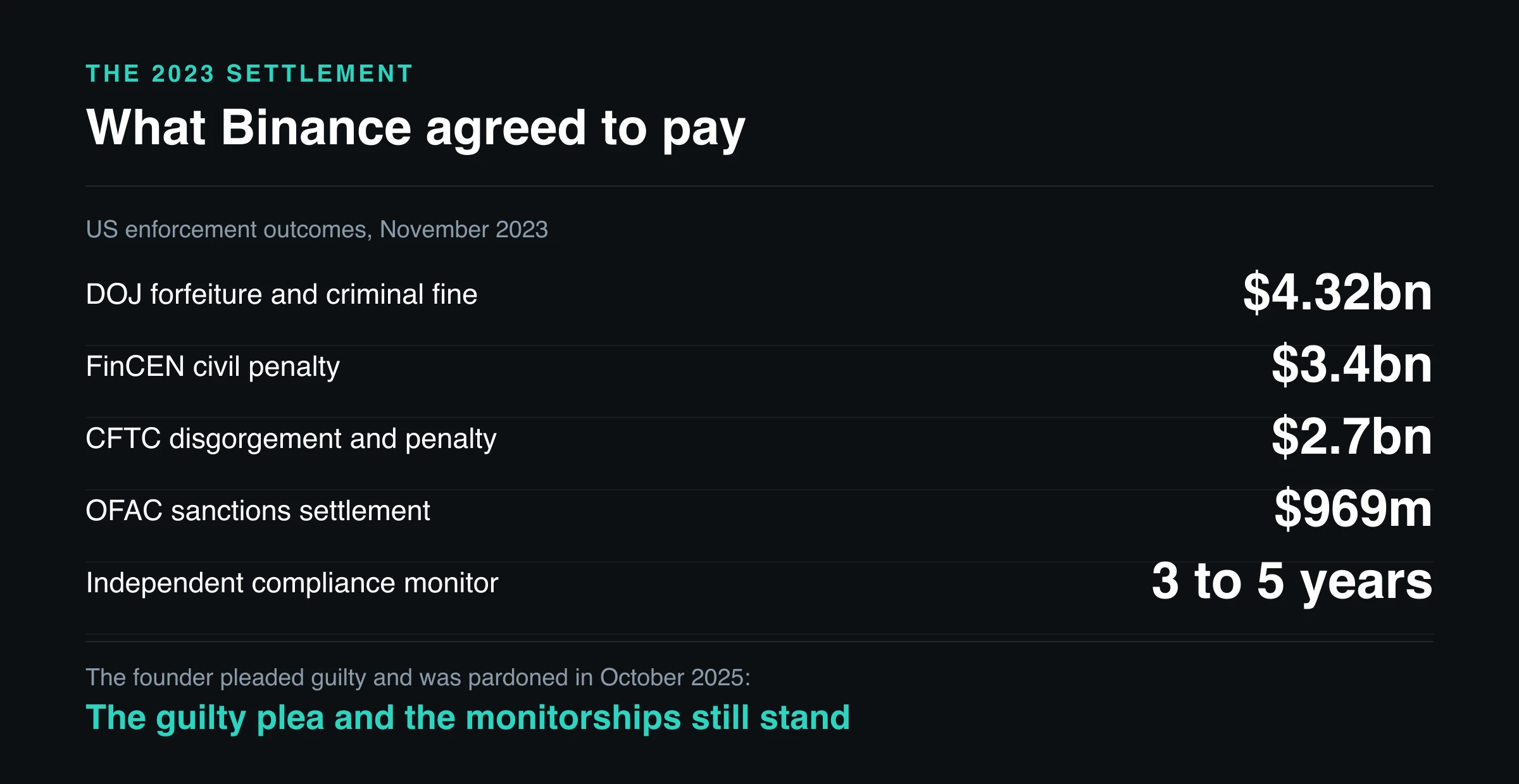
This is the part affiliate reviews skip, and it is the reason "is Binance legit" is a fair question. In November 2023 Binance agreed to forfeit 2,510,650,588 dollars and pay a criminal fine of 1,805,475,575 dollars, a total of 4,316,126,163 dollars, and to retain an independent compliance monitor for three years. Changpeng Zhao pleaded guilty on 21 November 2023 to failing to maintain an effective anti-money-laundering programme and resigned as chief executive.
The findings are specific. The Department of Justice said US users traded trillions of dollars on Binance between 2017 and 2022, generating over 1.6 billion dollars in profit; that Binance required identity verification from August 2021 but let unverified users keep trading until May 2022; that it never filed a single suspicious activity report; and that it willfully caused over 898 million dollars in trades between US users and users resident in Iran. FinCEN added a 3.4 billion dollar civil penalty, the largest in its history, with a five-year monitorship and a required complete exit from the United States. OFAC settled 1,667,153 apparent sanctions violations for 968,618,825 dollars. The CFTC ordered 1.35 billion in disgorgement plus a 1.35 billion penalty.
Two things changed after. The SEC's civil case was dismissed with prejudice on 29 May 2025, and Changpeng Zhao received a full and unconditional presidential pardon on 21 October 2025. Neither erases the 2023 guilty plea or the monitorships, and neither is a finding that the underlying conduct did not happen. What they do mean is that the US legal overhang is smaller in 2026 than it was in 2024.
Where Binance does hold licences, it holds real ones: a VASP licence from Dubai's regulator issued in April 2024, registration with Japan's Kanto Local Finance Bureau since October 2022, a digital asset service provider registration in El Salvador since August 2023, and a Category 4 licence from the Central Bank of Bahrain. Where it does not, it is out: the FCA states no Binance Group entity holds any UK authorisation, the exchange left the Netherlands in 2023 after failing to obtain registration, and it stopped serving Ontario in 2022.
The European problem nobody is advertising
If you trade from the EU, this is the most important paragraph on this page. MiCA's transitional period ended across the European Union on 1 July 2026. On 23 June 2026 ESMA publicly called on crypto-asset service providers without authorisation, explicitly including large providers still serving EU clients under old national regimes, to stop onboarding new EU clients and cease marketing. On 24 June 2026 Binance announced it had withdrawn its MiCA licence application in Greece and would pursue authorisation in another member state, to be named later.
As of today no Binance entity appears in ESMA's register of authorised providers, and none appears on the French regulator's current list either; Binance France was removed from the AMF register. ESMA's statement is blunt about what that means for you: clients of unauthorised providers "do not benefit from MiCA safeguards, including protections for client assets".
This is not a claim that Binance will fail or that your coins are about to vanish. It is a statement about what recourse exists if something goes wrong. A MiCA-authorised venue owes you segregation rules and a supervisor you can complain to. Right now, in the EU, Binance owes you its own policies. Binance says affected users will be contacted directly with their options and timelines, so if you hold a balance there and live in the EU, read that email rather than deleting it.
The practical response is not panic, it is proportion: keep working capital rather than savings on the venue, know where your withdrawal path goes, and if regulatory protection is something you actually want, use an exchange that currently has it.
The five settings that matter more than SAFU
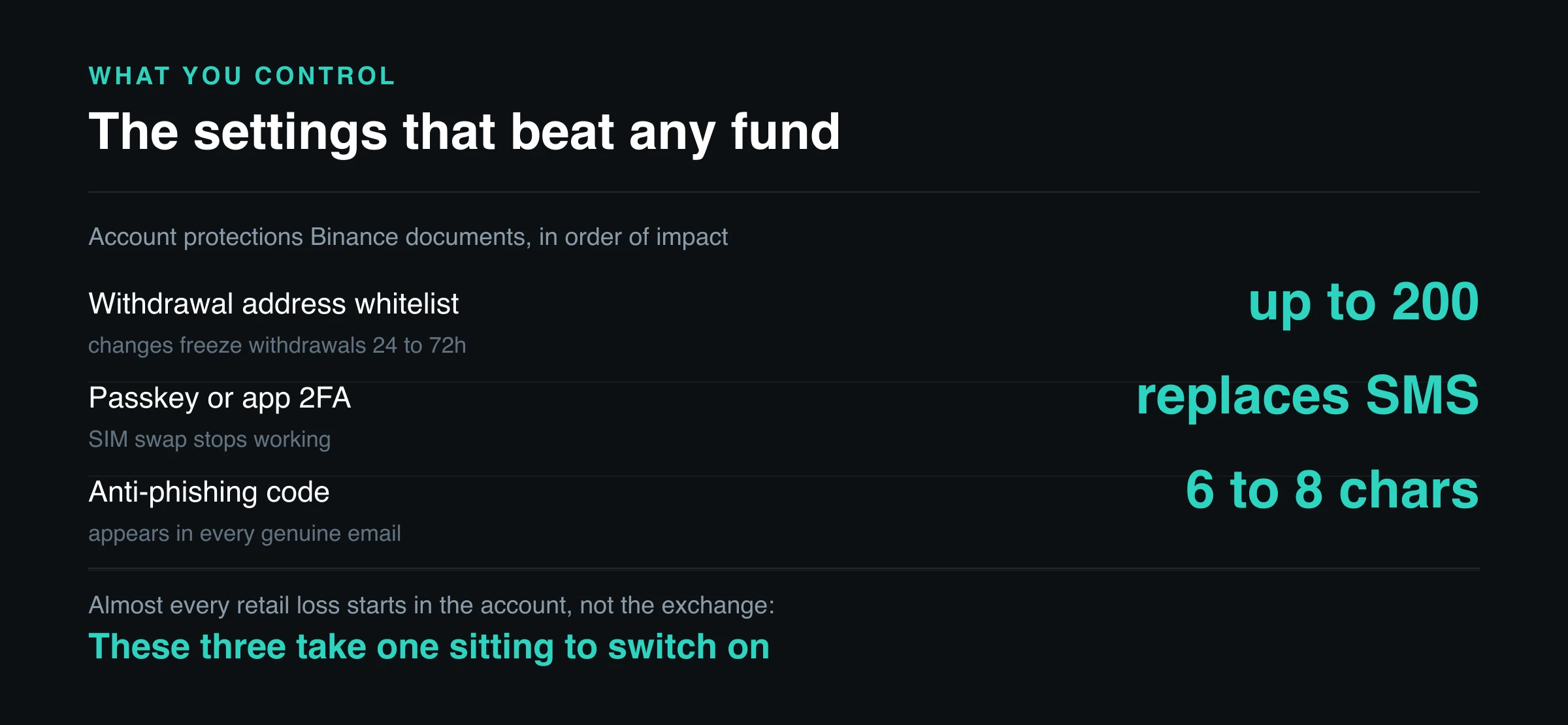
Almost every retail loss on a major exchange starts with the account, not the exchange. Binance gives you the tools; most people never switch them on. The withdrawal address whitelist is the strongest one: turn it on, add up to 200 addresses, and withdrawals can only go to addresses you approved. Changing or disabling it triggers a 24, 48 or 72 hour withdrawal suspension, which is precisely the delay that saves you when someone else is inside your account.
Second, replace SMS two-factor with a passkey or an authenticator app. Binance supports passkeys through iCloud Keychain, a USB security key or your phone's screen lock. Third, set an anti-phishing code, six to eight characters that appear in every genuine Binance email; anything without it is fake. Fourth, read your activity log occasionally rather than never. Fifth, if you run bots, give API keys trade permission only, never withdrawal, and bind them to an IP.
None of this is exotic and all of it takes one sitting. It also moves you out of the category SAFU explicitly does not cover, because a phishing loss you enabled yourself is your loss, not Binance's.
What safety costs you, and what comes back
Binance is one of the cheapest large venues before discounts and the cheapest after them. Spot is 0.10% maker and taker at the base tier, dropping to 0.075% when you pay fees in BNB. USDⓈ-M futures are 0.0200% maker and 0.0500% taker, with a 10% BNB discount that applies to futures only in the USDⓈ-M wallet. The 25% spot discount and the 10% futures discount stack on top of VIP tiers.
The lever most traders never pull sits underneath that. Binance runs an affiliate programme, and the commission it pays is normally kept by whoever's link you used. Through Trade Reclaim that commission comes back to you instead: 30% of every trading fee, paid in USDT, withdrawable whenever you like. It stacks with BNB and with your VIP tier, because it happens after the fee is charged, not instead of it.
On a million dollars of monthly futures volume at 0.05% taker, that is 500 dollars of fees and 150 dollars back every month, on trades you were placing anyway. Linking is a one-time step using your public Binance UID: no API keys, no account access, and nothing that touches the security settings you just tightened.
Trading on Binance? Get 30% of your fees back
Connect your Binance account with its public UID and Trade Reclaim pays back 30% of every trading fee in USDT, withdrawable anytime. No API keys, no account access, and it stacks with the BNB discount and your VIP tier.
Frequently asked questions
Is Binance safe to keep money on?
For working capital, yes, with the same caveat that applies to every centralised exchange: you are trusting an operator rather than holding your own keys. Binance publishes proof of reserves you can verify for your own account, and SAFU held around 1 billion dollars in February 2026. For long-term savings, self-custody is the honest answer, on Binance and everywhere else.
Is Binance legit, or is it a scam?
It is legitimate. It is the largest crypto exchange by volume, it is licensed in Dubai, Japan, Bahrain and El Salvador, and it publishes verifiable reserve proofs. It also pleaded guilty to US anti-money-laundering violations in 2023 and paid 4.32 billion dollars. Legitimate and clean are different words, and the honest description of Binance needs both.
Can EU traders still use Binance in 2026?
Binance withdrew its MiCA licence application in Greece on 24 June 2026 and no Binance entity currently appears in ESMA's register of authorised providers. ESMA has stated that clients of unauthorised providers do not benefit from MiCA safeguards, including client-asset protection. Binance says affected users are being contacted individually about their options, so check your account notifications rather than assuming nothing has changed.
Has Binance ever been hacked?
Once at exchange level. On 7 May 2019 attackers withdrew 7,000 BTC from a hot wallet holding about 2% of Binance's total BTC, using phishing and malware to obtain API keys and two-factor codes. No customer balance was reduced. The separate 2022 exploit of 2 million BNB hit the BNB Smart Chain bridge, not exchange accounts.
What does SAFU actually cover?
Less than most people assume. Binance's own wording limits it to losses from a compromise of account credentials caused by a vulnerability or deficiency in Binance's systems, and Binance retains full discretion over which claims qualify. It does not cover trading losses, liquidations, or a phishing link you clicked. Treat it as a backstop against Binance's failures, not yours.
Is Binance safer than Bybit or OKX?
On publicly verifiable measures the three are close: all publish proof of reserves, all run loss funds, all offer whitelisting and app-based two-factor. They differ on regulation rather than on security engineering. If supervisory protection matters to you, compare which venue currently holds authorisation in your own jurisdiction, because that answer changed for several exchanges during 2026.
What is the single best thing I can do to protect my Binance account?
Turn on the withdrawal address whitelist. It caps the damage of a full account takeover, because funds can only leave to addresses you approved, and any attempt to change the list triggers a 24 to 72 hour withdrawal freeze. Pair it with a passkey or authenticator app instead of SMS.
Does using a cashback service make my Binance account less safe?
No, because nothing about it touches your account. Trade Reclaim links to your public Binance UID, which is an identifier, not a credential. There are no API keys, no password, no withdrawal rights and no way for anyone to place a trade for you. The exchange pays its affiliate commission to us and we pass 30% of your fee back to you in USDT.
Trade Reclaim Research analyses exchange fee schedules, rebate structures and execution costs across the 9 exchanges the platform supports. The team publishes fee math, not price predictions, and every number in this article can be checked against the linked official sources.
Trade Reclaim earns from exchange referrals and shares most of it back to you as cashback. Education, not financial advice.