Binance Leverage Explained: What 150x Really Costs
Leverage on Binance is not one number. It is a table that shrinks as your position grows, a margin mode that decides what a liquidation takes with it, and a fee that scales with notional rather than with your own money. Here is the mechanism, with the current figures.

- The maximum is 150x and it exists on two contracts out of roughly a thousand: BTCUSDT and ETHUSDT. Sixteen symbols reach 100x and 754 cap at 75x or below.
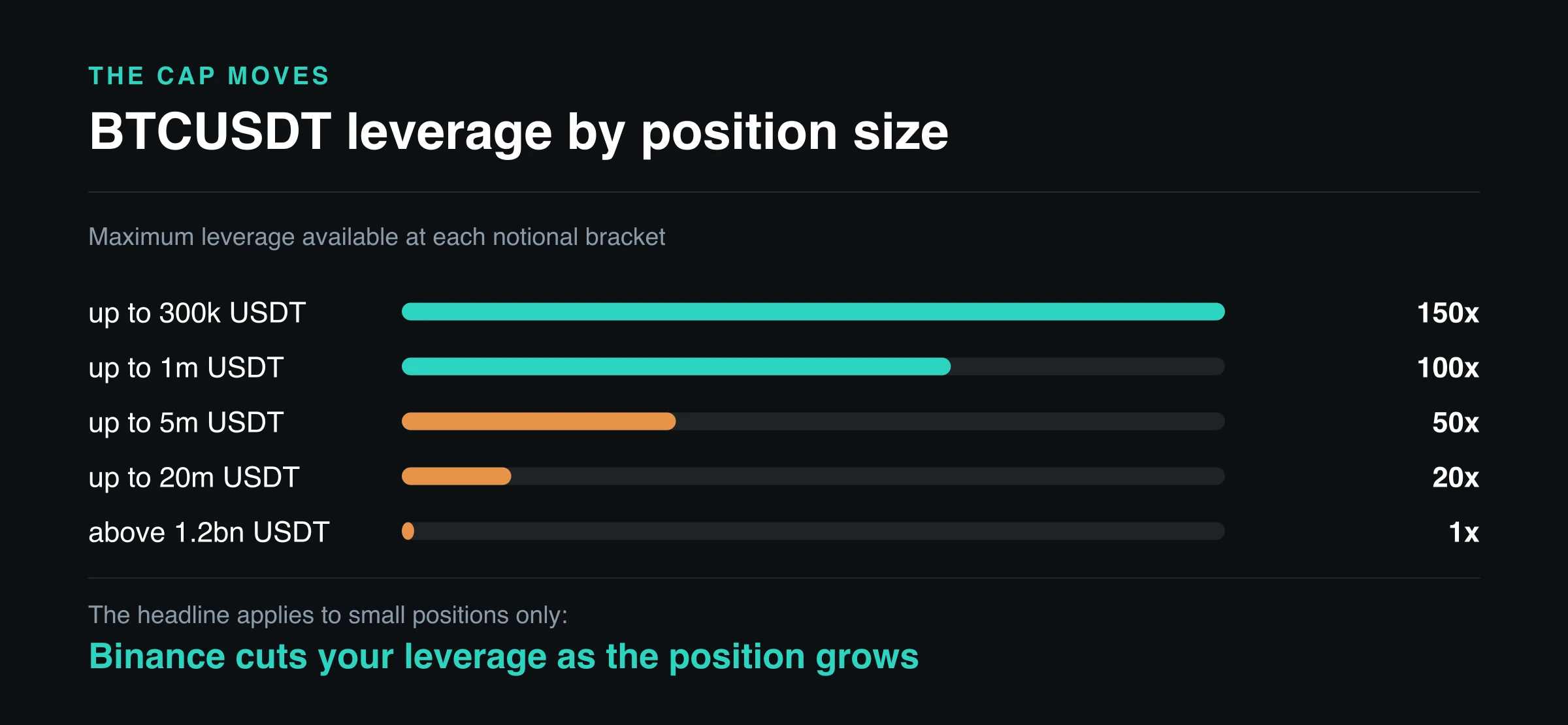
- Your leverage cap falls as your position grows. On BTCUSDT, 150x applies only up to 300,000 USDT of notional; a 5 million USDT position is capped at 50x.
- Funding is per symbol: 444 of 868 perpetuals settle every four hours, but every major including BTC, ETH, SOL, XRP, BNB and DOGE is still on the eight-hour cycle.
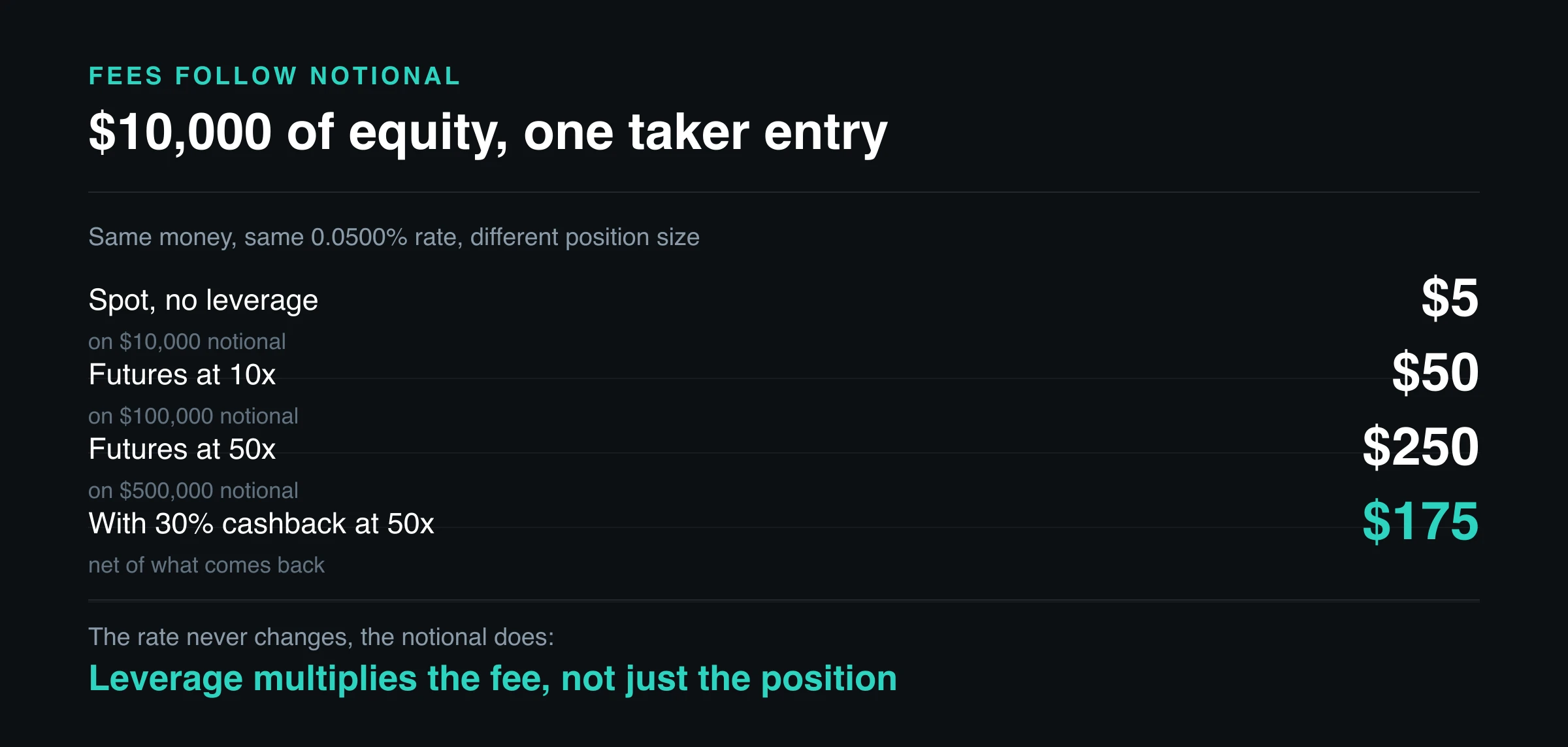
- Fees are charged on notional, not on your margin. At 50x, the same equity generates 50 times the fee it would on spot, which is where most leveraged accounts actually bleed out.
- Liquidation happens when margin balance falls to maintenance margin, before your money is gone, and a clearance fee of 1.25% to 2.5% of notional is deducted on top.
- Auto-deleveraging targets the most profitable and most highly leveraged positions first, so being right is not protection from it.
Ask what leverage Binance offers and you get a marketing number. Ask what leverage does to a position and you get four mechanisms: the tier table that caps you, the margin mode that decides the blast radius, the maintenance requirement that triggers liquidation, and the fee that quietly scales with every multiple you add. Traders who lose money on futures usually understand the first and none of the rest.
The real maximum, and why it moves
Binance's top leverage is 150x, and it exists on exactly two contracts out of roughly a thousand. BTCUSDT and ETHUSDT perpetuals carry it. Two more offer 125x, sixteen offer 100x, and 754 symbols cap at 75x or below. "Binance offers 150x" is true in the same way that a car company offering one track model means every model does 300 kilometres an hour. If a guide tells you the maximum is 125x, it was written before the current tables and you should check every other number in it too.
More importantly, the headline only applies to small positions. Leverage on Binance is a tier table indexed to position notional, not a setting you own. On BTCUSDT, 150x is available up to 300,000 USDT of notional. Grow the position and the cap steps down: a 5 million USDT position is capped at 50x, and at the very top of the table, above roughly 1.2 billion USDT, the cap is 1x. Binance reduces your effective leverage automatically as the position crosses into a higher bracket.
New accounts get less. Since 7 December 2025, users who registered within the last 30 days are held to a lower cap that is lifted gradually after that period. The previous rule was 60 days, and search results still surface the 2021 announcement describing it, which is a good reminder to read the date on anything about Binance limits.
Why you cannot select the leverage you want
Three separate rules cap you, and Binance never shows you all three in one place. The first is your account age: since 7 December 2025, accounts registered within the last 30 days cannot exceed 20x, and the restriction lifts gradually after that. Older guides still say 60 days, which was the rule until it was replaced. Sub-accounts are held tighter still, capped at 5x since 12 August 2025.
The second is position size. Leverage is indexed to notional, so the multiple you can select falls as your intended position grows into a higher bracket. If you set 150x and then size up past 300,000 USDT of notional on BTCUSDT, Binance reduces your effective leverage for you rather than letting the position sit outside the tier.
The third is your own open position. Changing leverage recalculates margin requirements, so Binance will not let you raise it in a way that would immediately breach the tier you are in. Adjusting leverage happens per contract in the trading interface, not once for the whole account: open the contract, click the current multiple next to the order form, choose the new one, and confirm. Do it before you enter, not while you are underwater.
Cross or isolated: what a liquidation takes with it
The margin mode decides the blast radius, and it matters more than the multiple you picked. Isolated margin ring-fences the margin assigned to one position: its liquidation price is fixed, and if it liquidates, nothing else in your account is touched. Cross margin shares your entire margin balance across all open positions, so one position's liquidation price moves as the others gain and lose, and a single bad position can consume the whole balance.
Neither is safer in the abstract. Cross survives volatility better because the whole balance backs each position, which is why it liquidates later. Isolated fails smaller. If you cannot say out loud which one you are in right now, you are in the wrong one.
Multi-Assets Mode adds a third wrinkle: it lets BTC, ETH, BNB and others serve as collateral for USDⓈ-M futures and shares margin between USDT and USDC contracts, so a profit on one offsets a loss on the other. Two conditions come with it. It works only in cross margin, and non-stablecoin collateral takes a haircut, with Binance's own example valuing 1,000 dollars of BNB at 950.
How liquidation actually triggers
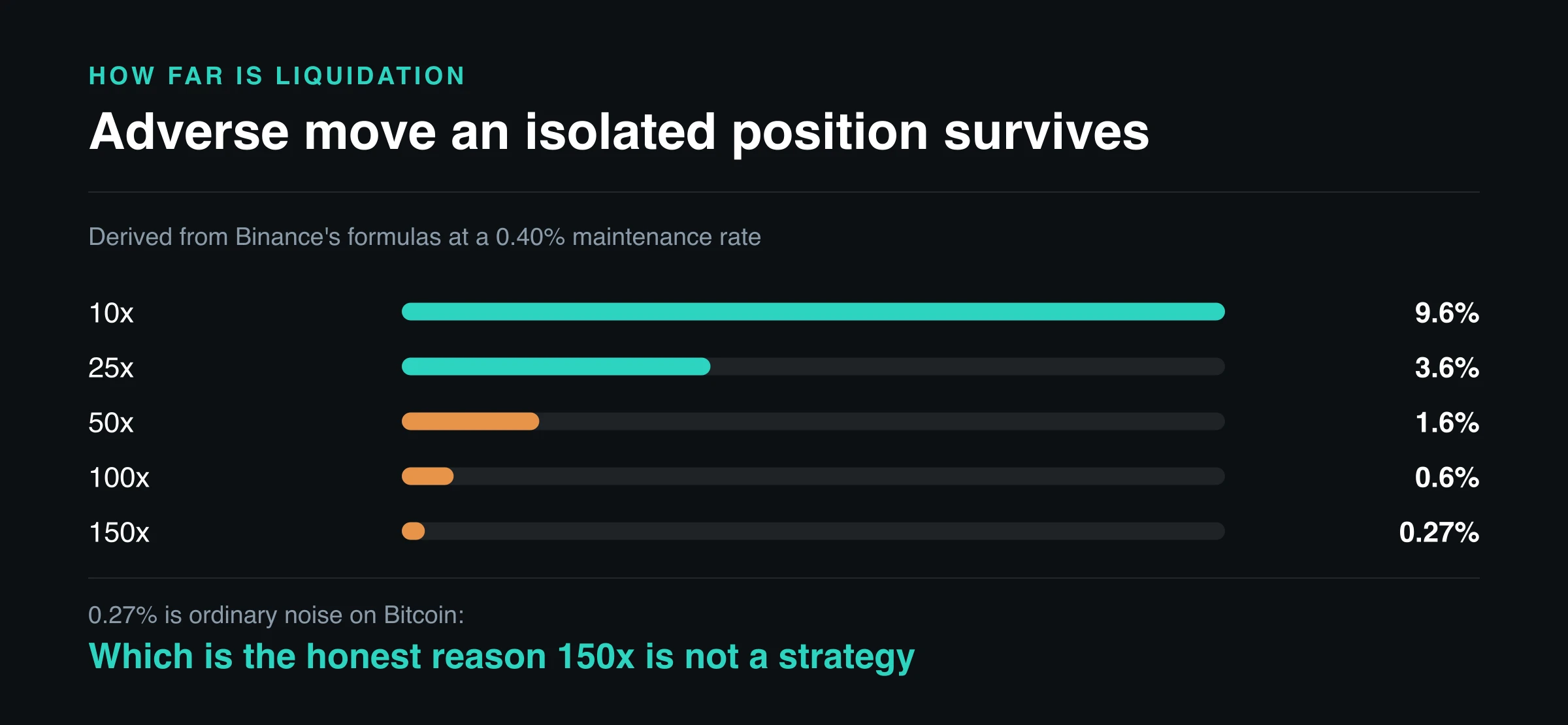
You are not liquidated when your margin hits zero. You are liquidated when your margin balance falls to the maintenance margin, which happens earlier. The maintenance margin rate is set by the notional tier, not by the leverage you selected, and Binance is explicit that it is calculated the same way regardless of leverage. For BTCUSDT tier one it is 0.40%.
That gives a workable rule of thumb. The adverse move an isolated position survives is roughly one divided by your leverage, minus the maintenance rate. At 10x that is about 9.6%, at 25x about 3.6%, at 50x about 1.6%, at 100x about 0.6% and at 150x about 0.27%, all before fees and funding. A 0.27% move against you is ordinary noise on Bitcoin, which is the honest reason 150x is not a strategy.
Liquidation prices are computed from the mark price, which Binance builds from a multi-exchange index rather than its own last traded price. A wick on Binance alone should not liquidate you. When liquidation does fire, Binance first attempts a partial reduction with an immediate-or-cancel order, and only wipes the position if that fails.
There is a cost on the way out. Binance deducts a liquidation clearance fee from the position's collateral on any non-bankrupt liquidation, calculated as a rate times notional value and shown as "Liquidation Clearance" in your transaction history. Binance does not publish one universal rate: it varies by symbol and is set in each contract's trading rules, commonly around 1.25% on the largest pairs and higher on thinner ones. On a 100,000 USDT position that is over 1,000 USDT on top of the loss that got you there, which is why the exact figure for your symbol is worth looking up before you need it.
When liquidation is not enough: the insurance fund and ADL
If your position cannot be closed above bankruptcy price, the futures insurance fund absorbs the shortfall. It is funded by those clearance fees and by profits when it takes over bankrupt positions, and as of 14 August 2026 the published USDⓈ-M balances total about 1.49 billion USDT and 844 million USDC across all fund groups. Binance states plainly that these are not insurance products and that it is not an insurer.
When the fund cannot absorb a position, auto-deleveraging takes over, and this is the part traders misunderstand. ADL does not close losers. It ranks accounts by profit percentage multiplied by effective leverage and closes the most profitable, most leveraged positions first. Being right about the direction is exactly what puts you at the front of that queue. Binance shows your position in the queue as an indicator on the trading interface, and it is worth glancing at during violent moves.
Funding: the cost of staying in
Funding is not a fee Binance charges you. It is a payment between traders, and Binance takes nothing from it. When the rate is positive, longs pay shorts; when negative, shorts pay longs. You only pay or receive it if you are holding at the exact settlement timestamp, so a position closed five minutes earlier pays nothing.
The interval is per symbol, not universal, and this is where most guides mislead. Binance documents an eight-hour default at 00:00, 08:00 and 16:00 UTC. Across the live contract list, 444 of 868 perpetuals now settle every four hours and one settles hourly. But every major is still on the eight-hour cycle: BTCUSDT, ETHUSDT, SOLUSDT, XRPUSDT, BNBUSDT and DOGEUSDT. So if you trade the majors the default holds, and if you carry an altcoin perp overnight you should check the contract rather than assume.
Rates are capped at 0.75 times the maintenance margin ratio, which puts BTCUSDT and ETHUSDT at plus or minus 0.30% per interval and most other symbols at plus or minus 2.00%. In a strongly trending market the funding on a leveraged position can cost more than the spread you worried about at entry.
The cost that scales with leverage
Binance charges 0.0200% maker and 0.0500% taker on USDⓈ-M futures at the base tier, calculated on notional position value rather than on your margin. That distinction is the whole point. The rate does not change when you raise leverage; the notional does. Ten thousand dollars of equity at 50x controls 500,000 dollars of notional and generates 250 dollars of taker fee on entry, against 5 dollars if you had bought spot with the same money.
Two levers reduce it. Paying fees in BNB takes 10% off futures, not the 25% you get on spot, and only for USDⓈ-M contracts with BNB sitting in that wallet. VIP tiers help, though futures volume thresholds are five times the spot ones precisely because leverage inflates volume.
The third lever is the one almost nobody uses. Binance pays affiliate commission on the fees you generate, and normally whoever's referral link you used keeps it. Through Trade Reclaim that commission comes back to you: 30% of every trading fee, in USDT, withdrawable anytime. On 1 million dollars of monthly futures notional at 0.05% taker, that is 500 dollars of fees and 150 dollars returned every month. It is applied after the fee, so it stacks with BNB and with your VIP tier.
The controls worth setting before you need them
Binance documents eleven futures order types, and two of them do most of the work. Stop-loss and take-profit are the same object: the system classifies the order by where the trigger sits relative to the price when you place it. The trigger defaults to mark price, which is usually what you want, because it ignores wicks on Binance's own book. Trailing stops use a callback rate between 0.1% and 10%.
Beyond orders, there is a cooling period that locks you out of futures for a day, a week, a month or indefinitely, and it cannot be lifted early. It cannot be switched on while you have open orders, but it can with open positions, and reduce-only orders keep working. For anyone who has ever revenge-traded a liquidation, it is the most useful button on the platform.
Position limits also exist per leverage tier by default, and raising them is a paid, scored process rather than a toggle. If you are anywhere near those limits, the tier table has already cut your leverage well below the headline number anyway.
Trading Binance futures? Get 30% of your fees back
Leverage multiplies your fees, so the rebate is worth more the harder you trade. Connect your Binance account with its public UID and Trade Reclaim pays back 30% of every trading fee in USDT, withdrawable anytime. No API keys, no account access.
Frequently asked questions
What is the maximum leverage on Binance?
150x, available only on BTCUSDT and ETHUSDT perpetuals and only for positions up to 300,000 USDT of notional. Two contracts offer 125x and sixteen offer 100x; everything else is lower. The cap steps down automatically as your position grows into a higher notional tier.
Which coins have 150x leverage on Binance?
Only BTCUSDT and ETHUSDT perpetuals, and only for positions up to 300,000 USDT of notional. BTCUSDC and ETHUSDC reach 125x, sixteen symbols reach 100x, and 754 of roughly a thousand cap at 75x or below.
Why can I not select the maximum leverage on my account?
Two common reasons. Accounts registered within the last 30 days are held to a reduced cap that lifts gradually afterwards, a rule in force since 7 December 2025. And leverage is capped by position notional, so if your intended size sits in a higher tier, Binance will not offer the headline multiple.
Does higher leverage mean higher fees on Binance?
Yes in practice, no in the rate. The fee rate is 0.0200% maker and 0.0500% taker regardless of leverage, but it is charged on notional value. Since leverage is what lets a given amount of equity control more notional, doubling your leverage doubles the fee you pay on the same capital.
How close to liquidation am I at a given leverage?
Roughly one divided by your leverage, minus the maintenance margin rate, which is 0.40% in BTCUSDT's first tier. That is about 9.6% at 10x, 1.6% at 50x, 0.6% at 100x and 0.27% at 150x, before fees and funding. Those are derived from Binance's published formulas rather than quoted as a table.
What is the difference between cross and isolated margin?
Isolated assigns a fixed amount of margin to one position, giving it a fixed liquidation price and containing the damage if it fails. Cross shares your whole futures balance across all positions, which pushes liquidation further away but puts the entire balance at risk from any single position.
Does Binance take a cut of funding payments?
No. Binance states it charges no fee on funding, which transfers directly between traders holding opposing positions. You pay or receive it only if you hold the position at the settlement timestamp.
How often is funding charged on Binance?
The documented default is every eight hours, at 00:00, 08:00 and 16:00 UTC, and that applies to BTCUSDT and ETHUSDT. In practice most contracts have moved to four hours: 444 of 753 configured symbols settle every four hours and one settles hourly. Check the contract you are trading.
What is auto-deleveraging and can it happen to me?
It is the last step after liquidation when the insurance fund cannot absorb a bankrupt position. Binance ranks positions by profit percentage multiplied by effective leverage and closes the highest first, so profitable, highly leveraged positions are deleveraged before anyone else. Your place in that queue is shown as an indicator on the trading interface.
Trade Reclaim Research analyses exchange fee schedules, rebate structures and execution costs across the 9 exchanges the platform supports. The team publishes fee math, not price predictions, and every number in this article can be checked against the linked official sources.
Trade Reclaim earns from exchange referrals and shares most of it back to you as cashback. Education, not financial advice.