
The Key Differences Between Spot vs Futures Markets: What Every Trader Should Know
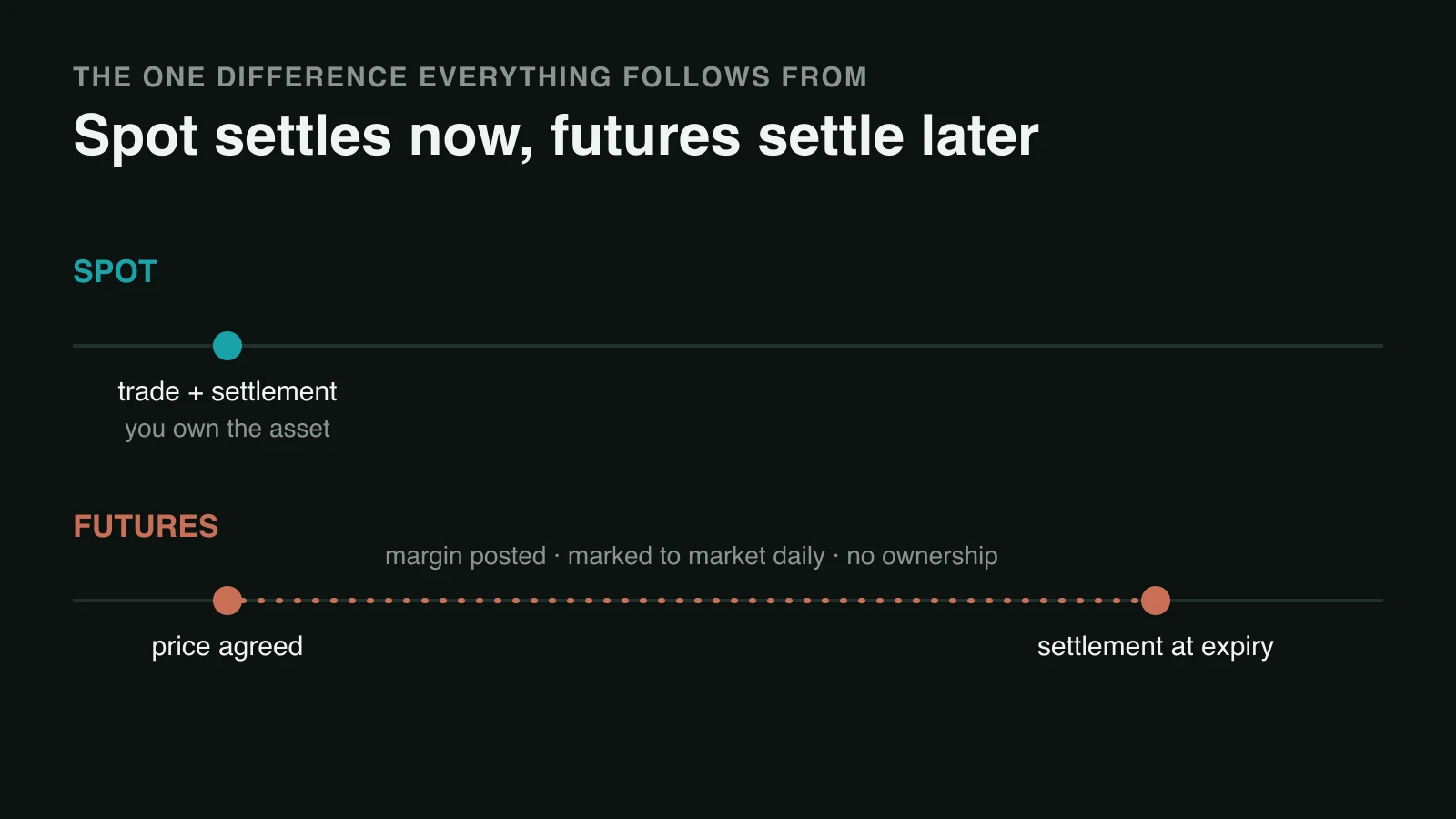
Spot markets settle now, futures markets settle later, and everything else follows from that one difference: pricing, leverage, settlement, risk and fees. This guide covers both market types end to end, from commodity futures and hedging strategies to crypto perpetuals and what each structure costs you per trade.

- Spot markets settle immediately at the current market price with full ownership; futures markets are contracts that lock in a price today for settlement later, without owning the asset.
- Futures prices equal spot plus cost of carry and expectations: storage, financing and insurance in commodities, funding rates in crypto perpetuals.
- Futures add leverage, margin and liquidation risk that spot trading simply does not have. Leverage amplifies fees as well as profits.
- In crypto, futures fees look lower per trade (about 0.02% maker / 0.055% taker vs 0.10% spot), but leverage multiplies the notional you pay fees on.
- Hedging happens in futures against spot exposure: producers, funds and traders lock prices to remove risk, while speculators and arbitrageurs supply the liquidity.
- Whichever market you trade, fees are the one cost you control: Trade Reclaim pays back 30 to 50% of every trading fee on 9 supported exchanges.
Every tradable asset lives in two parallel markets. In one, you exchange money for the asset right now at the current price. In the other, you agree today on a price for a transaction that settles later. That is the entire spot vs futures distinction, and yet it produces two markets with different pricing mechanisms, different settlement terms, different risk profiles and different fee structures. Understanding spot vs futures markets is not academic: it decides how much leverage you can use, whether you can be liquidated, what your carry costs are, and how much of your edge survives fees. This guide walks through both market types in full, in traditional finance and in crypto, and closes with the strategies traders actually run in each.
Spot vs Futures Markets at a Glance
The difference between spot markets and futures markets comes down to timing and obligation: a spot trade exchanges the asset for cash immediately at the current price, while a futures trade is a binding contract to transact at a set price on a later date. When people ask about the spot markets vs futures markets difference, finance textbooks and trading desks give the same answer: spot is ownership now, futures is agreement now and settlement later.
That one structural difference cascades into everything traders care about. Spot markets price assets by immediate supply and demand, transfer ownership at settlement, and involve no leverage unless you borrow separately. Futures markets price contracts off the spot price plus carry costs and expectations, never transfer the underlying until settlement (if at all), and build leverage in through margin. The table below summarizes the contrasts this guide unpacks section by section.
Both structures exist because they serve different needs. Spot markets exist to move assets. Futures markets exist to move risk. A wheat farmer, an airline, a market maker and a crypto day trader all use futures for the same underlying reason: they want price certainty or price exposure without touching the asset itself right now.
| Aspect | Spot market | Futures market |
|---|---|---|
| What is traded | The asset itself | A contract on the asset |
| Settlement | Immediate, at the current price | At a future date, or never (perpetuals) |
| Ownership | Full ownership, withdrawable | Price exposure only |
| Pricing | Current supply and demand | Spot + cost of carry + expectations |
| Leverage | None built in | Built in via margin, often 10-100x in crypto |
| Liquidation risk | None | Yes, below maintenance margin |
| Holding period | Unlimited | Until expiry, or funding paid on perpetuals |
| Typical crypto fee | 0.10% flat | 0.02% maker / 0.055% taker |
| Main users | Investors, holders, converters | Hedgers, speculators, arbitrageurs |
What Is the Spot Market?
The spot market is where assets are bought and sold for immediate delivery at the current market price, called the spot price. "Immediate" is defined by convention: equities settle in one to two business days, foreign exchange typically in two, and crypto spot trades settle the moment the order fills. In each case, the defining feature holds: the buyer takes ownership of the actual asset, and the seller receives cash, at the price displayed right now. We cover the mechanics of that price itself in our guide to what spot price means.
Spot trading has four defining characteristics. First, ownership: after settlement you hold the asset itself, whether that is 1 BTC in your exchange account, a share certificate, or a barrel of oil in a delivery terminal. Second, simplicity: the price you see is the price you pay, plus the trading fee. Third, no expiry: a spot position can be held indefinitely with no contract rolling over or settlement date approaching. Fourth, no built-in leverage: you can only buy what your capital covers, which also means a spot position cannot be liquidated by a margin call.
The spot market is also the price discovery anchor for everything else. Derivatives, ETFs, index products and lending rates all reference spot prices. When you hear that gold trades at 2,400 dollars an ounce or bitcoin at 100,000, those are spot quotes: the consensus value for immediate delivery, updated continuously by live order flow.
For most people, spot is where trading starts. It is the natural market for investors accumulating an asset they intend to hold, for anyone converting between currencies or coins, and for traders who want market exposure without the added dimensions of margin, funding and expiry that derivatives introduce.
What Are Futures Markets?
A futures market trades standardized contracts that obligate the buyer to purchase, and the seller to deliver, an asset at a predetermined price on a specified future date. The instrument being traded is the contract, not the asset. Nobody hands over gold, oil or bitcoin when a futures trade executes; the two sides exchange an obligation, and the exchange's clearing house guarantees both ends of it.
Futures contracts share five key features. Standardization: every contract on an exchange specifies the same quantity, quality and delivery terms, which is what makes them liquid and interchangeable. Margin: instead of paying full value, both sides post collateral, typically a small fraction of the contract's notional value. Leverage: because margin is a fraction of notional, a small price move produces a large percentage gain or loss on the capital posted. Daily settlement: gains and losses are marked to market and credited or debited every day, not just at expiry. Expiry: each contract has a settlement date at which it is closed in cash or settled by physical delivery.
Settlement at expiry takes one of two forms. Physically delivered contracts end with the actual asset changing hands, which matters for commercial users like refineries and grain buyers. Cash-settled contracts simply pay out the difference between the contract price and the spot price at expiry, which is how most financial futures, and nearly all crypto futures, work.
Crypto added a third structure that now dominates digital asset derivatives trading: the perpetual future. A perpetual has no expiry date at all. Instead, a funding rate paid between longs and shorts every few hours keeps the contract price tethered to the spot price. It behaves like a futures contract you can hold forever, which is exactly why it became the default instrument for leveraged crypto trading.
Spot vs Futures: The Key Differences in Detail
Four mechanisms separate the two markets: how prices form, how settlement works, what timeframe applies, and what each side is obligated to do. Understanding each one tells you exactly when a spot position and a futures position on the same asset will behave differently.
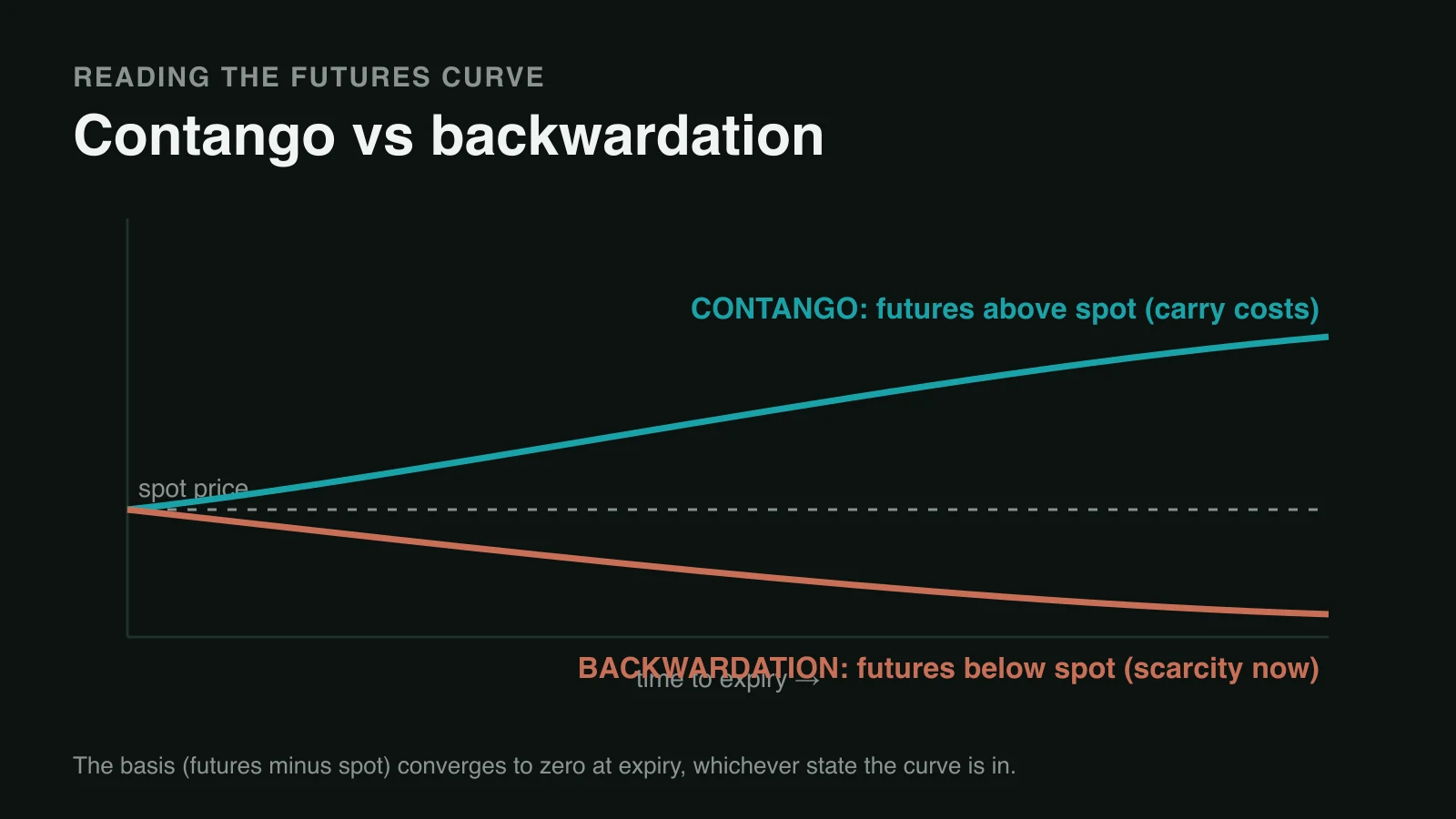
Pricing mechanisms. The spot price is pure current supply and demand. A futures price is the spot price plus the cost of carry (financing, storage, insurance) plus the market's expectation of where spot will be at expiry. When futures trade above spot, the market is in contango, the normal state when carry costs are positive. When futures trade below spot, the market is in backwardation, typically signaling near-term scarcity or high demand for the asset today. The gap between spot and futures, the basis, converges to zero as expiry approaches, because at expiry a futures contract is simply a spot transaction.
Settlement terms. Spot settles now: asset moves one way, cash the other, and the trade is done. Futures settle later, and until then both sides carry open obligations that are marked to market daily. That daily mark is why futures accounts can be margin-called weeks before expiry: losses are realized every day, not at the end.
Timeframes. A spot position has no clock on it. A futures position always does, except for perpetuals, which replace the clock with a recurring funding payment. For dated contracts, traders who want continuous exposure must roll from the expiring contract into the next one, paying the spread and fees each time. The timeframe difference also shapes who uses each market: buy-and-hold capital lives in spot, while defined-horizon hedges and trades fit naturally into dated futures.
Immediate vs contractual obligations. A spot buyer's obligations end at settlement; owning the asset creates no further duties. A futures position is a standing contractual obligation: maintain margin above the maintenance level or be liquidated, accept daily settlement flows, and either close, roll or settle at expiry. This is the deepest difference between the two markets. Spot risk is the asset's price. Futures risk is the asset's price multiplied by leverage, plus the path it takes getting there, because a violent enough wick can liquidate a position that would have recovered by expiry.
Reading the Curve: Contango, Backwardation and the Basis
The relationship between spot and futures prices is itself a market signal, and professionals read it the way others read charts. The basis is the difference between the futures price and the spot price. Plot the prices of contracts across successive expiry dates and you get the futures curve: upward sloping in contango, downward sloping in backwardation. The shape of that curve compresses everything the market believes about carry costs, scarcity and demand into a single line.
Contango is the resting state when carry costs are positive: a contract for delivery in six months should cost more than spot, because whoever provides the asset then has to finance, store and insure it until delivery. Backwardation appears when the present is worth more than the future: a supply squeeze, a war premium, or in crypto, periods of intense demand to be long right now. Traders track flips between the two states closely because they mark regime changes; oil flipping into steep backwardation says more about physical scarcity than most headlines do.
Convergence is the mechanism that makes all of it coherent. As expiry approaches, the futures price and the spot price must meet, because at expiry the contract literally becomes a spot transaction. That guaranteed convergence is what basis traders monetize, and it is why the basis is often described as the closest thing futures markets have to gravity: positions built on it are not betting on direction, only on prices doing what the contract's own mechanics force them to do.
Crypto compresses this whole structure into one number. A perpetual has no expiry, so instead of a curve there is the funding rate: positive funding means the perpetual trades above spot and longs pay shorts, the perpetual equivalent of contango. Watching funding across exchanges gives crypto traders the same regime information the futures curve gives a commodity desk.
One more thing the curve encodes: price discovery. Because futures aggregate the market's forward view, they often move first and pull spot along, especially around scheduled events, so traders watch futures and funding as a leading signal for spot. The formal link is spot-futures parity: a fair futures price equals spot plus the cost of carry (financing plus storage and insurance, minus any yield the asset pays). When the actual futures price drifts from that fair value, arbitrageurs trade the gap until it closes, which is what keeps spot and futures tethered.
Spot vs Futures Crypto: How the Difference Plays Out on Exchanges
In crypto, the spot vs futures crypto question is mostly a question about perpetuals: they account for the large majority of digital asset trading volume, with leverage commonly offered up to 100x or more. Buying 1 BTC on the spot market gives you 1 BTC you can withdraw to your own wallet. Opening a 1 BTC perpetual long gives you price exposure, funded by margin, that exists only inside the exchange. The first is an asset, the second is a position. On Binance that headline number is also the rarest: its leverage tier table caps most contracts far below it.
Three crypto-specific mechanics matter. Funding rates: every few hours, one side of a perpetual pays the other a small percentage based on how far the contract trades from spot. In sustained bull markets longs pay shorts, and funding can quietly cost a leveraged holder several percent a month, which is why holding perpetuals long-term is usually more expensive than holding spot. Index and mark prices: liquidations are triggered off a mark price derived from several spot markets, precisely so a single venue's wick cannot cascade positions unfairly. Liquidation: below maintenance margin, the exchange force-closes the position, and the leverage that multiplied gains multiplies the speed at which that happens.
Then there are fees, and this is where the comparison gets interesting for anyone trading size. Futures fees look cheaper per trade: a typical standard tier charges around 0.02% maker / 0.055% taker on perpetuals versus 0.10% flat on spot. But leverage multiplies the notional you pay fees on. A 10x leveraged position pays futures fees on 10 times the capital, so the effective fee on your margin is far higher than the headline rate. Our maker vs taker guide covers how order types set which rate you pay, and the 2026 exchange fee comparison lines up the exact schedules per venue.
Whichever side of the spot vs futures line you trade, the fee is the cost you control. Trade Reclaim pays back 30 to 50% of every trading fee, spot and futures alike, on 9 supported exchanges, in USDT, withdrawable any time. On a futures account turning over millions in notional per month, that difference compounds into four figures a year.
How Margin and Liquidation Actually Work in Futures
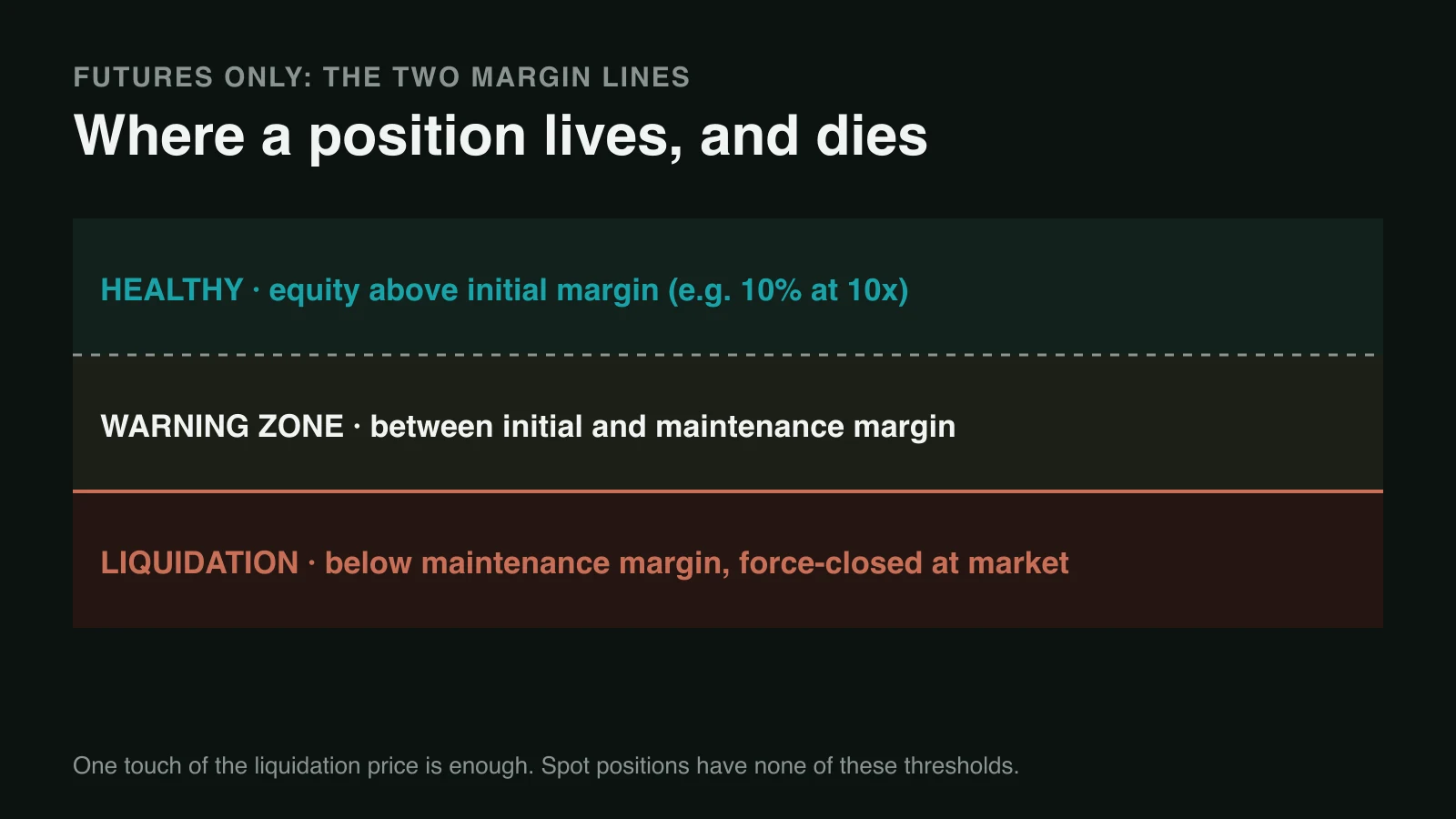
Margin is the collateral that stands behind a futures position, and understanding its two thresholds is the difference between using leverage and being used by it. Initial margin is what you must post to open a position: at 10x leverage, 10% of the notional value. Maintenance margin is the lower threshold your equity must stay above while the position is open, commonly around half the initial requirement. Between those two lines, your position breathes with the market. Below the second line, it stops being yours.
Liquidation is the exchange enforcing that second line. When adverse price movement pushes your margin below maintenance level, the engine force-closes the position at market, charges a liquidation fee, and in fast markets can leave you with nothing of the margin you posted. The mechanism exists for a sound reason: with leveraged losses growing faster than most traders can react, someone must guarantee the winning side gets paid. But its consequences are asymmetric. The market only needs to touch your liquidation price once, for one second, for the loss to become permanent, no matter where price goes afterwards.
Two design choices tilt survival odds meaningfully. Isolated margin caps the damage: only the margin assigned to that one position is at risk, so a liquidation costs a defined amount. Cross margin backs every position with your whole account balance, which delays liquidation but means one runaway trade can drain collateral from everything else. Professional guidance is boring and consistent: moderate leverage, isolated margin while learning, and position sizes set so that a normal-volatility move cannot reach the liquidation price. Spot traders never have to think about any of this, and that simplicity is itself a feature worth pricing in.
The Commodity Futures Market: Where It All Started
The commodity futures market is the original futures market, and it still shows most clearly why futures exist. Organized commodity futures trading dates to 19th century grain exchanges in Chicago, where farmers and millers needed a way to agree on prices months before harvest. The Chicago Board of Trade standardized those agreements into contracts, and the modern futures exchange was born. Today the commodity futures market spans energy (crude oil, natural gas), metals (gold, silver, copper), and agriculture (wheat, corn, soybeans, coffee), traded on venues like CME Group and ICE.
Commodities also make the economics of futures pricing tangible. Storing physical wheat costs real money; insuring and financing a warehouse of copper does too. Those carry costs flow directly into futures prices, which is why dated commodity contracts in normal conditions trade above spot. And because commodities respond to weather, geopolitics and supply disruptions, the commodity futures market is where contango and backwardation are most visible: an oil supply shock pulls near-term contracts above later ones almost instantly.
The commercial logic has not changed in 150 years. Producers sell futures to lock in revenue before the harvest or the extraction. Consumers, such as airlines buying fuel or food companies buying grain, buy futures to lock in costs. Speculators take the other side, absorb the risk, and get paid, in expectation, through the risk premium. Crypto inherited this entire structure wholesale; only the underlying changed.
Futures in Context: The Wider World of Derivatives Trading
Futures are one branch of derivatives trading, the family of instruments whose value derives from an underlying asset rather than being the asset itself. The other major branches are options, which grant the right but not the obligation to transact at a set price, and swaps, which exchange one stream of cash flows for another. Crypto perpetuals are technically a swap variant, which is why some venues call them perpetual swaps.
What all derivatives share is the property that made futures markets matter in the first place: they separate price exposure from ownership. That separation is what enables hedging, leverage and short selling, and it is also what concentrates risk when leverage is used carelessly. Derivatives trading rewards understanding the contract mechanics, margin math, settlement, funding, expiry, at a level spot trading never demands.
For a retail trader, the practical hierarchy is simple. Spot is the base layer: unleveraged, ownable, forgiving. Futures add defined-term or perpetual leverage with liquidation risk. Options add asymmetric payoffs and time decay. Each layer up adds power and cost, and each is a worse place to learn than the one below it.
Hedging Strategies Across Spot and Futures
Hedging strategies use futures to neutralize risk in a spot position: the classic structure is holding the asset in the spot market while selling futures against it. A gold miner sells gold futures to lock in the sale price of metal still in the ground. A fund holding a large bitcoin position shorts perpetuals against it before an event, converting price risk into a known funding cost. In both cases the spot asset and the futures position offset, and the hedger has traded upside for certainty.
The same structure produces one of the cleanest trades in derivatives: the cash and carry. Buy the asset spot, sell a futures contract trading in contango above it, and hold both to expiry. The basis between the two prices converges to zero, and the trader collects the spread regardless of where the market goes. In crypto, the equivalent is holding spot while shorting a perpetual to harvest positive funding, a strategy that at times has paid double digit annualized rates and is the engine behind most "delta neutral yield" products.
Hedging in the spot market itself is blunter but real: diversifying across assets, holding cash or stablecoins as a buffer, or rotating from volatile assets into stable ones ahead of risk events. These spot-side moves reduce exposure by changing what you hold, while futures-side hedging keeps the holding and offsets its risk with a contract. The right tool depends on whether you want to keep the asset. If you do, hedge with futures; if you do not, spot rotation is simpler and carries no margin risk.
One cost note that hedgers learn quickly: a hedge is a position, and positions pay fees on entry, exit and every roll. On a hedge rolled monthly, the fee drag alone can eat a meaningful slice of the protection value, which is exactly the kind of recurring cost that fee cashback claws back.
Trading Strategies for Futures, Speculation and Arbitrage
Trading strategies for futures fall into three families: directional speculation, spread trading and arbitrage. Directional trades are the familiar ones, trend following, breakout trading, momentum, executed with the capital efficiency that margin provides. The strategy logic is identical to spot trading; what changes is that leverage compresses the timeline. A 2% move against a 10x position is a 20% loss of margin, so position sizing and stop discipline stop being style points and become survival requirements.
Spread strategies trade the relationship between two contracts instead of outright direction: long the near month and short a later month (a calendar spread), or long one asset's futures against a correlated asset's futures. Spreads are how professional futures desks express views with less exposure to outright direction, and margin requirements on recognized spreads are usually far lower than on naked positions.
Arbitrage strategies exploit price gaps that should not exist: spot vs futures basis trades, funding rate harvesting on perpetuals, and cross-venue price differences. Speculation and arbitrage are often framed as opposites, gambling versus free money, but they are both liquidity services. The speculator absorbs risk that hedgers pay to shed; the arbitrageur enforces the pricing relationships everyone else relies on. Fee levels decide who can play: an arbitrage capturing 0.15% is profitable at 0.02% maker fees and dead at 0.10%, which is why serious basis traders obsess over fee tiers and cashback before they obsess over anything else.
If you are earlier in the journey, start with the strategy overview in our crypto trading strategies guide before adding leverage to any of it. Every strategy that works on futures works on spot first, slower and more forgivingly.
The Fee Math: What Spot and Futures Cost at Real Volume
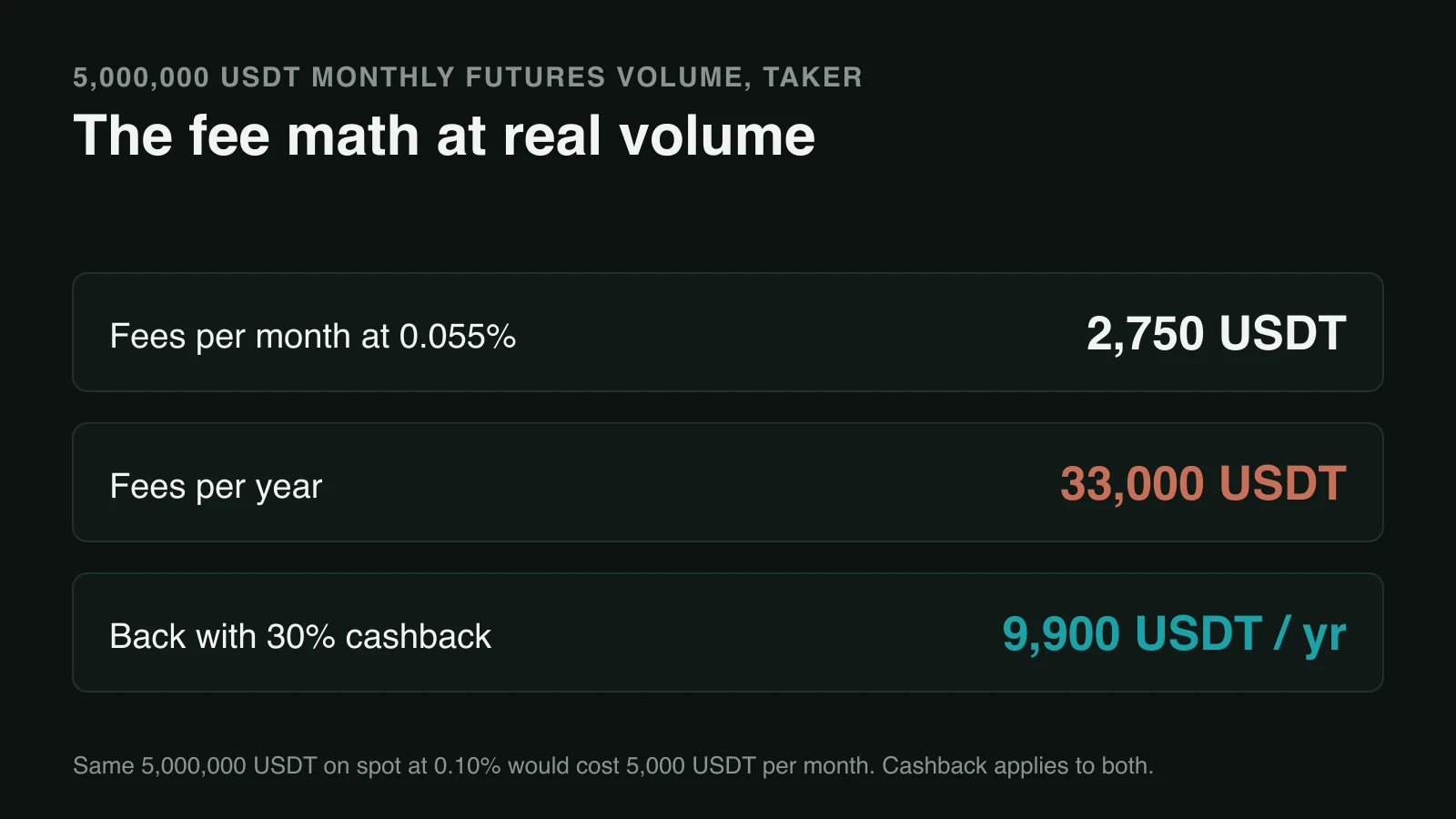
Fee schedules only become meaningful when you multiply them by real volume, so here is the arithmetic for an active futures trader turning over 5,000,000 USDT a month. At a standard taker rate of 0.055%, that volume costs 2,750 USDT in fees per month, 33,000 USDT a year. Filling as maker at 0.02% cuts the monthly bill to 1,000 USDT. The same 5,000,000 USDT traded on spot at 0.10% would cost 5,000 USDT a month, which is exactly why high-frequency turnover lives on derivatives: per unit of notional, futures are the cheaper venue.
But notional is doing quiet work in that sentence. A futures trader at 10x leverage generates 5,000,000 USDT of notional from 500,000 USDT of capital, so the 2,750 USDT monthly fee bill is 0.55% of deployed capital, not 0.055%. Add funding payments on perpetual positions held through funding windows and the all-in cost of leveraged trading routinely exceeds what the headline fee table suggests. None of this makes futures expensive per se; it makes measuring your own numbers essential.
Cashback changes the slope of the whole calculation. Trade Reclaim pays back 30 to 50% of trading fees depending on the exchange, so the 33,000 USDT annual taker bill above returns roughly 10,000 to 16,000 USDT, paid in USDT and withdrawable any time. That applies to spot fees and futures fees alike, stacks on top of VIP tiers, and requires no change to how you trade. At every volume level, it is the same trade: keep the strategy, lose a third to half of its largest fixed cost.
Spot or Futures: Which Market Should You Trade?
Trade spot if you want to own assets, hold long-term, or you are still building consistency. Trade futures if you need leverage, short exposure or hedging, and you can manage margin risk. That is the honest decision rule, and most experienced traders end up using both: spot for the core holdings, futures for tactical exposure and hedges around them.
Costs should shape the choice more than they usually do. Spot costs the flat fee per trade and nothing else. Futures cost lower headline fees but add funding on perpetuals, roll costs on dated contracts, and the tail risk of liquidation. Run the numbers for your actual volume and style: our cashback calculator shows what your fee bill looks like per exchange, and how much of it Trade Reclaim pays back on both spot and futures. On the fee side, at least, the spot vs futures question has one universal answer: whichever you trade, pay less for it.
Spot or futures, the fee is the cost you control
Trade Reclaim pays back 30 to 50% of every trading fee, spot and futures alike, on 9 supported exchanges. Paid in USDT, withdrawable any time.
Frequently asked questions
What is the main difference between spot and futures markets?
Timing and obligation. A spot trade exchanges the asset for cash immediately at the current price, with full ownership transferring at settlement. A futures trade is a binding contract to transact at a set price at a later date; the asset itself does not change hands when the trade executes.
What is the difference between spot vs futures in crypto?
Buying spot gives you coins you can withdraw to your own wallet. Trading futures, usually perpetuals, gives you leveraged price exposure that exists only on the exchange, with funding payments every few hours and liquidation risk if margin runs out. Spot fees are typically 0.10% per trade, futures around 0.02% maker / 0.055% taker on much larger notional.
Why are futures prices different from spot prices?
Futures prices equal the spot price plus cost of carry (financing, storage, insurance) plus market expectations for the settlement date. Futures above spot is called contango, futures below spot is backwardation, and the gap (the basis) shrinks to zero as expiry approaches.
Are futures riskier than spot trading?
Structurally, yes. Futures add leverage, daily mark to market and liquidation: a position can be force-closed on a sharp move even if the market later recovers. A spot position can lose value but can never be liquidated by a margin call.
What are the most common trading strategies for futures?
Directional speculation (trend following, breakouts, momentum with leverage), spread trading (calendar and inter-asset spreads), hedging spot holdings, and arbitrage such as cash and carry basis trades or funding rate harvesting on crypto perpetuals.
What is a perpetual future?
A crypto-native futures contract with no expiry date. A funding rate exchanged between longs and shorts every few hours keeps its price tied to spot. Perpetuals dominate crypto derivatives volume because they offer futures-style leverage without contract rollovers.
Do spot and futures trades pay the same fees?
No. On major crypto exchanges, spot typically costs around 0.10% per trade while futures cost around 0.02% maker / 0.055% taker. Leverage multiplies the notional futures fees apply to, so the effective cost on your capital is often higher than the headline rate. Trade Reclaim pays back 30 to 50% of both.
Which is better for beginners, spot or futures?
Spot. It has no leverage, no liquidation and no funding, so a beginner can only lose what they put in and learns the market without the added dimensions of margin and expiry. The common path is to build consistency on spot first, then add futures for leverage or hedging once the risk mechanics are understood.
Can you lose more than you invest in futures trading?
On most crypto exchanges, no: positions are liquidated at the maintenance-margin level, capping the loss at your posted margin. On traditional futures without such protection, or in a gap that jumps past the liquidation price, losses can exceed the initial margin. Spot trading can never lose more than you put in.
Do futures prices affect or move spot prices?
Often, yes. Futures aggregate the market's forward expectations and are highly liquid, so they frequently lead price discovery and pull spot along, particularly around scheduled news. Arbitrage via spot-futures parity keeps the two prices tethered so neither drifts far from the other for long.
Can you convert or transfer futures to spot?
You do not convert a futures position into spot directly; you close the futures position and, if you want the asset, buy it on the spot market. On an exchange, spot and futures balances usually sit in separate wallets, and you move margin between them by transferring funds, not by converting the position itself.
How are futures prices calculated from the spot price?
A fair futures price equals the spot price plus the cost of carry: financing cost plus storage and insurance, minus any yield the asset produces. That is spot-futures parity. In crypto perpetuals, the same idea appears as the funding rate, which nudges the perpetual toward spot every few hours instead of a dated carry cost.
Are spot and futures taxed differently?
In many jurisdictions, yes, and the treatment varies widely by country and by whether the contract is a regulated future or a crypto perpetual. Tax rules change and are location-specific, so treat this as a reason to check with a qualified tax professional rather than assume the two are taxed the same.
Sofia Dani is Head of Marketing at Trade Reclaim, based in Switzerland. She earned a Bachelor of Arts at the University of Lucerne and went on to complete a Master's degree. She has little patience for products that win by confusing people, and covers crypto exchanges, their products, and what trading actually costs.
Trade Reclaim earns from exchange referrals and shares most of it back to you as cashback. Education, not financial advice.