
What Is Spot Price? Definition and Uses in Markets
Spot price is the current price for immediate delivery of an asset. This guide covers the spot price definition, how it is determined, how it differs from futures prices, and how traders use it across commodities like gold and markets like crypto.

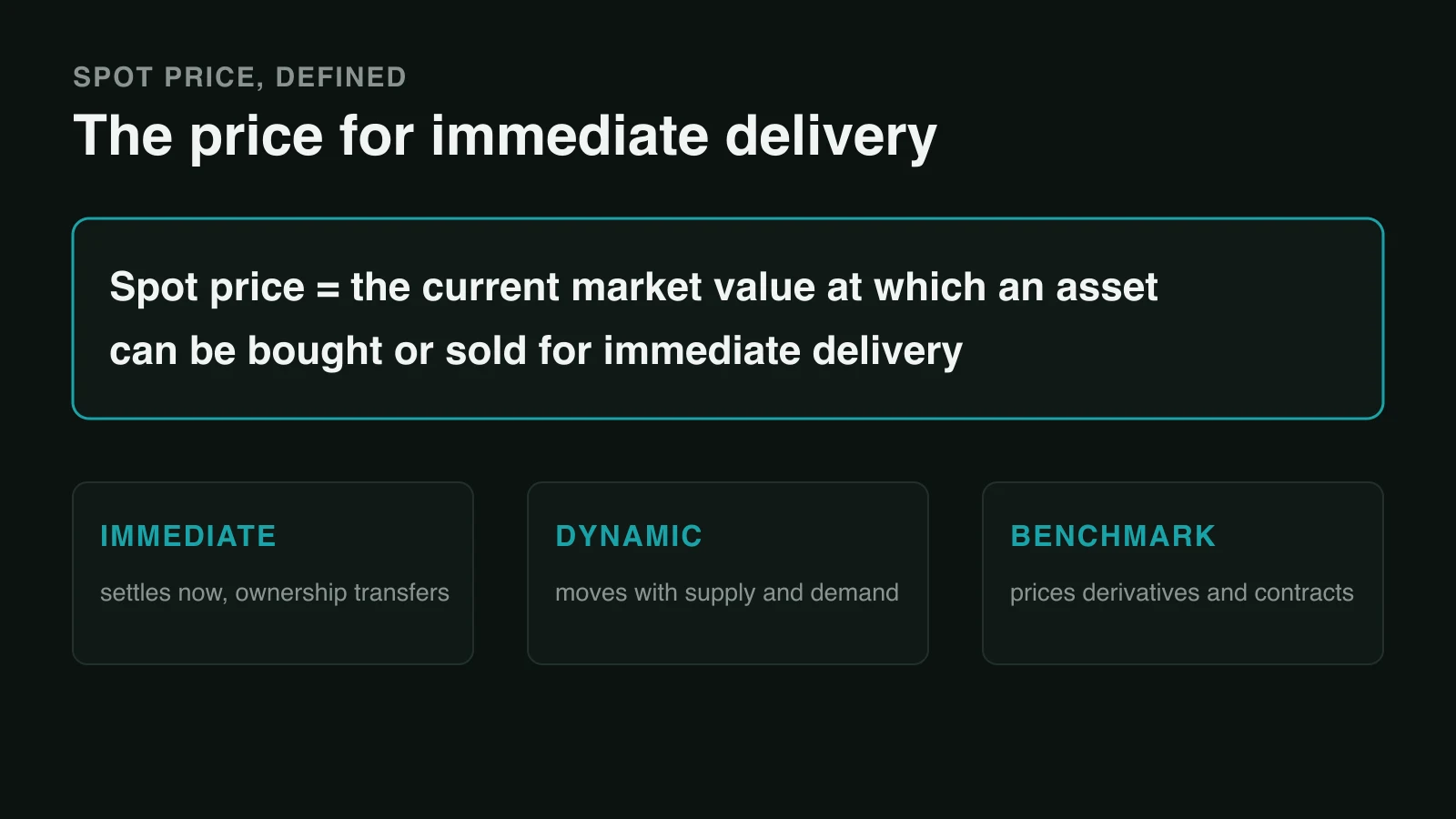
- The spot price is the current market value at which an asset can be bought or sold for immediate delivery.
- It is dynamic: supply and demand, economic indicators and geopolitical events move it continuously through the trading day.
- Spot prices differ from futures prices, which are agreed today for delivery later and include cost of carry components like storage and insurance.
- In commodities, gold and silver spot prices are the benchmarks for contracts and derivatives pricing.
- In crypto, the spot price is what you pay on a spot market, and the trading fee on top of it is the cost lever you can actually control.
Spot price is a key term in financial markets. If you're wondering what is spot price, a simple spot price definition is the current price for immediate delivery of an asset. Spot prices are dynamic, reflecting real-time market conditions: they move with supply and demand, economic data and geopolitical events, which makes them a vital tool for decision-making. In commodities, spot prices are quoted for metals like gold and silver and serve as benchmarks for pricing derivatives and other financial instruments. This article explores the definition, significance and applications of spot prices. To define spot price succinctly: it is the immediate market value used for transactions that settle now.
Spot Price Definition: What Does Spot Price Mean?
The spot price refers to the current market value at which an asset can be bought or sold for quick delivery. This term is pivotal in financial markets, where transactions occur almost instantaneously. It serves as an indicator of an asset's real-time value. People sometimes search "what is spot price mean"; they're usually asking the same question in different words and looking for a clear explanation of the concept.
The spot price varies based on market conditions, offering a snapshot of what traders are willing to pay at a given moment. This price is not static and can change frequently with supply and demand shifts. Three characteristics define it: immediate delivery (it reflects real-time transactions), dynamic movement (it changes with supply-demand fluctuations), and its role as a benchmark for pricing derivatives and contracts.
Spot prices differ from futures prices, which involve agreements for future delivery. This distinction matters, especially in commodities trading, and knowing how these prices interact helps investors manage risks. Two mechanical details complete the definition. First, the spot market is also called the cash market, the venue where assets change hands for immediate delivery. Second, "immediate" follows a settlement convention rather than the same second: equities and many assets settle in about two business days (T+2), foreign exchange typically in two, and crypto spot trades settle the moment the order fills. At any instant, the quoted spot price sits between the highest bid and the lowest ask, so the bid-ask spread is what you actually cross to trade at spot.
How Spot Price Is Determined
Spot prices are not set in stone; they fluctuate based on several factors, and supply and demand are the primary forces. When demand rises or supply falls, the spot price typically increases. Market conditions also play a significant role: changes in geopolitical stability, economic data and interest rates can lead to price adjustments, and traders keenly watch these indicators to predict potential price movements.
In addition to direct market influences, technological advancements and trading platforms impact spot prices. These tools allow for immediate price discovery and faster trade execution, so prices may change rapidly in response to new information. The three levers to watch: supply and demand as the core drivers, economic indicators like data releases and trends, and technological changes that alter price dynamics. Monitoring these factors supports better-informed decisions in fast-moving markets.
Spot Price vs. Futures Price: Key Differences
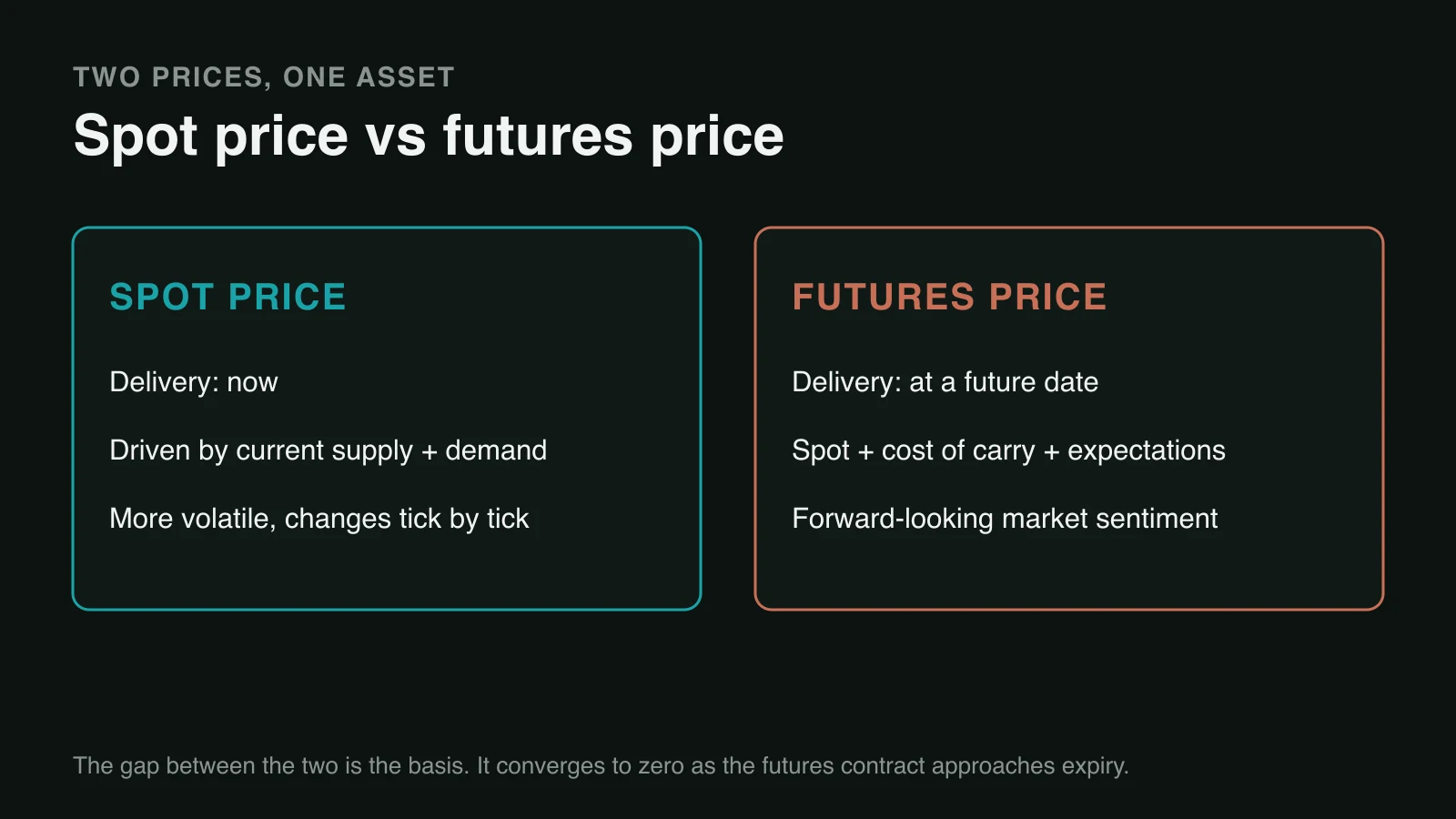
Spot prices and futures prices are often confused but differ significantly: the spot price is the cost of immediate delivery, while the futures price is the agreed cost for delivery at a later date. Futures prices incorporate expectations about future supply and demand, and they include additional costs such as storage and insurance, known as the cost of carry.
Spot prices are more volatile, reflecting current market conditions. Futures prices offer a glimpse into market expectations and sentiment, a forward-looking perspective useful for strategic planning. The three key differences: timeframe (spot is now, futures is later), volatility (spot prices fluctuate more often), and components (futures include carry costs). Spot prices inform short-term decisions, while futures prices help forecast longer-term trends. For the full picture of how these two market types work, see our guide to spot vs futures markets.
The gap between spot and futures has names, and they are the terms every reference uses. When the futures price sits above spot, the market is in contango, the normal state when the cost of carry (financing, storage and insurance) is positive. When futures sit below spot, it is backwardation, typically signaling near-term scarcity or strong demand for the asset today. The fair size of that gap is set by spot-futures parity: futures should equal spot plus the cost of carry, minus any yield the asset pays. As the contract nears expiry the gap, called the basis, converges to zero, because at expiry a futures contract simply becomes a spot transaction.
The Role of Spot Price in Financial Markets
Spot prices hold a pivotal role in financial markets: they represent the market consensus on an asset's value at any given moment. This clarity helps investors make informed decisions quickly. Spot prices serve as benchmarks for valuing commodities, currencies and securities, guide traders in their transactions, and inform pricing strategies for financial instruments.
For derivative markets, spot prices are essential in setting prices for options, futures and swaps; these instruments rely on spot price information to determine their market value. Three functions summarize the role: benchmarking across markets, decision support for traders and analysts, and serving as the basis for derivatives pricing. By providing real-time data, spot prices enhance market transparency and facilitate efficient trading strategies.
A Spot Price Example
A worked example makes the spot price concrete. Suppose bitcoin's spot price is 100,000 USDT. You place a market buy for 0.1 BTC on a spot exchange: it fills near 100,000, you pay about 10,000 USDT plus the trading fee, and 0.1 BTC lands in your account for immediate withdrawal. That is a spot transaction, settled now at the current market value.
Contrast the same trade in futures. Instead of paying 10,000 USDT, you might post a few hundred USDT of margin to open a 0.1 BTC perpetual, gaining the same price exposure with leverage but owning no coin, paying funding every few hours, and risking liquidation if price moves against you. Same underlying spot price; entirely different instrument, cost and risk. That side-by-side is the clearest way to see what the spot price is and is not.
Spot Price in Commodities: Gold, Silver and More
Spot prices play a critical role in the commodities market: they reflect the immediate price for buying or selling a commodity. Gold and silver spot prices are frequently quoted and are key for investors and traders interested in precious metals, offering a snapshot of the market's current valuation. Beyond precious metals, oil, natural gas and agricultural products also have spot prices, and knowing them helps in assessing supply and demand dynamics.
Spot prices matter in commodities for three reasons: they anchor price negotiation when setting contract terms, they provide clear market insight at a glance, and they act as economic indicators of overall health. By understanding spot prices, businesses can better manage supply chains and hedging programs, navigate volatile markets and secure favorable contracts.
What Does Gold Spot Price Mean?
The gold spot price is the cost to buy or sell gold for immediate delivery; it reflects the real-time value of gold in the market. Some also ask "what does spot gold mean": it refers to the same immediate-delivery benchmark for gold. Gold's spot price is crucial for traders and investors because it helps them determine entry and exit points, track gold's performance and assess potential investment returns.
The spot price of gold fluctuates based on supply, demand and market sentiment. Political events and economic indicators also play a role. Understanding these elements provides insight into gold's market dynamics and supports strategic decision-making.
One question follows almost every gold search: why can't you buy gold at spot price? The spot price is the wholesale benchmark for immediate delivery of pure bullion in large, market-standard form. Retail buyers pay a premium over spot, the dealer's markup for minting, fabricating, distributing and making a market in a specific coin or bar. So spot is the reference, and the price over spot is the real cost of holding physical metal, which is why the spot price of gold per troy ounce and the price you pay a dealer are never quite the same number.
Factors Influencing Spot Prices
Spot prices are dynamic and subject to several influences: economic indicators, market conditions, geopolitical events and trader behavior. Economic indicators such as interest rates, inflation data and employment figures often have a direct impact. Supply and demand dynamics can shift prices quickly, and geopolitical events like conflicts or political instability can trigger sudden volatility, especially in commodities.
Trader and investor behavior adds another layer: speculative activity can amplify short-term spot price movements and make markets less predictable. Watching these four groups of factors helps investors and traders anticipate shifts, manage risk and identify opportunities.
Spot Price Applications: Trading, Hedging and Investing
Spot prices are used in three main ways: trading, hedging and investing. Traders rely on them for real-time valuation of assets, which supports timely buy and sell decisions. Hedging is the second application: businesses use spot prices to lock in costs or revenues for future transactions, minimizing the risk from adverse price movements. It is an essential tool for managing financial risk.
Investors benefit too. They use spot prices to assess market trends and decide on long-term strategies, and an accurate grasp of spot pricing adds value to portfolio management. Integrating spot prices into these activities enhances decision-making and provides a solid foundation for navigating financial markets.
How to Track and Use Spot Prices
Spot prices are accessible through numerous platforms: financial news websites, trading terminals and mobile apps. News sites like Bloomberg and Reuters provide up-to-the-minute updates. Trading terminals display spot prices in real time, and applications like MetaTrader offer comprehensive data that makes analysis simpler.
Efficient tracking leads to better strategies: use news websites for quick updates, trading platforms for real-time data and order execution, and mobile apps for convenient on-the-go information. Understanding these prices helps assess the true value of assets before you commit capital.
Spot Price in Crypto: What It Means for Your Trading Costs
In crypto, the spot price is the last traded price on an exchange's spot market, and it is the number every chart, index and portfolio app quotes. Unlike gold, crypto trades around the clock on hundreds of venues at once, so the spot price you see is specific to the exchange you trade on, with arbitrage keeping venues within a narrow band of each other. Derivatives platforms also compute an index price from several spot markets to settle their contracts fairly.
Here is the practical part most guides skip: you never trade the spot price alone. Every spot order pays a trading fee on top, typically 0.10% per side on major exchanges, and whether you pay the maker or the taker rate depends on your order type. Our maker vs taker fees guide breaks that down. The spot price is set by the market; the fee is the one cost you can actually control.
That is exactly the lever Trade Reclaim works on: it pays back 30 to 50% of every trading fee on 9 supported exchanges, in USDT, withdrawable any time. The spot price will always move against you half the time. The fee drag on top of it does not have to. See our 2026 exchange fee comparison for what each venue charges.
The spot price is the market's. The fee on top is yours to cut
Trade Reclaim pays back 30 to 50% of every trading fee on 9 supported exchanges, in USDT, withdrawable any time. Same spot price, lower cost per trade.
Frequently asked questions
What exactly is the spot price, in plain terms?
It's the current market value at which an asset can be bought or sold for immediate delivery. Because it reflects real-time supply and demand, it serves as a benchmark for pricing derivatives and contracts and helps traders and investors make quick, informed decisions.
What factors most influence spot price movements?
Spot prices are driven primarily by supply and demand, but they also react to economic indicators like interest rates and inflation, geopolitical events, and overall market conditions. Fast trading platforms speed up price discovery, while speculative trading can amplify short-term moves.
How does the spot price differ from the futures price?
Spot is the price for delivery now; futures is an agreed price for delivery later. Futures prices embed expectations about future supply and demand and include cost of carry items such as storage and insurance. Spot prices tend to be more volatile, while futures provide a forward-looking view of market sentiment.
Is the spot price constant throughout the day?
No. Spot prices are highly dynamic and change frequently as market factors shift. In crypto they move around the clock, so traders should monitor them continuously.
Why are spot prices especially important in commodities like gold and silver?
They provide the immediate benchmark for buying and selling these metals, guide pricing of related derivatives, and help with contract negotiations. Commodity spot prices, including oil, natural gas and agricultural goods, also offer insight into real-time supply-demand dynamics.
How can I track and use spot prices effectively?
Monitor real-time data on financial news sites like Bloomberg and Reuters, trading platforms, and mobile apps. Use spot prices to time trades, inform hedging decisions and evaluate longer-term trends, keeping in mind they change frequently and merit continuous monitoring.
What does spot price mean in simple terms?
It is the price you would pay to buy something right now for immediate delivery, set by current supply and demand. For gold it is the wholesale price per ounce this second; in crypto it is the last traded price on a spot exchange.
Is the spot price the same as the market price?
Effectively yes for immediate delivery: the spot price is the current market price at which an asset trades for settlement now. It sits between the best bid and best ask, so the exact number you transact at depends on which side of the spread you cross.
Why can't I buy gold at the spot price?
Spot is the wholesale benchmark for large, standard bullion. Retail coins and bars carry a premium over spot for minting, fabrication and dealer margin, so the price you pay is spot plus that premium, not spot itself.
What is the difference between spot price and strike price?
The spot price is the current market value for immediate delivery. A strike price is the fixed price written into an options contract at which the holder may buy or sell later. Spot moves continuously; the strike is set when the option is created and does not change.
Why is the spot price often lower than the futures price?
Because of the cost of carry. A futures price usually equals spot plus financing, storage and insurance to the delivery date, which pushes it above spot in normal conditions, a state called contango. When futures trade below spot instead, the market is in backwardation.
Sofia Dani is Head of Marketing at Trade Reclaim, based in Switzerland. She earned a Bachelor of Arts at the University of Lucerne and went on to complete a Master's degree. She has little patience for products that win by confusing people, and covers crypto exchanges, their products, and what trading actually costs.
Trade Reclaim earns from exchange referrals and shares most of it back to you as cashback. Education, not financial advice.