Can You Really Make $100 a Day Trading Crypto? The Math, With Fees
With roughly 10,000 to 25,000 USDT, a proven edge and costs under control, $100 a day is a defensible target. On a small account with market orders, the math says no before your strategy gets a vote. Here is the full arithmetic, including the fee line the guides leave out.

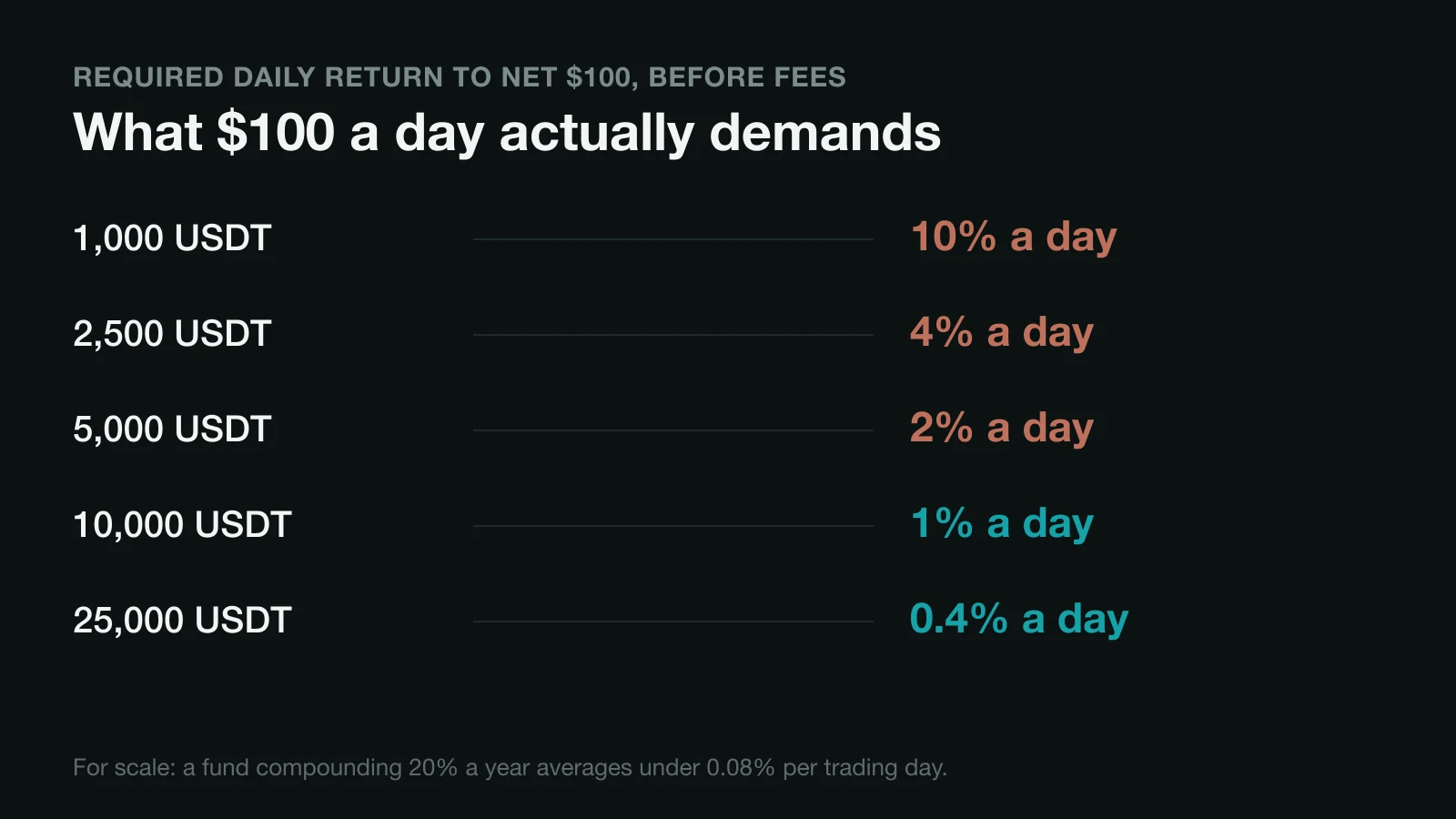
- $100 a day equals 10% daily on a 1,000 USDT account, 1% on 10,000 USDT and 0.4% on 25,000 USDT. A fund that returns 20% a year averages under 0.08% per trading day.
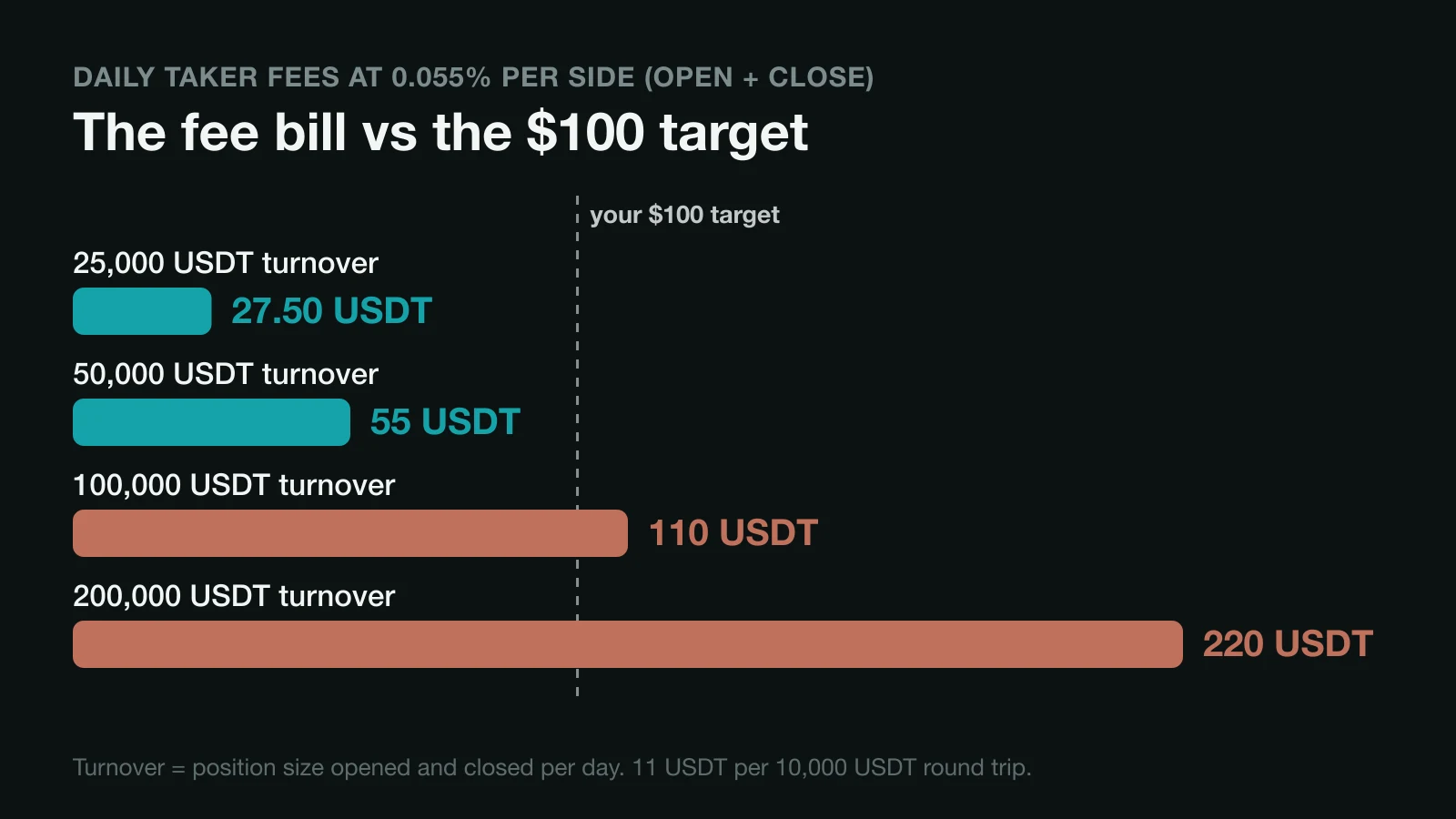
- A taker round trip costs about 11 USDT per 10,000 USDT of position size at standard rates. Open and close 100,000 USDT a day and fees run 110 USDT, more than the target itself.
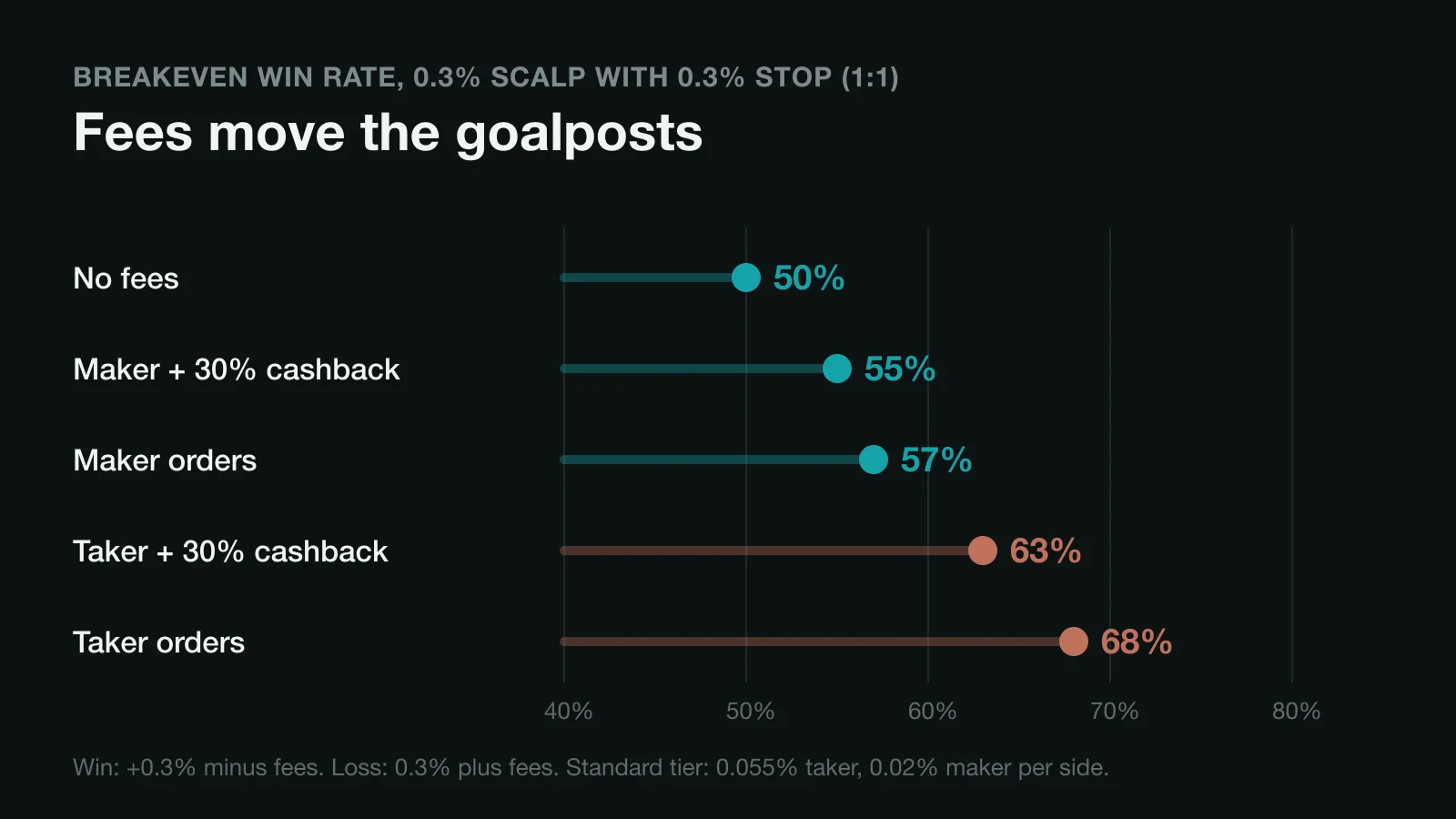
- Fees move your breakeven win rate. A 0.3% scalp at 1:1 breaks even at 50% without fees, 68% with taker fees and 57% with maker fees.
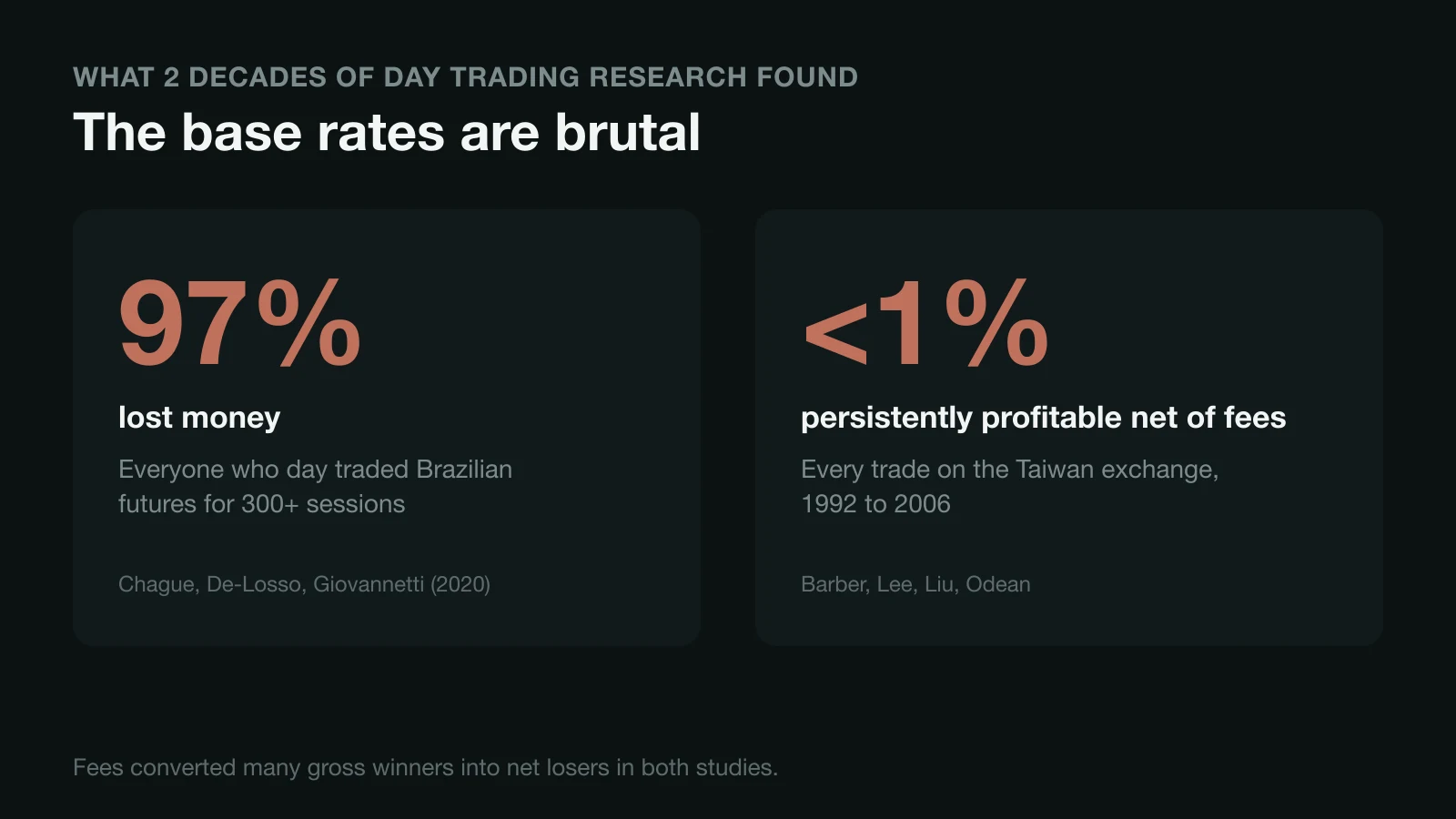
- The research is one-sided: 97% of persistent day traders lost money in the largest Brazilian futures study, and fewer than 1% of Taiwan day traders earned persistent profits net of fees.
- Fees are the one variable you fully control. Maker orders plus 30 to 50% cashback cut the round trip cost by up to 75% and lower every hurdle in this article.
Making $100 a day trading crypto is possible, but it is a capital and cost problem before it is a strategy problem. On a 1,000 USDT account it demands 10% a day, which nobody sustains. On 10,000 USDT it means 1% a day, and once you trade with market orders, fees claim about 11 USDT of every 10,000 USDT position you open and close. This article walks through the numbers that decide the question: account size, fee drag, the win rate you actually need, and what 2 decades of day trading research says about your odds.
Can you make $100 a day trading crypto?
Yes, it is possible, and no, most people will not get there. The deciding factors are account size, cost control and edge, in that order. $100 a day is not one question but three: can your account produce it, can your costs survive it, and does your strategy have any edge left after both?
The rest of this guide is arithmetic, not motivation. We use real standard tier futures rates, verified in October 2026, and we count every fee, because the fee line is exactly what the screenshots selling this dream leave out. If you want the strategy side first, start with our crypto trading strategies guide and come back for the math.
How much capital does $100 a day actually demand?
To target $100 a day at a return a skilled trader can sustain, you need roughly 10,000 to 25,000 USDT of trading capital. The chart below is the whole argument: $100 a day is 10% daily on 1,000 USDT, 2% on 5,000 USDT, 1% on 10,000 USDT and 0.4% on 25,000 USDT.
For scale: a fund that compounds 20% a year, an excellent result, averages under 0.08% per trading day. A retail trader can beat that on single days without any skill at all. Sustaining 10 times that number every trading day for months is a different claim, and it is the claim a 1,000 USDT account makes when it targets $100 a day.
Leverage does not change this math, it concentrates it. 10x leverage on 1,000 USDT gives you a 10,000 USDT position, but the 10% daily demand is still there, now expressed as a 1% move against you wiping a tenth of your account, plus liquidation risk on the bad days. What leverage does reliably scale is the fee bill, because fees are charged on position size, not on your margin.
The fee math: what market orders cost you every day
At a standard 0.055% taker rate, opening and closing a position costs about 11 USDT per 10,000 USDT of position size. Turn over 100,000 USDT a day and you pay roughly 110 USDT in fees, more than the $100 you are trying to make. This is the most ignored number in every guide on the topic.
It compounds quietly. 3 taker round trips a day on 20,000 USDT positions cost 66 USDT in daily fees, about 1,450 USDT a month at 22 trading days. On a 10,000 USDT account that is 14.5% of your capital going to the exchange every month, before your first dollar of profit. The exchange earns its $100 a day from you whether you earn yours or not.
The rate itself decides less than the order type does. The same round trip in maker orders costs 4 USDT per 10,000 USDT instead of 11, and the maker vs taker mechanics are learnable in an afternoon. Every serious answer to the $100 question starts with cutting this line, because it is the only line you control with certainty.
What win rate do you need? Fees move the goalposts
A 0.3% scalp at 1:1 breaks even at a 50% win rate in a world without fees. With taker fees on both sides it breaks even at 68%. With maker fees, 57%. Fees redefine what a good strategy has to look like before it earns anything.
The arithmetic: a 0.3% target with a 0.3% stop nets +0.19% on a taker win (0.30 minus 0.11 in round trip fees) but loses 0.41% on a taker loss (0.30 plus 0.11). At those payoffs you need 68 winners out of every 100 trades to stand still. Documented win rates on 1:1 setups sit far below that, which is why scalping on taker fees is where most $100 a day attempts mathematically die.
Cashback shifts the same curve. With 30% of every fee returned, the taker breakeven drops from 68% to 63%, and the maker breakeven from 57% to 55%. None of this replaces edge. It widens the corridor in which an ordinary, imperfect edge can survive.
Why do most day traders lose money? The research
The academic record is one-sided. In the largest Brazilian futures study, 97% of everyone who day traded for more than 300 sessions lost money. In 15 years of complete Taiwan market data, fewer than 1% of day traders earned persistent profits net of fees.
The Brazilian numbers come from Chague, De-Losso and Giovannetti, "Day Trading for a Living?", which followed everyone who started day trading Brazilian equity futures between 2013 and 2015, roughly 20,000 people. Of those who persisted beyond 300 sessions, 97% lost money and 1.1% earned more than the local minimum wage. The question mark in the title is the authors' conclusion.
Barber, Lee, Liu and Odean reached the same shape of answer in "The Cross-Section of Speculator Skill", built on every trade on the Taiwan exchange from 1992 to 2006: a thin elite earns real returns, the median day trader loses, and fees convert many gross winners into net losers. That last clause is the one you can act on. Some traders in these studies had an edge before costs and still lost after them.
None of this says you cannot be the exception. It says the base rate is brutal, and that treating $100 a day as an income promise rather than a performance ceiling is how accounts die. Our look at the pros and cons of day trading covers the psychological side of the same story.
Three traders, one month: the full math
Here is the same $100 a day target on 3 real setups across a month of 22 trading days, with every fee counted at standard tier rates.
The 1,000 USDT account, 10x leverage, 3 market order round trips a day: fees run 33 USDT daily and 726 USDT a month, 73% of the starting account. Reaching $100 a day net means earning 13.3% a day gross. This setup does not have a strategy problem, it has an arithmetic problem, and no strategy solves arithmetic.
The 10,000 USDT account, 2 selective taker trades a day on 20,000 USDT positions: 44 USDT in daily fees, 968 USDT a month. Netting $100 a day needs 144 USDT gross, a 0.36% average favorable move across 40,000 USDT of daily position size. This is the first setup where the question becomes skill instead of arithmetic, and the fee line still eats 31% of the gross target.
The same 10,000 USDT account with the cost stack applied, maker entries and cashback at a 30% rate: the round trip falls from 22 USDT to about 5.60 USDT, daily fees to 11.20 USDT, the month to roughly 246 USDT. That is 722 USDT a month recovered, 7 full green days of the target, from cost discipline alone, before any improvement in the trading itself.
| Setup | Fees per day | Fees per month | Gross needed daily |
|---|---|---|---|
| 1,000 USDT, 10x, 3 taker round trips | 33 USDT | 726 USDT | 13.3% of account |
| 10,000 USDT, 2 taker trades | 44 USDT | 968 USDT | 1.44% of account |
| 10,000 USDT, maker + 30% cashback | 11.20 USDT | 246 USDT | 1.11% of account |
The variables you control, and the ones you do not
You do not control the market, this month's win rate or the funding rate. You fully control position size, order type, trade count and what happens to your fees. The $100 a day question is usually decided by the second list.
Position size decides whether you survive a losing streak. Order type decides your fee rate. Trade count decides how often you pay it. And the fee stack decides how much of it comes back: on the 9 exchanges we track, standard taker rates run 0.04% to 0.08%, and 30 to 50% of every fee flows back through fee cashback, paid in USDT and withdrawable anytime. The full comparison sits in our 9 exchange fee table.
Cashback is the one lever that works identically on your good months and your bad ones, because it is a function of volume, not of profit. That cuts both ways: it funds no dream by itself, and it never stops paying while you trade.
The honest summary
Can you make $100 a day trading crypto? With 10,000 to 25,000 USDT, a proven edge, maker discipline and the full fee stack, it is a defensible target in good months. On a small account with market orders, the arithmetic closes the question before your strategy gets a vote.
If you keep one number from this article, keep this one: at standard taker rates the exchange collects 11 USDT per 10,000 USDT round trip from you, win or lose. Cut that line first. It is the only edge in trading that is guaranteed.
See what your daily fee bill returns
Enter your volume and your exchange. The calculator shows your monthly fee bill next to what 30 to 50% cashback returns in USDT, at your real numbers. Takes 2 minutes, no account needed.
Frequently asked questions
How much money do you need to make $100 a day trading crypto?
Working backwards from returns a skilled trader can sustain: at 1% a day you need 10,000 USDT, at 0.4% a day you need 25,000 USDT. Below 5,000 USDT the required return exceeds 2% every single trading day, which no documented retail cohort sustains. Honest answers land between 10,000 and 25,000 USDT, plus an edge you have already proven on smaller size.
Can you make $100 a day trading crypto with 1,000 USDT?
Not sustainably. It requires 10% daily returns, and with 10x leverage and market orders the fee bill alone runs about 33 USDT a day, a third of the target, while a single 1% move against you costs 10% of the account. Individual green days happen. The month loses.
What win rate do you need to day trade crypto profitably?
It depends on your risk to reward and your fees. A 0.3% target with an equal stop breaks even at 50% with zero fees, 68% with taker fees on both sides and 57% with maker fees. Larger profit targets dilute the fee share and pull the breakeven back toward 50%, which is one reason fewer, bigger trades age better than constant scalps.
Is day trading crypto profitable for most people?
The research says no. 97% of Brazilian futures day traders who persisted beyond 300 sessions lost money, and fewer than 1% of Taiwan day traders earned persistent profits net of fees across 15 years of complete market data. The minority who win combine genuine edge with low costs, and the studies show fees turning gross winners into net losers.
How much do trading fees matter for a day trader?
At a 0.055% taker rate, every 10,000 USDT round trip costs 11 USDT. A day trader turning over 100,000 USDT daily pays about 2,400 USDT a month in fees. The same turnover on maker orders with 30 to 50% cashback costs under 700 USDT. For most active traders that difference is larger than their monthly profit or loss.
Does fee cashback make you a profitable trader?
No. Cashback returns 30 to 50% of fees you already paid, which lowers every breakeven in this article but creates no edge. Unprofitable strategies stay unprofitable, borderline strategies get room to breathe, and profitable ones keep more of what they earn. Treat it as cost reduction, never as a strategy.
Is $100 a day realistic for a beginner?
No. A fixed dollar target on a small account forces oversized risk, which is how most new accounts end. Treat the first 6 to 12 months as tuition: practice on a demo account, keep live positions small, and measure your performance in percent rather than dollars. If the percentage edge shows up consistently, the dollar figure follows from capital, not from pressure.
Trade Reclaim Research tracks fees, rebate structures and rate changes across 9 crypto exchanges and turns them into the numbers traders actually pay. Every rate in this article was verified against the official fee schedules in October 2026.
Trade Reclaim earns from exchange referrals and shares most of it back to you as cashback. Education, not financial advice.